
Clarence River Light
Two lighthouses stand at Yamba, and only one of them is real. On Pilot Hill above the mouth of the Clarence River, a plain concrete tower from 1955 quietly does the work - flashing a beam visible 16 nautical miles out to sea, steering ships through a notoriously tricky river entrance. A short distance away stands its predecessor's twin: a lovingly built replica of the elegant 1880 lighthouse that once held this hill, raised not by a government but by locals who refused to let the old light be forgotten. The story of the Clarence River Light is really two stories - one of maritime duty, and one of a community's stubborn affection.
From a Lamp on a Bench
Light came to Pilot Hill the hard way. The first marker, around 1866, was little more than a wooden hut with a large kerosene lamp set on a bench - a flame tended by hand to warn vessels off the bar at the river mouth. It was enough to matter but far from grand. As traffic on the Clarence grew, so did the need for something permanent, and in 1878 tenders went out for a proper tower. The mast from that first crude light survives today, preserved in the Story House Museum in Yamba - a humble relic of the years when a single lamp and a watchful keeper stood between the ships and the reefs.
A Colonial Architect's Signature
The 1880 lighthouse was the work of James Barnet, the prolific Colonial Architect whose buildings still define much of New South Wales. It was one of a matched set of five he designed between 1878 and 1880 - the others marking Fingal Head, Crowdy Head, Tacking Point, and the Richmond River - all variations on the same neat theme: a short tower, barely 7 metres tall, joined by a roofed porch to a small annexe, with a keeper's cottage close by. Built by W. Kinnear for the modest sum of 1,097 pounds, the Clarence light shone for six nautical miles and was automated in 1920. Then progress crowded it out: a hotel rose in 1934 and blocked the beam, a reservoir was planned for the hill, and in 1956 - a year after its replacement was built - the Barnet tower was pulled down.
The Light the Town Rebuilt
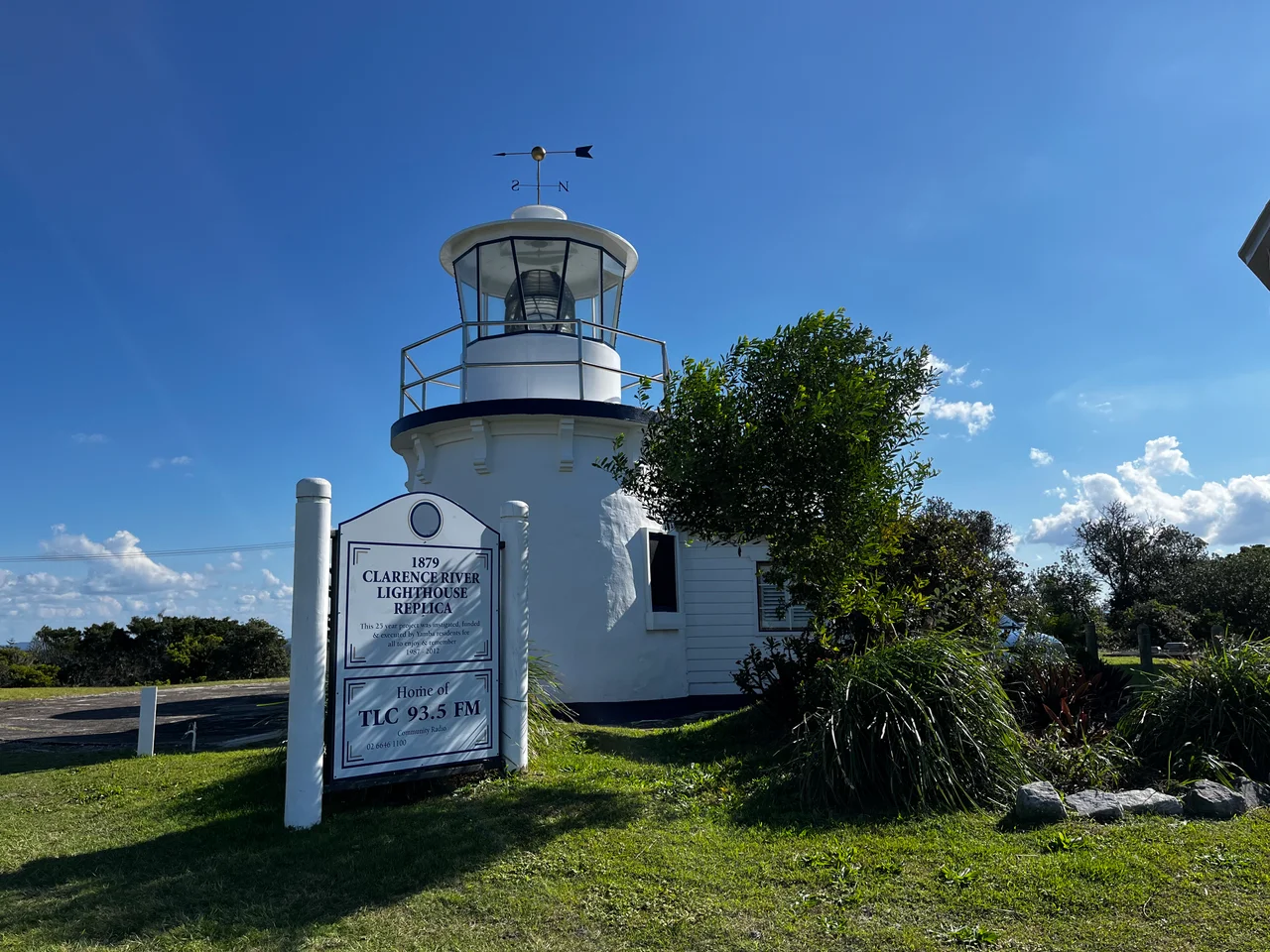
Some places let their landmarks vanish. Yamba would not. After the reservoir was demolished in 1980, residents pushed to recreate the lost lighthouse on its original ground. When government funding fell through, local volunteers simply funded and built the replica themselves - at first without even a lantern, the building pressed into service as home to the community radio station 2TLC. The dream did not stop there. In 2009 a fresh restoration effort began, backed by local people and businesses, and in November 2011 it was crowned with a lantern and a genuine 19th-century Fresnel lens, donated by the Australian Maritime Safety Authority. Barnet's tower was gone, but its likeness stands again - proof of how fiercely a small town can love a lighthouse.
Still on Duty
The lighthouse that actually guides ships is the unassuming one. Built in 1955 from concrete in a stripped-back modern style, it inherited the old light's apparatus and now runs on a compact electric beacon - a 75-watt quartz halogen lamp throwing 22,000 candela, visible 16 nautical miles offshore. It serves as the rear range light for two separate ranges, lining vessels up safely through the shifting channels of the Clarence entrance. The tower itself is closed, but the grounds on Pilot Hill are open to anyone, with sweeping views over the river mouth, the breakwaters, and the Pacific beyond. Together the two towers tell the whole arc of the place: the working beacon that keeps the ships safe, and the cherished replica that keeps the memory alive.
From the Air
The Clarence River Light stands on Pilot Hill at Yamba, roughly 29.43 degrees south, 153.36 degrees east, on the south side of the Clarence River mouth on the far north coast of New South Wales. From the air, the key landmark is the broad mouth of the Clarence - the largest river on the NSW north coast - with its long training walls reaching out into the Pacific, the town of Yamba on the southern headland, and Iluka opposite. The lighthouse sits on the elevated ground above the southern entrance. The nearby surfing village of Angourie lies just to the south. The nearest field is Grafton Airport (ICAO YGFN), inland to the southwest up the Clarence Valley; Ballina Byron Gateway Airport (ICAO YBNA) lies to the north and Coffs Harbour Airport (ICAO YCFS) to the south. Best viewed in clear coastal conditions; sea haze and onshore weather can reduce visibility near the river mouth.
Nearby Stories
- History of New Italy, New South Wales 16 km away
- Yuraygir National Park 22 km away
- Susan Island Nature Reserve 27 km away
- Guy Fawkes River National Park 71 km away
- Tenterfield School of Arts 90 km away
- HMS Porpoise (1799) 789 km away
- Wreck Reefs 819 km away
- SS Elingamite: Gold, Fog, and a Captain Wrongly Blamed 1771 km away