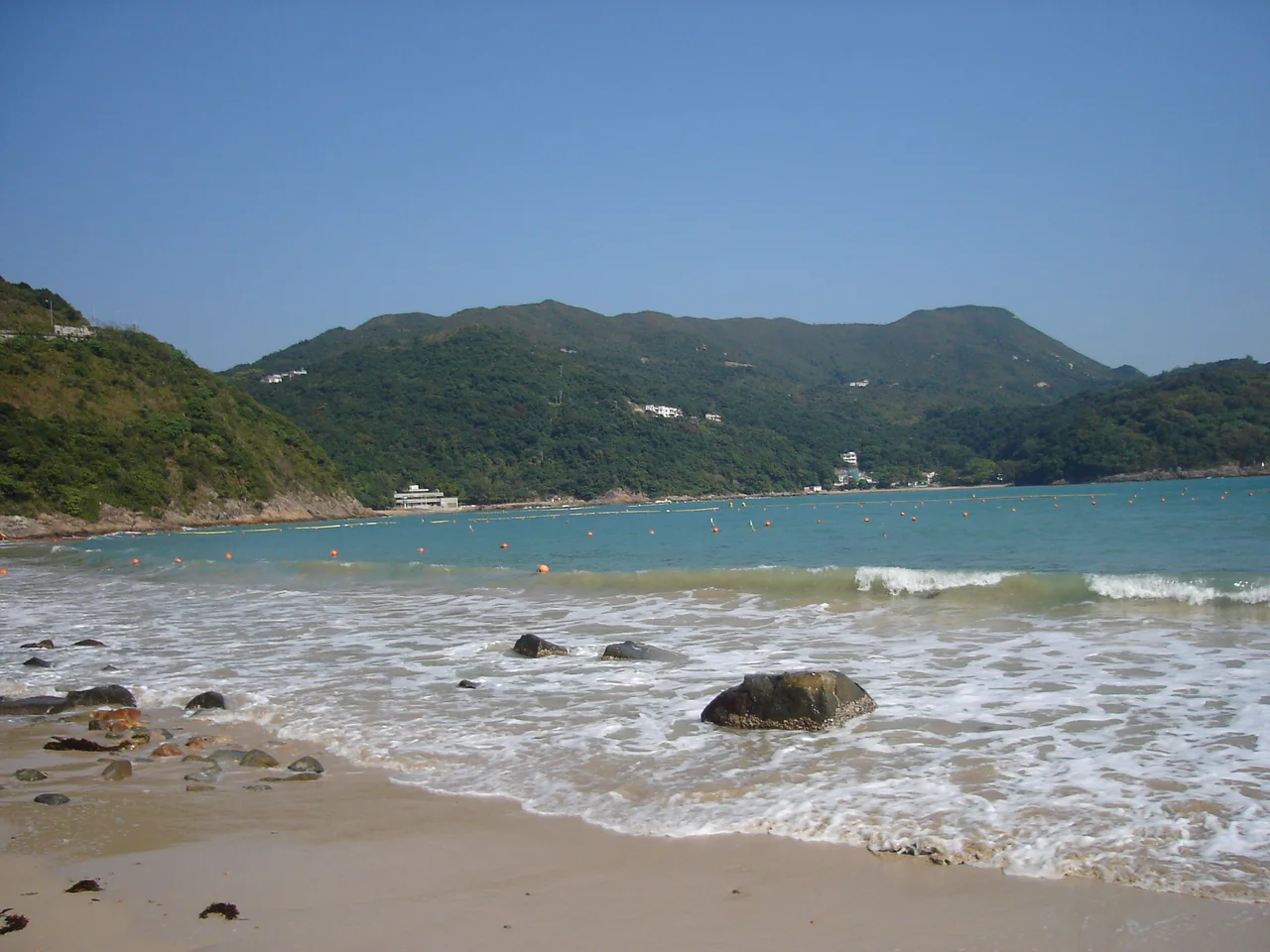

Clear Water Bay
The name is both a promise and a description: Clear Water Bay. Tucked into the eastern shore of the Clear Water Bay Peninsula in Hong Kong's Sai Kung District, this bay lives up to its billing — the water genuinely runs clear, the kind of clarity that makes you see the bottom even where the depth surprises you. Two beaches here, First Beach and Second Beach, draw Hong Kongers out of the city on summer weekends with a simplicity the rest of the territory rarely offers: just sea, sand, and the green peninsular hills folding down to the water's edge.
Two Beaches, One Hundred Steps
Access to both Clear Water Bay beaches requires negotiating about a hundred steps — an unavoidable descent that has shaped the character of the place. No strollers, no wheelchairs, no casual drive-up crowds. The stairs filter visitors to those willing to make the climb, which keeps the beaches from becoming overwhelmed even in peak season. Once down, the facilities are straightforward and well-maintained: changing rooms, lockers, showers, toilets, and floating rafts anchored offshore for swimmers to rest on. First Beach adds a barbecue area; Second Beach offers a refreshment kiosk instead. Both beaches are guarded by shark nets installed after three fatal attacks occurred here in 1995. On 13 June of that year, a 49-year-old woman named Wong Kui-Yong lost her left arm and left leg to a shark at First Beach. She died of her injuries. The nets have been in place ever since, a sombre reminder written into the infrastructure of an otherwise sunlit place.
A Peninsula of Layers
The bay gives its name to the wider peninsula and the country park that wraps around both. Inland from the shoreline, Clear Water Bay Country Park preserves a landscape of rough hills and coastal views that feels remote despite its proximity to one of Asia's densest cities. High Junk Peak rises above the peninsula, its summit offering panoramic views across the South China Sea and back toward Kowloon. Villages like Po Toi O and Tai Wan Tau sit scattered around the bay's edges, fishing communities that have occupied these shores for generations. The area also holds Cham Shan Monastery, a Buddhist retreat established in the hills, and most significantly, Tai Miu at Joss House Bay — Hong Kong's oldest and largest Tin Hau Temple, dedicated to the goddess of the sea. Fishermen have brought offerings here for centuries.
Dream Factory on the Hillside
There is another kind of history on these slopes, one measured not in temples and fishing boats but in celluloid. The former headquarters of Shaw Brothers Studio once occupied a large compound in the Clear Water Bay area. Shaw Brothers was for decades the dominant force in Chinese-language cinema, producing hundreds of martial arts and dramatic films that defined a regional popular culture from the 1950s through the 1980s. The studio lot, later converted and rebranded as TVB City, became headquarters for Hong Kong's biggest television broadcaster. The presence of both institutions on this particular peninsula gave Clear Water Bay an unlikely double identity: a place of natural retreat that was also, just over the ridge, a production machine for mass entertainment. That combination — the wild country park coastline existing alongside a media empire — captures something essential about how Hong Kong occupies its geography.
Science and Skyline
The Hong Kong University of Science and Technology sits on the peninsula as well, its campus carved into steep slopes above the sea with dramatic views across Port Shelter and the islands beyond. Founded in 1991, HKUST has become one of Asia's leading research universities. The campus architecture makes ambitious use of the terrain — buildings stacked down the hillside in terraces, connected by covered walkways and escalators, with the South China Sea as an ever-present backdrop from lecture halls and libraries alike. Students studying here are reminded daily that Hong Kong is, before anything else, a coastal city living in close negotiation with the sea. Clear Water Bay, with its ancient temple, its shark-netted swimming beaches, its converted film studios, and its world-ranked university, holds that negotiation in concentrated form.
From the Air
Clear Water Bay lies at approximately 22.284°N, 114.294°E on the eastern shore of the Clear Water Bay Peninsula in Hong Kong's Sai Kung District. Approaching from VHHH (Hong Kong International Airport, roughly 35 km to the west-northwest), fly east over Kowloon Bay and Port Shelter to reach the peninsula. A viewing altitude of 1,500–2,500 feet provides excellent perspective on both beaches, the country park hills, and the Tseung Kwan O development to the north. High Junk Peak (344 m / 1,129 ft) is the prominent ridgeline summit above the bay. On clear days the South China Sea extends visibly southward toward Dapeng Peninsula on the Chinese mainland.
Nearby Stories
- Shek Pik 1.7 km away
- Tung Ping Chau 4.8 km away
- Hong Kong 12 14 km away
- Wanshan Archipelago Campaign 16 km away
- Pearl River Delta 18 km away
- Battle of Penghu 478 km away
- Penghu Air Raids 487 km away
- Cape Maobitou 596 km away