
Cliffe Castle Museum
Henry Isaac Butterfield wanted a castle, so he made one. The Keighley textile manufacturer took an early-Victorian house called Cliffe Hall, dropped towers onto it, attached a ballroom and conservatories, and gave the whole confection a new name in 1878: Cliffe Castle. He had a personal griffin crest carved into the stonework as though his family had been Norman knights instead of nineteenth-century mill owners. A century later the people of Keighley walked through that same ballroom for free, past Egyptian mummies, William Morris stained glass, and the wooden harpies of a chandelier nobody could explain.
A Hall Becomes a Castle
The original Cliffe Hall was built between 1828 and 1833 by Christopher Netherwood. Its architect, George Webster of Kendal, worked in the gothic revival style that was then fashionable for new country houses pretending to be older than they were. The Butterfields, a textile manufacturing family who had made their fortune in Keighley's mills, bought the property in 1848. Henry Isaac Butterfield's renovations between 1875 and 1880 added the towers and the ballroom and conservatories that turned a comfortable hall into something closer to a stage set. By 1887 the estate ran to about 300 acres of grounds on the edge of town.
From Family Seat to Public Gift
Sir Frederick Butterfield, Henry Isaac's son, died in 1943. His daughter Marie-Louise, Countess Manvers, inherited Cliffe Castle, took a portion of its contents to her own home at Thoresby Hall, and the great house began the strange afterlife so many English mansions had in the twentieth century. In 1950 the local benefactor Sir Bracewell Smith bought it, redesigned it as a museum and art gallery for the people of Keighley, and handed it over. It reopened as Cliffe Castle Museum in 1959, absorbing collections from older museums in the Bradford area. The successor to a Keighley Museum that had opened in Eastwood House around 1893, it became the local memory house of the upper Aire valley.
Mummies, Minerals, and Morris Glass
The galleries do not try to be encyclopaedic. They tell a particular northern story with the artefacts the town actually has. The Egyptians gallery centres on a mummy of a girl from the Ptolemaic dynasty and unfolds the Ancient Egyptian belief that survival continued past the breath. The mineral display, anchored by 800 specimens from the Hinchcliffe Collection purchased in 1984 from the old Gem Rock Museum at Heaton, walks visitors through colour and streak and hardness and the patient chemistry of crystals. The Breakfast Room downstairs holds a stained glass gallery with some of the earliest William Morris glass made in the country, light filtering through patterns from his Arts and Crafts workshop into a quiet bay-windowed space.
The Chinese Chandelier
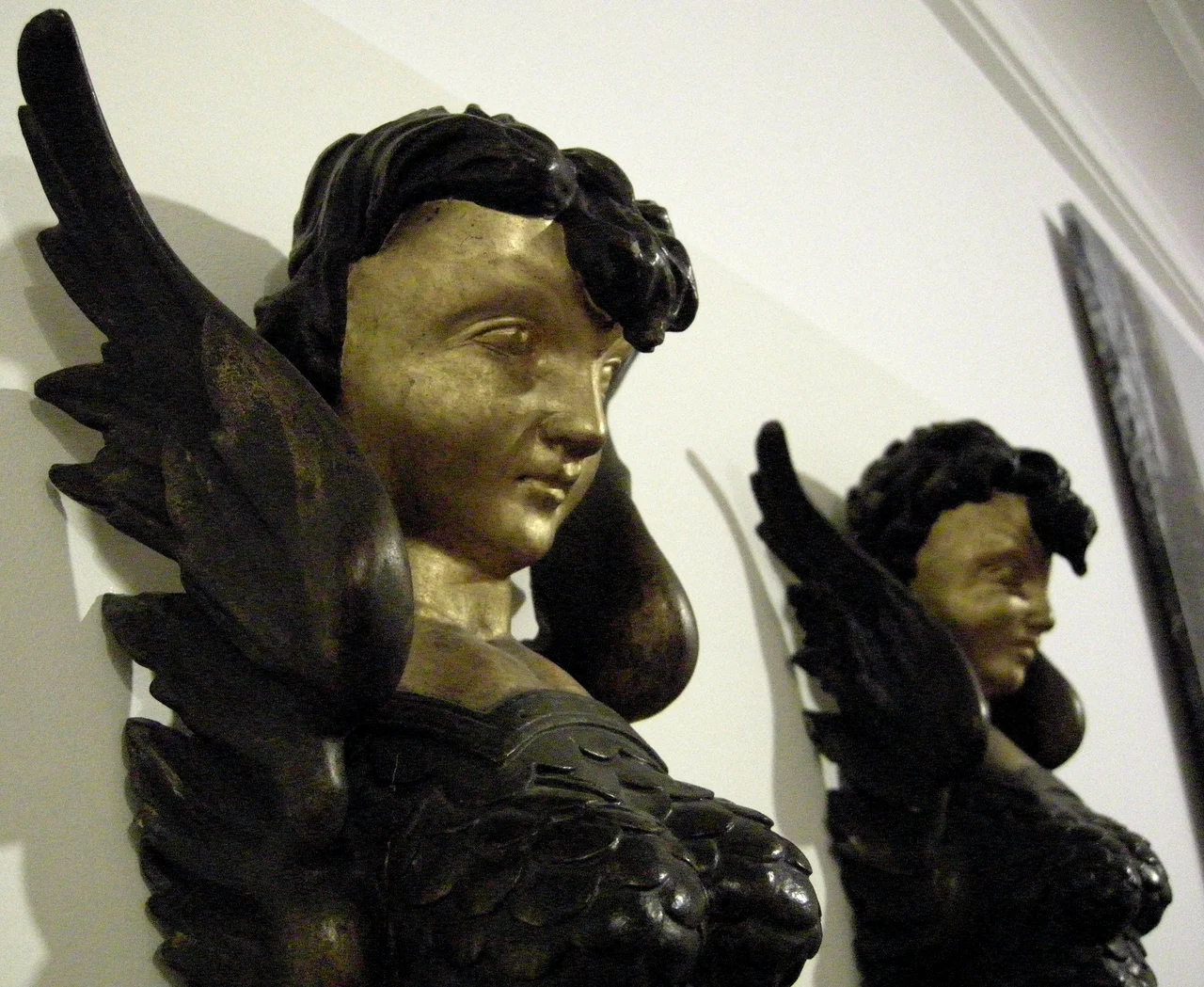
Up in the octagonal Sir Bracewell Smith Hall, the Mansion to Museum gallery traces the building's own century-long transformation. The centrepiece is the so-called Chinese Chandelier, hung with carved wooden harpies, restored and rehung in the 1950s though often described, perhaps in deference to Cliffe's manufactured romance, as nineteenth-century. The Local Pottery gallery records a Keighley industry that has otherwise almost disappeared, jugs and plates produced in works long gone. Outside, the surrounding park is municipal in the best Yorkshire sense: a Grade II listed Victorian landscape with conservatories and gardens that the town still uses for picnics and weddings. The Friends of Cliffe Castle, founded by locals to support the museum, have funded restoration after restoration. The Castle began as one man's idea of his own importance and ended as a community's idea of its shared history.
From the Air
Cliffe Castle stands at 53.875 N, 1.914 W on the northern edge of Keighley, perched above the town on the lower slopes of Keighley Moor. Recommended viewing altitude 2,000 to 3,500 ft AGL; the Victorian towers and slate roofs are unmistakable from above, with the green of Cliffe Castle Park spilling down toward the Aire valley. Nearest airport is Leeds Bradford (EGNM) about 13 nm east-south-east. Manchester (EGCC) lies about 26 nm south-west. Expect frequent low cloud off the South Pennines.
Nearby Stories
- Battle of Seacroft Moor 3 km away
- RAF Topcliffe 7.4 km away
- Pretoria Pit Disaster 8.7 km away
- Lundhill Colliery Explosion 11 km away
- Forest of Bowland 12 km away
- Coverham Abbey 16 km away
- Macclesfield Canal 18 km away
- Leighton Hall, Lancashire 21 km away