
Clifton Cathedral
The architect was not a Catholic. That, the bishop decided, was the point. When Joseph Rudderham commissioned a new Roman Catholic cathedral for Bristol in 1965, he chose Ronald Weeks of the Percy Thomas Partnership precisely because Weeks could ask the naive question: What is an altar? Catholics, Weeks observed, took too much for granted. He could not. So he listened, drew, listened again, and gave Bristol a hexagonal cathedral of pale concrete that one local writer would describe as resembling a spaceship that had recently landed in Clifton and never bothered to leave. It opened in 1973. It is the first cathedral in the world built under the rules of the Second Vatican Council.
From Punishment to Cathedral
Until 1791 it was illegal to be a Catholic priest in Britain. The penalty was life imprisonment. The Roman Catholic Relief Act of that year began a slow unwinding, but Bristol's Catholic community had to wait nearly two centuries for a proper cathedral. The old Pro-Cathedral of the Holy Apostles, built on a difficult hillside, was structurally compromised almost from the start, and by the 1960s it was effectively unusable. Around the same time, in Rome, an extraordinary council was rewriting how Catholic worship should look. The Second Vatican Council, meeting between 1962 and 1965, called for the altar to be visible, the priest to face the people, and the congregation to gather around rather than file in. Bristol got to design the first cathedral built entirely under these new rules. Other dioceses were renovating. Bristol started from scratch.
Hexagons and a Horseshoe
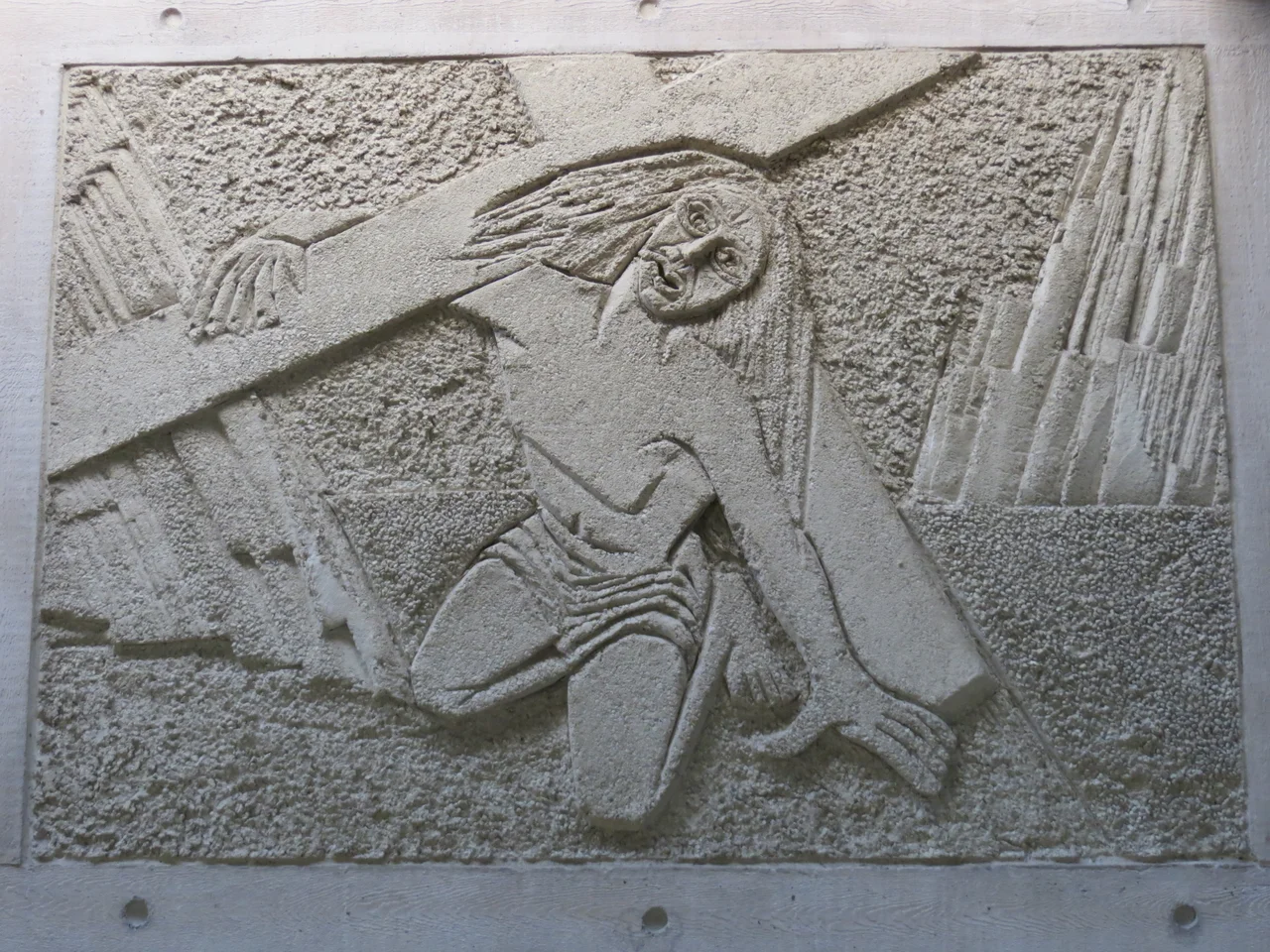
Weeks's solution was geometry. Hexagons fit together without gaps, like honeycomb, and they let the congregation curve naturally around the altar in a horseshoe shape rather than the conventional rectangular nave. The altar was placed to one side instead of in the middle, giving everyone a clear view of the celebration. The nave floor is tiled in hexagons, each one drawn out individually by a young architectural assistant named Richard Gordon to calculate the count. Pale concrete, mixed for a creamy almost-white finish, rises in unornamented planes. The roof tilts in clean angles. Glass by Henry Haig fills the narthex with kaleidoscopic colour. The Stations of the Cross are by William Mitchell. The font is by Simon Verity. Nothing is wasted. Nothing is sentimental. Mary Haddock, writing in Building magazine, admired 'the hint of theatre in the design; the absence of clutter and garish church ornament.'
Brutalist Spaceship
Not everyone loved it. A Catholic newspaper called the exterior 'gaunt and forbidding.' Bristol traditionalists were appalled by the brutalist concrete that arrived in their gracious Georgian suburb. The writer Ray Newman captured the polarisation neatly: 'The thrusting spaceship-like spire can be seen for miles around and the more-or-less hexagonal church was apparently unpopular with conservation minded locals and worshippers when it arrived from its home planet in 1974.' But the concrete was unusually fine: pale, dense, board-marked, weathering gracefully where lesser brutalism cracked and stained. In 1974 the Concrete Society gave it their annual award. Historic England eventually listed it Grade II*, calling its 'integration of materials and spatial quality... remarkable for a cathedral of any period.' A 2014 study found it was the only Catholic church built in the 1970s to have earned that designation.
Doctor Who and the Lampedusa Cross
The acoustics are good enough that European chamber ensembles compete to play there. The cathedral hosts an annual classical music festival and has appeared on the BBC's Songs of Praise more than half a dozen times, including the live televised Midnight Mass in December 2020 during the pandemic, with a specially composed Missa Universalis sung to a congregation of fewer than thirty. Doctor Who used the interior in 2020 as Captain Jack Harkness's spaceship in the episode 'Fugitive of the Judoon,' which the producers presumably enjoyed more than the bishop did. In the Lady Chapel hangs a Lampedusa Cross, made from the timber of a migrant boat wrecked off the Italian island, similar to the one held by the British Museum. It is small. It is unornamented. It marks Pope Francis's 2017 'Share the Journey' call to remember the people behind every statistic about migration, and in a building of pale concrete and clean lines it speaks louder than anything else inside.
Flight Context
Clifton Cathedral stands at 51.4597°N, 2.6163°W on Pembroke Road in Clifton, north-west Bristol. The hexagonal floorplan and tilted concrete spire are distinctive from the air, set among the Georgian terraces of Clifton Village and easy to mistake for a piece of modernist civic architecture. The Clifton Suspension Bridge lies half a mile west. Recommended viewing altitude 2,000-3,500 feet. Bristol Airport (EGGD/BRS) is 7 nautical miles south. The cathedral is roughly half a mile northeast of the former Bristol Zoo site and a short walk from the open expanse of Clifton Down.
From the Air
Located at 51.4597°N, 2.6163°W on Pembroke Road in the affluent Clifton district of Bristol. Recommended viewing altitude 2,000-3,500 feet. Hexagonal floor plan and tilted pale concrete spire are distinctive from above, surrounded by Georgian terraces; Clifton Suspension Bridge half a mile west. Nearest airport: Bristol Airport (EGGD/BRS) 7 nm S. Roughly half a mile NE of the former Bristol Zoo and a short walk from Clifton Down.
Nearby Stories
- Cosmeston Medieval Village 1.4 km away
- Glastonbury Festival 3.5 km away
- Tintern Abbey 3.6 km away
- Quantock Hills 4.8 km away
- Ebbw Vale Steelworks 10 km away
- New Wardour Castle 12 km away
- Windmill Hill, Avebury 16 km away
- Cotswolds 18 km away