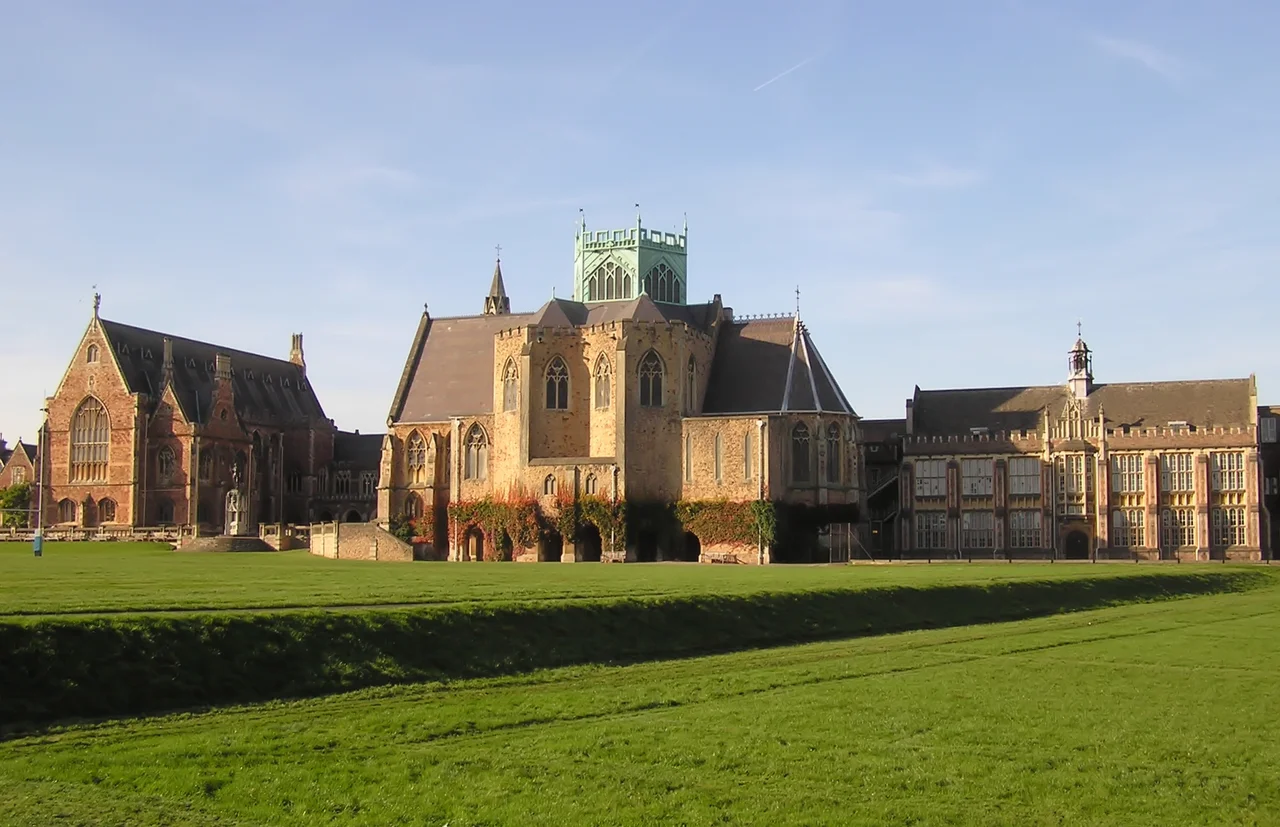

Clifton College
In June 1899, a thirteen-year-old boy named A. E. J. Collins walked out to bat on a school cricket pitch in Bristol and, over the course of a four-afternoon house match, scored 628 not out. The total stood as the highest cricket score ever recorded for 116 years, finally surpassed in 2016 by a fifteen-year-old in Mumbai. Collins himself was killed in the First World War. His pitch at Clifton College is now called Collins' Piece, and his record is commemorated on a small plaque on the side of the ceramics building. The story is suitably Cliftonian: a feat of slightly absurd Victorian schoolboy ambition, attached to a young life that ended early, recorded with quiet care by an institution that has been keeping its own records since 1862.
Science, Day Boys, and Polack's House
When the Reverend John Percival opened Clifton College in 1862 with sixty-nine boys, he ran it on principles that other public schools found mildly disturbing. The curriculum emphasised science over classics. Day boys were admitted on equal terms with boarders, rather than treated as a lesser breed. And from 1878, Polack's House provided a dedicated Jewish boarding house with a kosher dining hall and synagogue, the only such house in any English public school, and eventually the last in Europe. It survived for 125 years, finally closing in 2005 due to dwindling numbers. The Polack's House Educational Trust still offers scholarships open to Jewish candidates. In 1987, Clifton became the first traditional boys' public school to admit girls to every year group from pre-prep to upper sixth, with the calculated exception of fifth-form, where O-level disruption was thought too risky.
Four Nobel Laureates
For a school of fewer than 800 pupils, Clifton's haul of Nobel Prizes is remarkable. Sir John Kendrew won the Nobel Prize in Chemistry in 1962 for unravelling the structure of myoglobin. Sir John Hicks won the Nobel Prize in Economics in 1972 for his contributions to general equilibrium theory. Sir Nevill Francis Mott won the Nobel Prize in Physics in 1977 for work on the electronic structure of disordered systems. And in 2024, Geoffrey Hinton, the British-born father of deep learning, won the Nobel Prize in Physics for foundational work on neural networks that ultimately produced the entire generative AI revolution. Four Nobel laureates from one English boarding school is unusual. So is the spread: chemistry, economics, physics, and the new physics that turned out to be computer science.
D-Day Planning Rooms
In 1942, with Bristol's docks being hammered by the Luftwaffe and the pupils evacuated to Bude in Cornwall, the United States Army moved in. Clifton became the headquarters of US V Corps and then First Army. The classrooms where boys had studied Latin were now planning rooms for the largest amphibious invasion in human history. General Omar Bradley used the school's buildings as his staff office for the lead-up to Normandy. School House, the oldest of the boarding houses, was the main planning HQ for the D-Day landings of 6 June 1944. After the invasion, the buildings became the headquarters of the Ninth Army under General William Hood Simpson, who pushed across Germany toward the Elbe. Boys returned to find their dormitories still smelling faintly of American cigarettes and to find the school's place in twentieth-century history quietly and permanently changed.
The Close, and Newbolt's Hush
The cricket field, known as the Close, watched W. G. Grace score thirteen first-class hundreds for Gloucestershire. Grace's own children attended the school. Henry Newbolt, an Old Cliftonian poet, immortalised the ground in 'Vitai Lampada': 'There's a breathless hush in the Close to-night...' The poem went on to become an instrument of empire and, to many later readers, an embarrassment, but the hush is real and the Close is still there. Field Marshal Douglas Haig was an Old Cliftonian, and a life-size statue of him stands in front of School House, beyond a memorial arch designed by Charles Holden that commemorates the boys who died in two world wars. Tradition still requires pupils to remove their headgear when walking through. Like much of what Clifton commemorates, it sits awkwardly on the modern eye: a Victorian institution that has had to reckon, slowly and not always willingly, with what its own history actually contains, including a 2015 conviction of a housemaster for covertly filming pupils and the wholesale safeguarding reforms that followed.
Flight Context
Clifton College sits at 51.4623°N, 2.6204°W on College Road in the heart of Clifton, north-west Bristol. From the air it is easy to identify: a cluster of yellow-stone Gothic Revival buildings surrounding the green expanse of the Close, just south of the wide open space of Clifton Down. The college chapel and the Wilson Tower (1890) are prominent vertical landmarks. The Clifton Suspension Bridge lies half a mile west. Recommended viewing altitude 2,000-3,500 feet. Bristol Airport (EGGD/BRS) is 7 nautical miles south. Clifton Cathedral stands a quarter-mile southeast, and the former Bristol Zoo site is immediately adjacent.
From the Air
Located at 51.4623°N, 2.6204°W on College Road in the affluent Clifton district of Bristol. Recommended viewing altitude 2,000-3,500 feet. Cluster of yellow-stone Gothic Revival buildings around the green expanse of the Close cricket field, just south of Clifton Down; chapel and Wilson Tower (1890) are vertical landmarks. Nearest airport: Bristol Airport (EGGD/BRS) 7 nm S. Clifton Cathedral lies a quarter-mile SE; former Bristol Zoo site is immediately adjacent.
Nearby Stories
- Cosmeston Medieval Village 1.4 km away
- Glastonbury Festival 3.5 km away
- Tintern Abbey 3.6 km away
- Quantock Hills 4.8 km away
- Ebbw Vale Steelworks 10 km away
- New Wardour Castle 12 km away
- Windmill Hill, Avebury 16 km away
- Cotswolds 18 km away