
Clifton Observatory
On 30 October 1777, a gale was blowing through the Avon Gorge, and someone had left the sails of the Clifton windmill turning. They turned faster and faster. The wooden gears inside, designed for the slow grind of corn and then the dry pulverisation of snuff tobacco, span beyond what they were built to handle. Friction did what friction does. The mill caught fire from the inside. By the time the flames burned out, the machinery was gone and the stone tower was a hollow shell. It sat that way for fifty-two years, until in 1828 an artist named William West offered the Society of Merchant Venturers five shillings a year for the use of it and proceeded to make it one of the strangest small attractions in Britain.
The Snuff Mill
The Society of Merchant Venturers, who owned much of Clifton Down, gave permission for a corn mill on the highest point above the Avon Gorge in 1766. The wind that funnelled up the gorge was reliable and strong, exactly what a windmill needed. When demand for corn-grinding faded, the mill switched to snuff tobacco, a fashionable Georgian habit that required pulverising dried tobacco leaf into fine powder. Locals called it the Snuff Mill. The gale of October 1777 ended that business in a single night. The tower stood roofless and gutted, picturesque enough to feature in landscape paintings but useless for any practical purpose. The Merchant Venturers were not in a hurry to do anything with it. The structure aged into the gorge view, becoming part of the scenery painters came to capture.
William West's Studio
William West was a Bristol School painter, part of a circle of artists drawn to the Avon Gorge's dramatic limestone cliffs and changing light. In 1828 he rented the derelict tower for five shillings a year, twenty-five new pence, and converted it into a working studio. The position was perfect: 250 feet above the river, with views straight down to Hotwells, across to Leigh Woods, and up to where Brunel's Clifton Suspension Bridge would eventually leap the gorge. By 1842 West had gone further. He installed reflecting and achromatic telescopes for astronomical work, and on the very top of the tower he built something unusual: a camera obscura. He charged a shilling a visit, or ten shillings and sixpence for an annual membership. The Snuff Mill had become the Clifton Observatory.
The Camera Obscura
A camera obscura is older than the photograph it eventually became. West installed a five-inch convex lens and a sloping mirror at the apex of the tower. Light from outside enters through the lens, bounces off the angled mirror, and is projected vertically downward into the darkened room below. Visitors stand around a fixed circular table, five feet across, with a concave metal dish for the surface. The image lands on the dish as a true panorama of the gorge, not a mirror image, and turning a wheel rotates the mirror so the view sweeps across Leigh Woods, the cliffs, the river, the Suspension Bridge. It has been doing this since 1828. The technology was based on William Fox Talbot's work in early photography, which is a way of saying the camera obscura at Clifton is older than photography itself and still working, almost two centuries on, on Victorian gear with the lens cleaned occasionally and the mirror still turning.
Giants' Cave
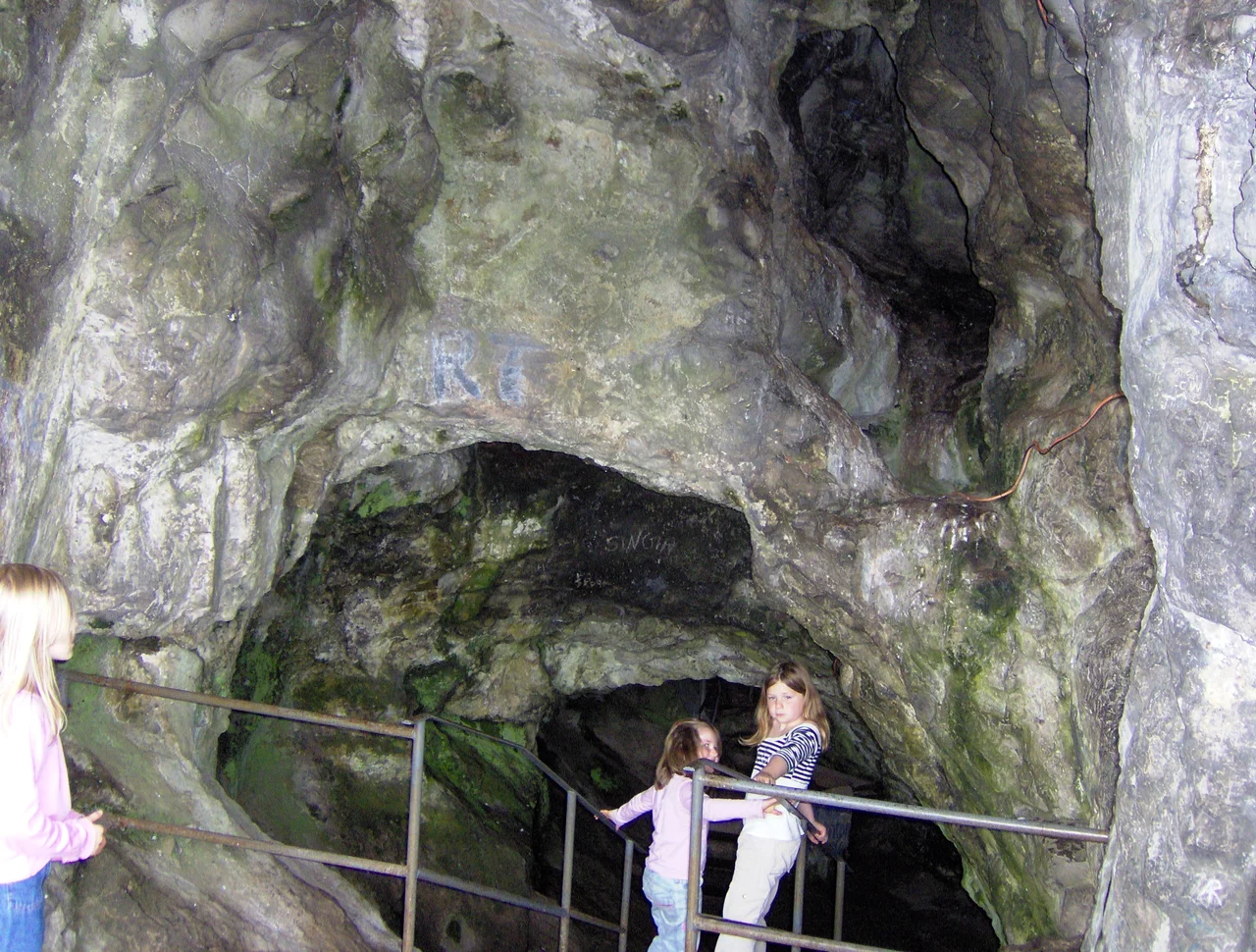
Not content with a telescope and a camera obscura, West kept digging. From the observatory he drove a 200-foot tunnel through the limestone cliff, downward and outward, until it broke through into a natural cavity called St Vincent's Cave, also known as Ghyston's Cave or Giants' Cave. The cave opens out of the gorge cliff 250 feet above the river floor and 90 feet below the cliff top, a vertiginous mouth in the limestone with a viewing platform now installed inside. The tunnel took two years to build at a cost of £1,300, a substantial sum in 1837 when it first opened to the public. Visitors emerge into the cave to find themselves apparently floating in mid-gorge, with the river below and the bridge directly overhead. In 1977 the building was listed Grade II*. It went onto the Buildings at Risk Register in 2011 and came off it in 2014 after the local entrepreneur Ian Johnson, also owner of the Clifton Rocks Railway, bought and restored it. The tunnel still runs. The camera obscura still turns. The Snuff Mill became something stranger than its makers could have imagined.
Flight Context
Clifton Observatory stands at 51.4566°N, 2.6265°W on Clifton Down, immediately east of the Clifton Suspension Bridge and high above the Avon Gorge. The squat circular stone tower with its cupola is unmistakable from the air, set in open parkland on the edge of the dramatic limestone cliffs that drop straight down to the River Avon. Brunel's Suspension Bridge spans the gorge a hundred metres west. Recommended viewing altitude 1,500-3,000 feet. Bristol Airport (EGGD/BRS) lies 7 nautical miles south. The gorge runs roughly north-south below; Leigh Woods covers the steep western side.
From the Air
Located at 51.4566°N, 2.6265°W on Clifton Down, immediately east of the Clifton Suspension Bridge above the Avon Gorge. Recommended viewing altitude 1,500-3,000 feet. Squat circular stone tower with cupola sits in open parkland on the cliff edge; Brunel's Suspension Bridge spans the gorge 100m west, Leigh Woods on the steep western side. Nearest airport: Bristol Airport (EGGD/BRS) 7 nm S.
Nearby Stories
- Cosmeston Medieval Village 1.4 km away
- Glastonbury Festival 3.5 km away
- Tintern Abbey 3.6 km away
- Quantock Hills 4.8 km away
- Ebbw Vale Steelworks 10 km away
- New Wardour Castle 12 km away
- Windmill Hill, Avebury 16 km away
- Cotswolds 18 km away