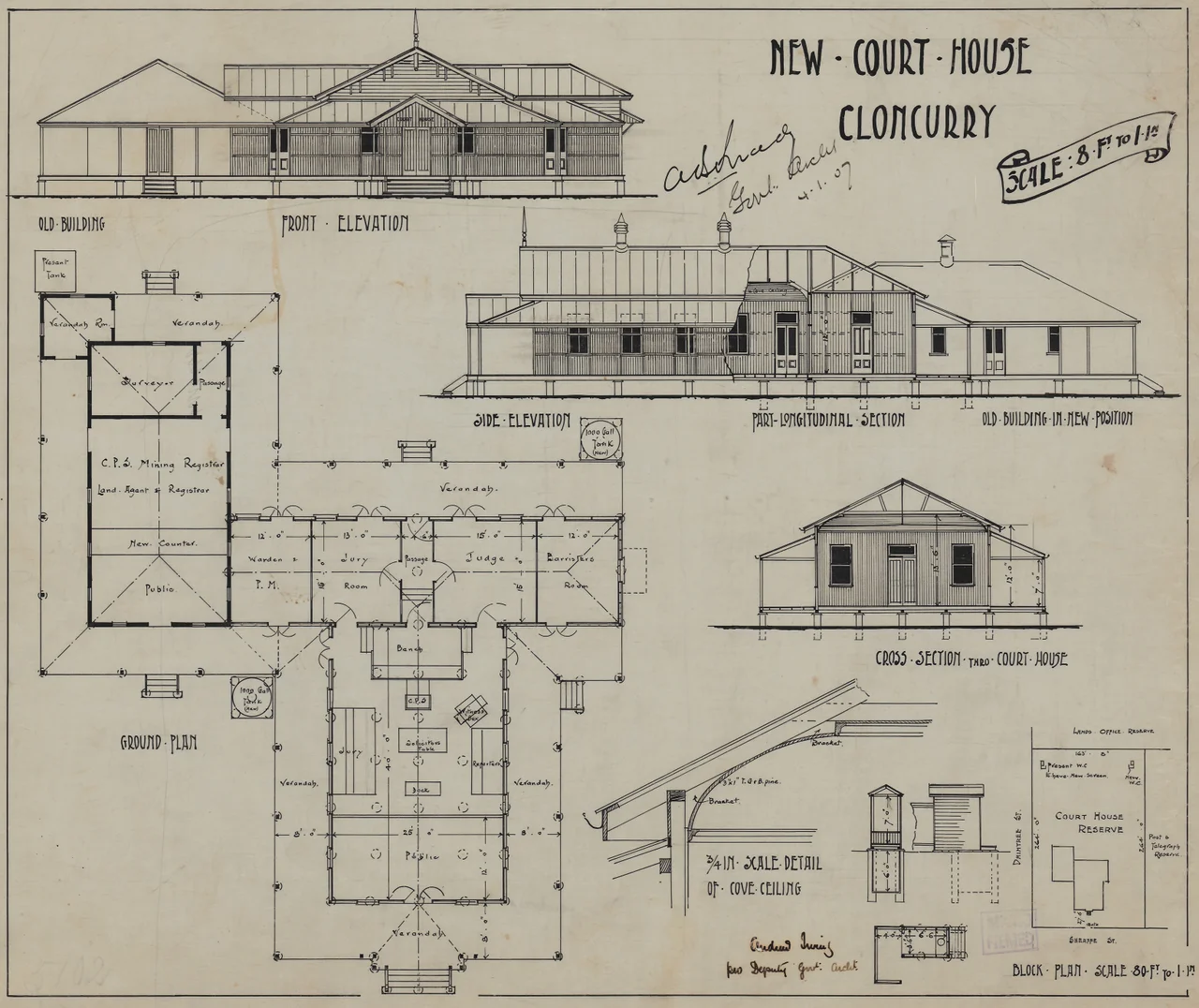

Cloncurry Courthouse
Before there was a courthouse in Cloncurry, there was a slab hut with a bark roof that served as the lock-up, and a handful of police living in tents. Justice in the far north-west of Queensland arrived the way everything else did - slowly, by horse and bullock and camel, across distances that made the law feel theoretical. The weatherboard building that stands today on Daintree Street is the answer the colony eventually built: a courthouse that did not so much get constructed as accumulate, growing wing by wing across six decades as the town around it boomed.
Law by Slab Hut and Visiting Magistrate
Cloncurry was settled by pastoralists from the mid-1860s and given over to copper after Ernest Henry's 1867 strike, but governance lagged far behind the diggers and drovers. Police were stationed here from 1870 - a contingent of four men and an inspector, living under canvas - yet the early machinery of justice was makeshift in the extreme. The lock-up was a slab hut roofed with bark. There was a magistrate who rode the circuit between scattered settlements, and for years no proper court at all. A permanent Clerk of Petty Sessions did not arrive until 1880, and the first Police Magistrate not until 1882. This was how the law reached the outback: in small timber courthouses bolted onto police stations, served by men who travelled hundreds of miles to hear cases across a district the size of a small country. The administration of justice was, quite literally, carried out to the frontier rather than waiting for the frontier to come to it - and in a town where copper money and cattle disputes could turn sharp, that slow-arriving authority mattered.
Built to Grow
Cloncurry was made a District Court Area in 1889, but it took nearly a decade more before a proper courthouse rose. The building completed by the firm of Murray and Litster in 1897 and 1898 was simple: a rectangular, two-roomed, timber-framed structure with exposed studwork and a deep verandah wrapping all four sides - the classic Queensland defence against heat and glare. What makes the building remarkable is not that first room but everything that followed. As copper prices soared in the new century and Cloncurry's importance swelled, the courthouse kept expanding to keep pace with the town's fortunes.
Sixty-Four Years of Additions
In 1906 Cloncurry became a Circuit Court centre, and the following year the complex more than doubled, gaining a full courtroom and offices for judge, barristers, jurors, and the court warden - a new wing whose entrance turned to face Sheaffe Street. The 1907 courtroom still wears its handsome coved ceiling of tongue-and-groove pine. In 1914 more rooms went up for the land commissioner, the mining registrar, and the inspector of machinery, the very titles a reminder of how completely mining and grazing ran this district. A strongroom and toilet block followed in 1953, and a final four-room wing in 1961 - all of it built under matching rooflines, in the same weatherboard, with the same window hoods, so the seams barely show. The result is a single building that quietly records sixty-four years of a frontier town's growth in timber and corrugated iron.
Still Sitting
By the 1960s the centre of gravity in the north-west had shifted. Mount Isa, with its vast mines, had eclipsed Cloncurry, and in 1963 the police inspectorate moved there. Yet the courthouse did not close. Conservation work in 1977 shored up the ageing timber, and the building still operates for the purpose it was first raised to serve - one of the oldest continuously working courthouses in outback Queensland. Added to the Queensland Heritage Register in 1992, it endures as a record of how the law put down roots in hard, distant country: not as a grand stone monument, but as a humble timber building that simply refused to stop growing, or to stop doing its job.
From the Air
Cloncurry Courthouse stands at roughly 20.70°S, 140.51°E, at 42-48 Daintree Street in the heart of Cloncurry, North West Queensland. From the air it reads as a low, sprawling timber building under pale corrugated-iron roofs near the town centre, hard to single out from surrounding civic buildings - the nearby Cloncurry Post Office on Scarr Street makes a useful companion landmark. The braided Cloncurry River and the saleyards help fix the town, and the Flinders Highway runs past east-west. Cloncurry Airport (ICAO YCCY) lies just north of town; Mount Isa Airport (ICAO YBMA) is about 110 km west. The semi-arid dry season (April to November) gives the clearest air; summer afternoons bring intense heat haze over the township.
Nearby Stories
- Eloise Copper Mine 3.9 km away
- Quamby 18 km away
- Lake Moondarra 38 km away
- Kuridala Township site 41 km away
- Mount Cuthbert Township and Smelter 45 km away
- Millungera Station 85 km away
- Moonah Creek Hanging Tree 123 km away
- Combo Waterhole 155 km away