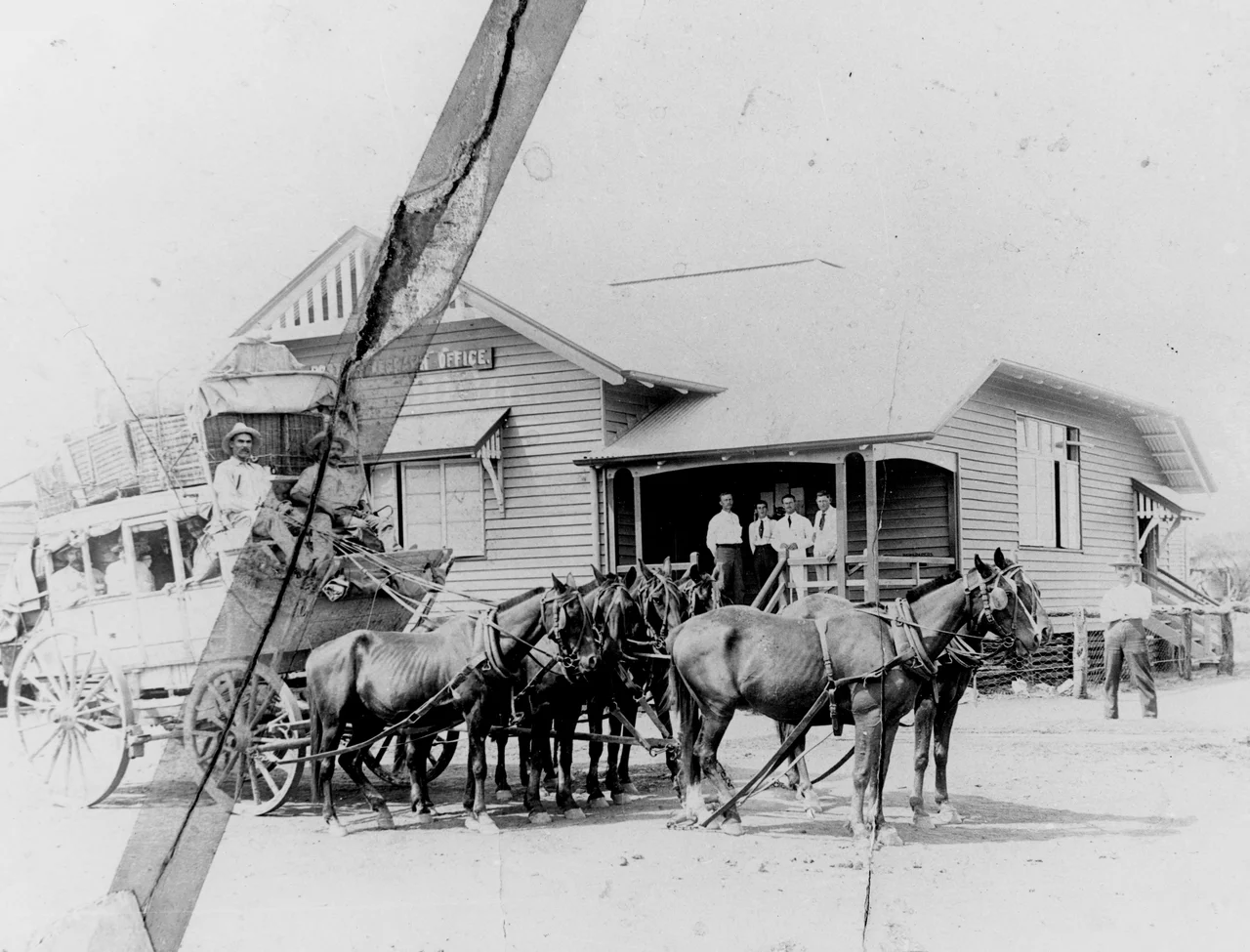
Cloncurry Post Office
In an outback town in the 1880s, the most important building was not the pub or the church or even the bank - it was the one with wires running out of it. Cloncurry sat at the dry, isolated heart of north-west Queensland, weeks from the coast by camel and bullock, and the difference between connection and oblivion ran down a single telegraph line. The timber post office on the corner of Scarr and Sheaffe Streets, with its twin porches and projecting gable, is where that line came in. For more than a century, this modest weatherboard building has been the place where Cloncurry reached the rest of the world.
The Wire to Everywhere
Cloncurry was made a Country Post Office in 1871, and the first postmaster set up in temporary quarters that same year, before any proper building existed. The first purpose-built post office went up in 1883 - and in that single year it became a Money Order Office and an official electric telegraph station, suddenly tying this remote settlement into a continental nervous system. The first lines reached out to Aramac and Boulia. By 1888 a wire ran north to Normanton, and by 1890 west to Camooweal and Urandangi. Each new line stitched another stretch of empty country into the network. Mail came overland by horse, bullock, and camel team, and from 1884 by Cobb & Co coach, but the telegraph moved at the speed of light - and in a land this vast, that was nothing short of revolutionary.
A Standard Design for a Booming Town
The copper boom of the early twentieth century made Cloncurry prosperous and demanded a grander post office. In 1906 the Queensland Works Department designed a new one - a standard 'T17' type, a single-storey timber building with a distinctive twin porch and projecting gable, raised on low stumps against the heat. The old 1883 building was simply turned to face Scarr Street and shifted behind the new one to serve as the postmaster's quarters. The T17 was no mere off-the-shelf box: of all the timber post office types built across Queensland between 1906 and 1921, it is reckoned the finest, prized for the quality of its construction, its graceful proportions, and the clever way its deep porches and ventilation answered the tropical climate. Many of its siblings have since been demolished. Cloncurry's survives, still working.
Fire and Wet Blankets
The building's survival was not guaranteed. In 1914 a fire tore through the centre of Cloncurry, destroying the post office, the hotel, eleven shops, storerooms, and a cottage, and killing one man - a catastrophe that cost an estimated fifteen thousand pounds. The telegraph office, though, was saved by quick-thinking staff who soaked it down and draped it in wet blankets, fighting to keep the wires alive even as the town burned around them. They understood what was at stake: in 1914, a town that lost its telegraph lost its voice. The post office was rebuilt and carried on, and its later extensions - a brick wing added in 1954 - eventually housed the control station for the entire region's auxiliary radio network.
Epicentre of the North-West
By the 1920s the little post office stood at the centre of something extraordinary. Qantas had begun flying from Cloncurry, and the Flying Doctor Service was about to launch from the same town - and both depended utterly on rapid communication of the kind this building made possible. A doctor could not be summoned by air without a message getting through first. By the 1950s the Cloncurry exchange handled mail, telephone, and telegraph for a colossal sweep of country, from Normanton in the north to Boulia in the south and west to Camooweal. As Mount Isa rose, some of those functions moved away in 1964 - but the post office on Scarr Street, heritage-listed in 2005, still serves the town it has connected to the world since 1883.
From the Air
Cloncurry Post Office stands at approximately 20.71°S, 140.51°E, on the prominent corner of Scarr and Sheaffe Streets in central Cloncurry, North West Queensland. From the air, look for a small single-storey timber building under a hipped corrugated-iron roof near the town centre; the historic Cloncurry Courthouse a block away on Daintree Street makes a paired landmark for orientation. The braided Cloncurry River, the cattle saleyards, and the east-west Flinders Highway help fix the township. Cloncurry Airport (ICAO YCCY) lies just to the north; Mount Isa Airport (ICAO YBMA) is roughly 110 km west. Skies are clearest in the dry season (April to November); summer afternoons bring heavy heat haze over the town.
Nearby Stories
- Eloise Copper Mine 3.9 km away
- Quamby 18 km away
- Lake Moondarra 38 km away
- Kuridala Township site 41 km away
- Mount Cuthbert Township and Smelter 45 km away
- Millungera Station 85 km away
- Moonah Creek Hanging Tree 123 km away
- Combo Waterhole 155 km away