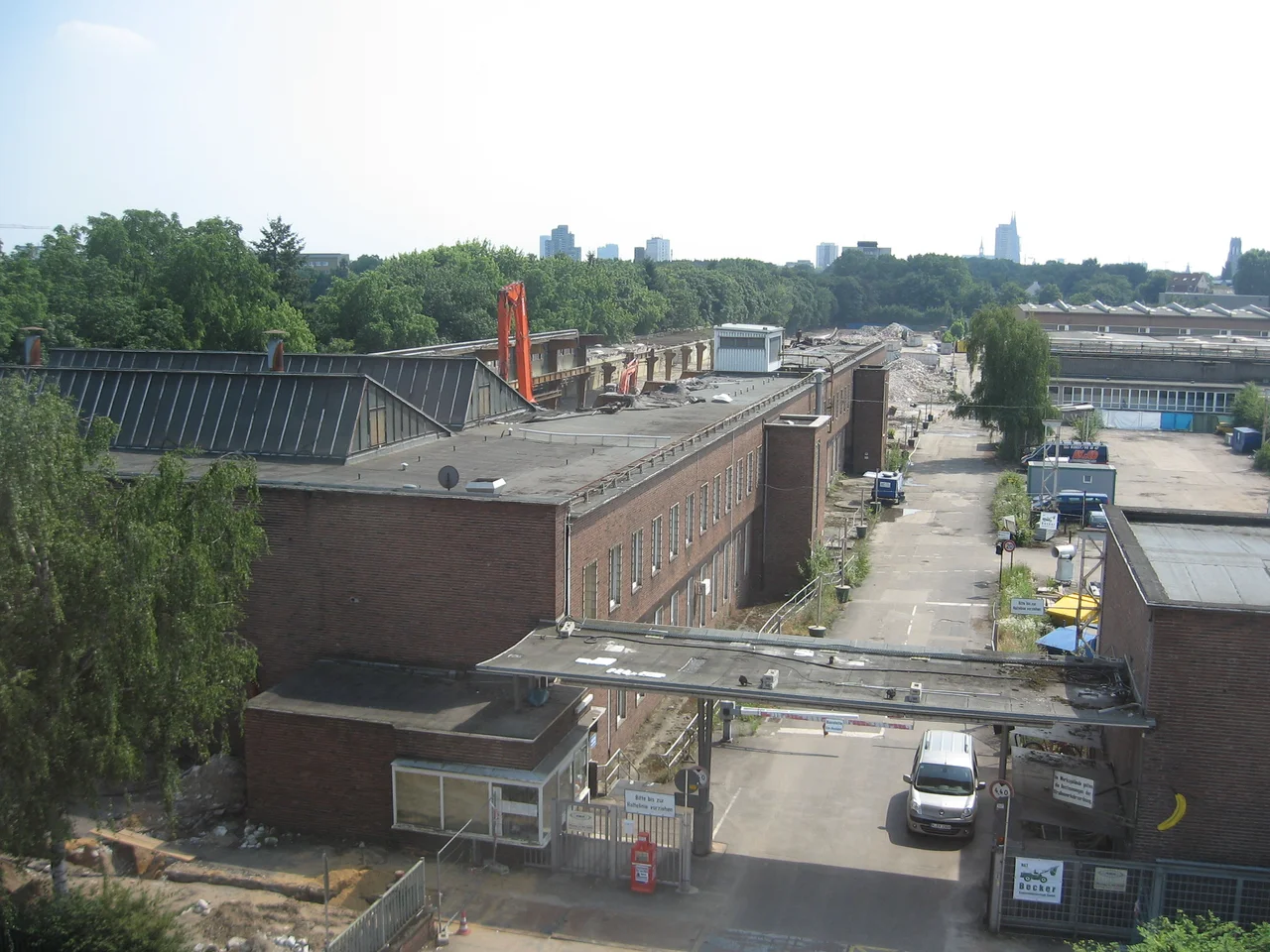

Clouth Gummiwerke
Begin with the unlikely catalog. The first transatlantic submarine telegraph cable from Germany to New York, laid in 1900. The gas envelope of the first Zeppelin airship, LZ1, delivered in July of the same year. Diving suits for the Imperial Navy, balloon silk, suspenders, milk-bottle teats, conveyor belts that fed the Aachen coal mines, tires for the bicycle boom that built Cologne's first racetrack, and a rubber-cushioned tram bearing called the Cologne Egg that now lies under 30,000 meters of track in its home city and many more elsewhere. All of it came from one rubber works in the Cologne district of Nippes, founded in 1862 by an entrepreneur named Franz Clouth and finally demolished in 2013 to make way for an apartment quarter. For 143 years, if it was rubber and it was hard to make, there was a chance Clouth had made it.
The Founder and the Address
On 10 September 1862, Franz Clouth opened a commission business in technical rubber goods at Sternengasse 3 in central Cologne - the same building his family lived in. For six years the business shared the family home. By 1868 demand had outgrown the parlor, and Clouth moved the works to a ten-thousand-square-meter site in Cologne-Nippes, the working-class district north of the inner city that would become his real address. The first products were domestic - rubber teats for milk bottles, suspenders for trousers. Industrial customers followed: roller coverings, conveyor belts, drive belts. By 1872 a fifty-meter chimney announced the works to the neighborhood. By 1892 a steam engine drove the line. Franz Clouth had become an industrialist, and the parlor at Sternengasse 3 was an artifact.
Cables Across the Atlantic
In 1890 Clouth opened a cable works department, producing gutta-percha-insulated telegraph cables for the Imperial Telegraph Administration and the first knot-braided municipal telephone cables in Cologne. The work expanded so fast that in 1898 the cable department was spun off as Land- und Seekabelwerke AG and won what was perhaps the most spectacular contract of its era: the laying of the first German transatlantic telegraph cable, from Emden in Lower Saxony to New York, through a consortium called the Deutsch-Atlantische Telegraphengesellschaft. The cable went into service on 1 September 1900. A separate Clouth cable laid in Saint Petersburg in 1898 was not replaced until 2001 - an active service life of 103 years. The cost of these projects was so large that a banking consortium took 50 percent of the spin-off, then handed it to Felten & Guilleaume in 1901; by 1904 Felten & Guilleaume owned the rest, and the Clouth family had stepped back from the cable business they had built.
Count Zeppelin Comes to Nippes
In 1898, Count Ferdinand von Zeppelin paid a visit to Cologne-Nippes with a peculiar order: eighteen large drum-shaped gas cells, to be fitted inside the rigid framework of his first airship, LZ1. Clouth also developed and supplied the rubberized silk that would form the outer envelope. The fabric was delivered in July 1900; the Zeppelin made its first flight at Friedrichshafen weeks later. The rubber industry's affinity for airships was not unusual for the era - rubberized fabric and gas-tight balloon silk were the high technology of lighter-than-air flight - but Clouth went further than most. The company built its own airships, Clouth I through V, in an airship hangar erected on the factory grounds in 1907. The forty-five-meter shed housed Clouth I, a forty-two-meter ship with a 1,700-cubic-meter gas volume, which made its first flight on 1 May 1908. Franz Clouth's son Richard was instrumental in the design. On 3 June 1910 the ship landed in Bickendorf at the military airship hangar - a feat then more remarkable than the bare numbers suggest.
Air Raids, Recovery, and the Cologne Egg
The Nazi years turned the works almost entirely to war production, and the Allies returned the favor. Targeted air raids on 13-14 March 1942 destroyed roughly 70 percent of the plant. On 15 October 1944 a renewed raid took out 90 percent of what remained. American troops occupied the site on 6 March 1945. Production restarted in October of that year, because conveyor belts from Clouth were urgently needed in the Aachen coalfield and the Rhenish lignite mines to dig the fuel that would heat what remained of German cities. In 1978 a Clouth engineer named Hans Braitsch filed a patent for a small rubber bearing shaped like an egg, designed to sit beneath tram rails and absorb the structure-borne noise that otherwise carried into the buildings above. The Cologne Egg, as everyone now calls it, was first installed that year on the Ebertplatz-Lohsestraße line in Cologne. The Kölner Verkehrsbetriebe rolled it out across 1,500 meters of track shortly after, then everywhere. The invention has been installed 30,000 times in Cologne alone and is in use in cities around the world. Trams glide where they used to rumble, and few of the people listening know why.
The Quarter That Replaced the Works
Continental AG had quietly built up its stake through the 1980s and took 98.29 percent of Clouth shares in 1990, with the Federal Cartel Office's blessing. The end came in waves: rubberized fabric production ended on 31 March 1992, the company merged into Continental's ContiTech division in 1997, and the last conveyor belt left the Nippes works on 16 December 2005. The city of Cologne bought the 160,000-square-meter site to redevelop it for housing and what city planners politely called non-disturbing commerce. Demolition ran from 2012 to 2013. The Clouth Quartier that has risen in its place includes around 1,100 apartments, 25,000 square meters of commercial space, and dedicated areas for creative professions. Some of the listed factory buildings on Niehler Straße have been preserved and integrated into the new neighborhood - a reminder, set among balconies and bike racks, that the apartments stand on ground where transatlantic cables were once spooled and the first Zeppelins took their first breath.
From the Air
The former Clouth works, now the Clouth Quartier, sits at 50.9654 N, 6.9615 E in Cologne-Nippes, about 3 km north of Cologne Cathedral and a few hundred meters west of the Niehl industrial harbor on the Rhine. From cruising altitude, look for the cathedral's spires, trace north along the Rhine for the Niehler Hafen basin, and the Nippes residential grid lies immediately west. Cologne Bonn Airport (EDDK / CGN) is 14 km southeast; Düsseldorf (EDDL / DUS) is 30 km north. Best viewing in clear weather between 2,500 and 6,000 ft.
Nearby Stories
- Diamond Interchange: How a Simple Idea Reshapes Towns Like Julich 2.8 km away
- Dusseldorf-Unterbach 6.1 km away
- Baumwollspinnerei Ermen & Engels 11 km away
- RAF Bruggen 15 km away
- Hagen Open-air Museum 21 km away
- Belgium 130 km away
- Marcinelle Mining Disaster 173 km away
- Zwingenberg Castle 178 km away