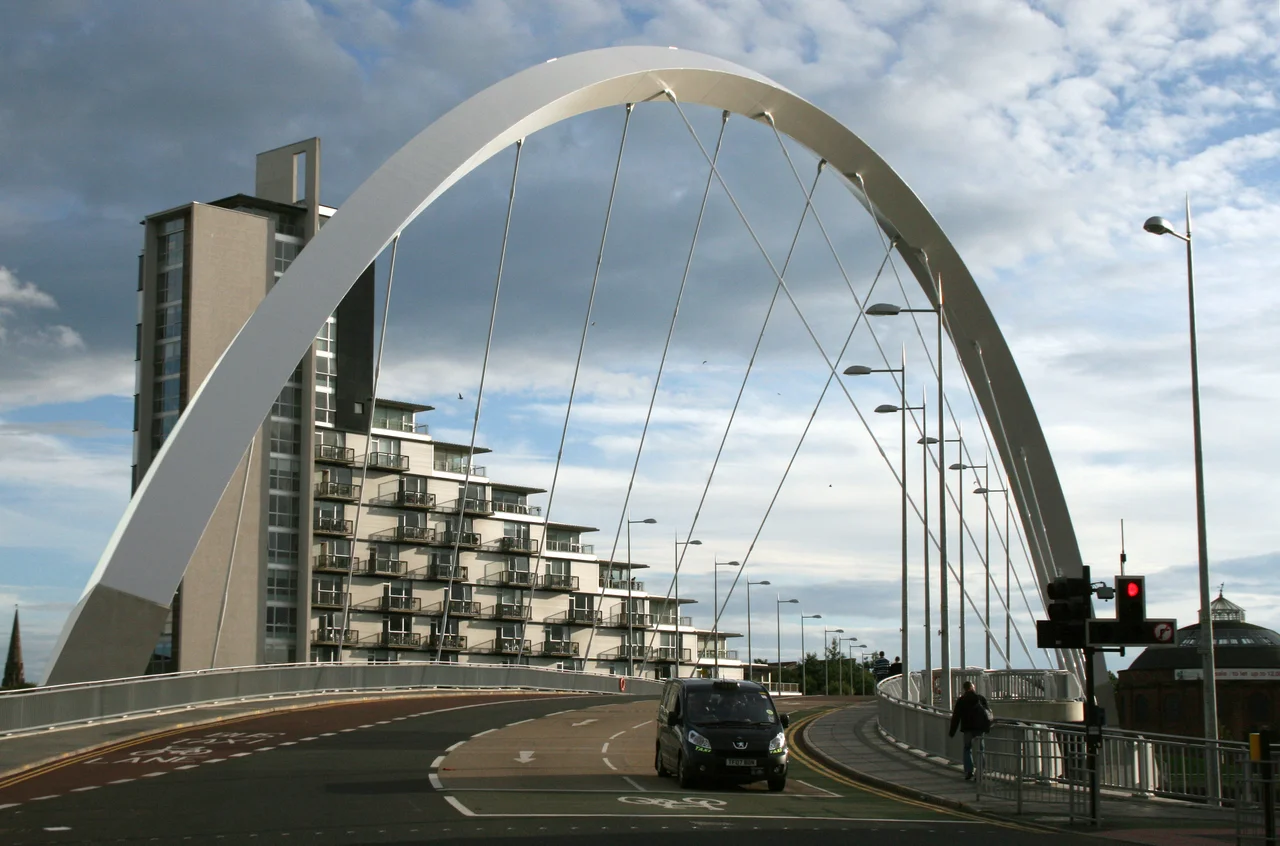

Clyde Arc
Walk onto the Clyde Arc from the Finnieston side and you can feel the geometry start to tilt under you. The bridge crosses the River Clyde diagonally, not square to the banks, and the steel arch overhead leans inward across the deck. Glaswegians took one look at this in 2006 and named it the Squinty Bridge, before the official opening could happen. The official name, Clyde Arc, was given at the 18 September 2006 ceremony. Nobody calls it that. The Squinty has become a small piece of vernacular truth about a city that has always been suspicious of pretension.
The First New City Bridge in Thirty-Six Years
Until the Clyde Arc opened, the most recent city-centre traffic crossing of the Clyde had been the Kingston Bridge, which carried the M8 motorway over the river when it opened in 1970. Thirty-six years later, the Squinty became the second. The bridge was a piece of the broader strategy to reshape both banks of the Clyde, connecting Finnieston near the SEC Armadillo and the SEC Centre on the north side to Pacific Quay and the Glasgow Science Centre on the south side in Govan. The Glasgow City Council instigated the project with Scottish Enterprise and the Scottish Government; Halcrow Group did the design, BAM Nuttall did the building. Planning permission was granted in 2003, construction began in May 2005, structural completion arrived in April 2006, and the deck opened to traffic five months after that. Total cost: about 20.3 million pounds. Designed life: 120 years.
Engineering on the Diagonal
The main span is 96 metres of steel arch, with two 36.5-metre end spans bringing the total to 169 metres. Piling work was carried out from a floating barge anchored on the Clyde, while the bridge superstructure was fabricated off-site and floated into place. The supports for the main span sit in the river itself, with the abutments tucked behind the existing quay walls so the new bridge could weave between old shipping infrastructure. The deck carries four lanes, two dedicated to public transport and two for private and commercial traffic, plus pedestrian and cycle paths. The design left room for a future light rail or tram system, the kind of long-horizon planning Glasgow seldom gets credit for. The central navigation height at mean water is 5.4 metres, generous enough for river craft. The angled crossing, the design feature that gives the bridge its character, was driven by the geometry of the existing roads on either bank, not by aesthetics. As often happens in good engineering, the practical answer turned out to be the beautiful one too.
The Night the Hanger Snapped
On the night of 14 January 2008, the Squinty went quiet very suddenly. The connecting fork on one of the bridge's fourteen hangers, the cables that transfer the deck's weight up to the arch, broke. Strathclyde Police closed the bridge to traffic before any vehicle was on it during a failure. A detailed inspection on 24 January found a stress fracture in a second support cable stay, identical in pattern to the one that had already failed. Engineers concluded that all the connectors would have to be replaced. The bridge stayed shut for nearly six months. River traffic below it was halted too. In March 2008 the contractor began installing five temporary saddle frames atop the bridge's arch, so the deck's weight could be borne while each hanger's fork connectors at top and bottom were replaced. Behind the closure was a commercial dispute: subcontractor Watson Steel Structures sued Macalloy, the supplier of the failed connectors, for 1.8 million pounds, alleging the parts did not meet British Standards or specifications. Macalloy denied the claim. The bridge reopened on 28 June 2008. Glasgow City Council estimated 6,500 daily crossings going forward.
Squinty Pride
There is a particular Glasgow knack for nicknaming a piece of civic kit so that the official name never quite catches on. Edinburgh has the Athens of the North; Glasgow has the Squinty Bridge, and is happier. The bridge sits in a section of the Clyde that has changed beyond recognition in twenty-five years. To the north, the SEC Armadillo, designed by Foster and Partners and opened in 1997, built to evoke an upside-down ship; later joined by the Hydro arena. To the south, the Glasgow Science Centre on Pacific Quay, the BBC Scotland headquarters, and the regenerated Govan Graving Docks. The Squinty knits this new riverfront together, in four lanes and a steel arch. Stand on it at night, with the floodlit Armadillo on one side and the Science Centre tower on the other, and you can see the city in its current self-image: leaner, more visual, still working out what to do with the river that built it.
From the Air
The Clyde Arc spans the River Clyde at approximately 55.8572 N, 4.2825 W, just west of central Glasgow. The bridge is easily picked out from the air by its single steel arch leaning over the deck and by its diagonal crossing relative to the river. Glasgow International (EGPF) lies 5 nm to the west; Glasgow Prestwick (EGPK) 28 nm to the south-southwest. From 1,500 to 2,500 feet AGL on a westerly heading along the Clyde, the bridge sits between the SEC Armadillo on the north bank and the cylindrical glass Glasgow Science Centre tower on the south bank, making the location unmistakable.
Nearby Stories
- Mauchline 3.6 km away
- Shotts 4.2 km away
- HMS Ulysses (1917) 7.7 km away
- Rothesay Castle 8.8 km away
- Inchcailloch 10 km away
- Strachur 14 km away
- Battle of Dollar 16 km away
- Crawford Castle 16 km away