.jpg)
Clyde Tunnel
A car at the 30 mile per hour limit takes about fifty-seven seconds to cross the river underground. Generations of Glasgow children have taken that fact as a challenge, holding their breath from one portal to the other, ducking under their seatbelts, willing the lights to stay green. The breath-holding game was the subject of artist Roderick Buchanan's video Gobstopper, which won the Beck's Futures art prize in 2000. Beneath the river, away from the children, the Clyde Tunnel quietly carries 65,000 vehicles a day, more than five times what its planners imagined. That is the polite history. The harder history is that two miners died building it.
Why a Tunnel and Not a Bridge
After the Second World War, Glasgow needed to move traffic more freely across the Clyde, but downstream from Jamaica Street the river was still busy with shipping. A bridge would have meant either a high clearance or a movable span; both were considered impractical for an active port. Tunnelling under the Clyde was not a new idea. The Glasgow Harbour Tunnel, with its rotunda buildings at each end, had carried foot and cart traffic between Finnieston and Mavisbank Quay since the 1890s. The new project was bigger, designed for the car era, and got the go-ahead from the Westminster government in 1948. Finances stalled it for nearly a decade. Construction did not begin until 1957. By the time the tunnel was complete, in 1963 and 1964, the engineering landscape around the lower Clyde had shifted again. Port facilities had moved downstream to deeper water, and bridges, the Kingston in 1970 and the much further downstream Erskine, became possible options for later crossings.
Sixteen Men in Compressed Air
The two tunnels were dug with tunnelling shields based on Marc Isambard Brunel's nineteenth-century design for the Thames Tunnel. Brunel's shield had been one of the great engineering innovations of the Victorian era, allowing miners to dig safely through soft ground. The Clyde geology was awkward: hard rock under a soft silt layer beneath the river. Sixteen miners at a time worked the shield in shifts, in a compressed-air environment to keep the rock and silt above from collapsing into the workings. Decompression was the problem. The procedures for safely returning workers to normal pressure after a shift were not yet well understood, and the decompression cycle took about an hour. Some workers refused to do the full sequence. Cases of decompression sickness were diagnosed. Two men died from it. There was also a frightening accident when compressed air escaped through the tunnel lining and burst upward through the river as a fountain, halting work for a time. Those two miners are not commemorated by a marker visible from the road. They deserve to be remembered here. They were Glasgow men who went under the river and did not come back.
An Underwater Road in the Boom Years
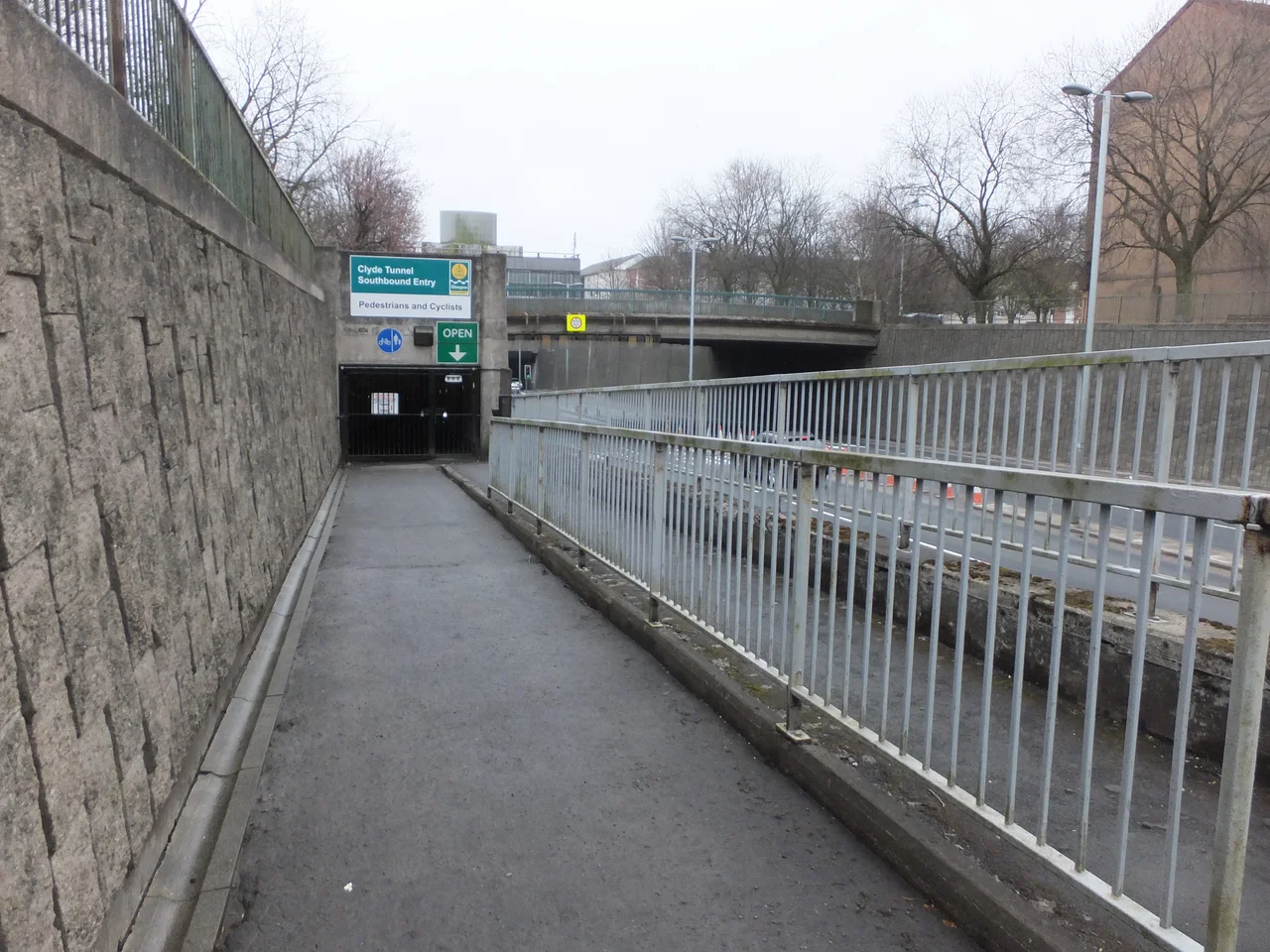
Queen Elizabeth II opened the first tube, for northbound traffic, on 3 July 1963. The southbound tube followed in March 1964. The two parallel tunnels are each 762 metres long, descending at gradients approaching six percent, with two lanes apiece carrying the A739 road between Whiteinch on the north bank and Govan on the south. The river above is 123 metres wide. Beneath each road deck runs a pedestrian and cycle tunnel, and below that the services. Portal towers at each end hold the control systems, monitored now by CCTV. In 2008 secure entry systems were installed at the pedestrian portals to reduce crime and antisocial behaviour. The estimate for daily traffic during construction was 9,000 to 13,000 vehicles. On opening day 22,000 vehicles used the tunnel. The current figure is around 65,000. The unanticipated load wore the tunnel faster than expected and contributed to the chronic congestion problems on the Kingston Bridge upstream.
Hold Your Breath
Repair work that began in March 2005 took until 2010 to complete, installing a modern fireproof layer to bring the tunnel up to European standards adopted after the Mont Blanc Tunnel fire in 1999. New air-extraction systems and new lighting went in at the same time. The total cost of these repairs was roughly the same as the original construction cost of 10 million pounds in 1963. During the works, an art project called Hold Your Breath was installed to give travelers something to look at as they passed through. The graffiti accumulated over decades in the pedestrian tunnels was removed at the same time, although it tended to return as fast as it was scrubbed. The breath-holding game survives all of this. It is, in a way, the tunnel's truest folk practice: a small private dare, undertaken by children and adults, in a piece of mid-twentieth-century engineering that was paid for partly in lives. The least we owe is to think of those two miners for a second, somewhere down there in the dark, before the lights come back on.
From the Air
The Clyde Tunnel runs beneath the River Clyde at approximately 55.8687 N, 4.33115 W, connecting Whiteinch on the north bank to Govan on the south. From the air the tunnel is invisible, but the matching portal towers at each end and the curving approach roads of the A739 mark the position cleanly. Glasgow International (EGPF) lies 3 nm to the west; Glasgow Prestwick (EGPK) 26 nm to the south-southwest. From 1,500 to 2,500 feet AGL the river curves broadly here, with Glasgow Harbour and the SEC complex a short distance upstream and the BAE Systems shipyards at Govan immediately south.
Nearby Stories
- Mauchline 3.6 km away
- Shotts 4.2 km away
- HMS Ulysses (1917) 7.7 km away
- Rothesay Castle 8.8 km away
- Inchcailloch 10 km away
- Strachur 14 km away
- Battle of Dollar 16 km away
- Crawford Castle 16 km away