
Cobra Mist
Eighteen wire strings, each two thousand and forty feet long, fanned out from a hub near the eastern shore of Orford Ness like the spokes of an enormous wheel. They were held up by masts that climbed from forty-two feet at the inner edge to a hundred and ninety-five feet at the rim. Beneath them a wire mesh sheet covered the ground as a reflector. This was the antenna of AN/FPS-95, codenamed Cobra Mist, an Anglo-American over-the-horizon backscatter radar built at the edge of the North Sea in the late 1960s to see deep into the Soviet Union. It came on in 1971, was declared operational in January 1973, and was switched off later that same year. Nobody ever fully explained why.
Why Turkey Said No
The radar was supposed to be in Turkey. Backscatter radar bounces a high-frequency signal off the ionosphere to look over the curve of the earth, and from Turkish soil the Americans could have watched almost all of European Soviet airspace, including the rocket ranges in the Caucasus. The technology had been proven by the Naval Research Laboratory's experimental MADRE installation on the Chesapeake Bay, which could detect aircraft two thousand nautical miles away and had even picked up rocket launches at Cape Canaveral and atomic tests in Nevada. The US Air Force placed tenders for the operational system in 1964. In 1965 the bids came in. Then Turkey refused to host the installation, and the project went looking for a new home. The British offered a piece of Suffolk shingle.
Building on the Ness
Orford Ness is one of the strangest landscapes in Britain. A long shingle spit running parallel to the Suffolk coast, it had hosted Ministry of Defence weapons research since the First World War, including early radar trials in the 1930s and atomic weapons environmental testing in the 1950s. Cobra Mist fit the local tradition perfectly. From this hard-to-reach, sparsely populated coastal strip, the radar could see most of Eastern Europe and the western Soviet Union, including the Northern Fleet missile test centre at Plesetsk. RCA built the system. Construction wrapped up on 10 July 1971. Testing began a week later. By February 1972 RCA handed the system over to the United States Air Force. The plan was for operational status that summer.
The Noise That Killed It
When operators turned the radar on, it returned signals that did not make sense. The displays were flooded with noise that the system could not filter out. Over-the-horizon backscatter radar relies on Doppler processing to extract targets from a vast quantity of ground and sea clutter, and Cobra Mist's filtering chain was supposed to gate out the unwanted returns and isolate aircraft, ships, and missiles by their characteristic speeds. Instead, something kept producing returns that overwhelmed the system. The cause has never been publicly identified. Theories included unusual local ionospheric conditions, interference from other radio sources, design flaws in the receivers, and even Soviet jamming, though no conclusive explanation was ever published. The operational date slipped from July 1972 to January 1973, the design verification and initial operational test phases were combined, and within months the system was shut down.
A Radio Station, Then Radio Caroline
The towers and buildings did not come down. From September 1982 the site became the Orfordness transmitting station, used by the UK Foreign Office and the BBC World Service to broadcast shortwave and medium-wave services to Europe. The BBC pulled out in 2011 and the transmitters were briefly used by the Dutch government when their own national transmitters failed. In August 2015 the site was acquired by Cobra Mist Limited, a privately owned company. In May 2017 the offshore pirate radio station Radio Caroline, which had once broadcast illegally from ships anchored in the North Sea before being legalised, was given a licence to use the 648 kHz frequency previously used by the BBC, and now transmits legally from the same antennas. A Cold War surveillance radar became a pop music station.
What Remains
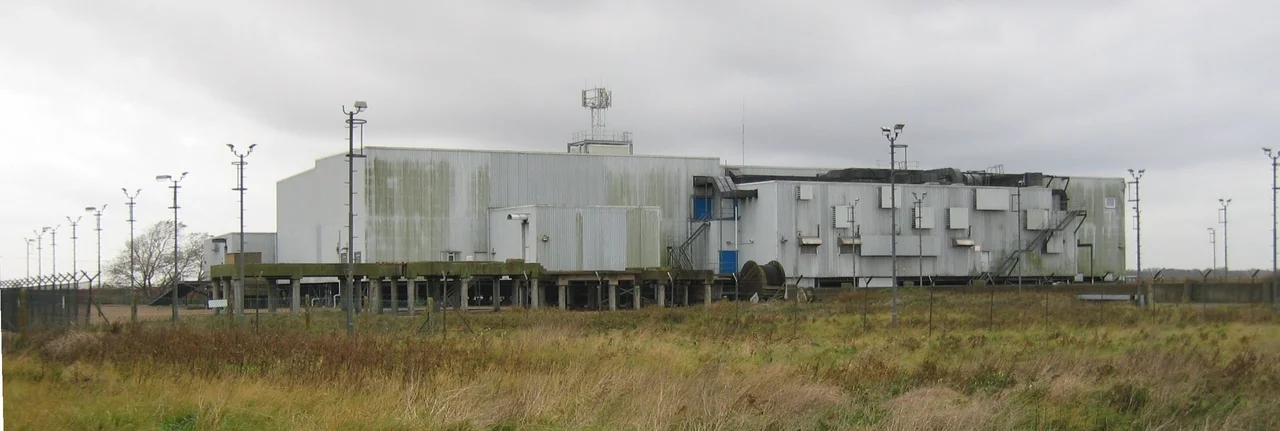
The National Trust took on most of Orford Ness in 1993 and now manages the shingle as a nature reserve, opened to the public for limited visits each year. The buildings of Cobra Mist, including the huge operations block beside the strange concrete pagodas of the earlier atomic weapons research site, sit out on the shingle as a kind of accidental museum of the Cold War. The antenna strings are gone, but the geometry of the eighteen radials can still be traced on the ground. The system was the 95th design of a Fixed Radar Search under the American Joint Electronics Type Designation System, and it was meant to watch missile launches at Plesetsk. What it watches today, mostly, is the wind blowing in across the North Sea, occasionally carrying old Radio Caroline broadcasts from the antennas that survived it.
From the Air
Cobra Mist sits at 52.10N, 1.58E on Orford Ness, a long shingle spit on the Suffolk coast. From altitude the Ness is unmistakable: a curving strip of shingle running south from Aldeburgh, separating the River Alde from the North Sea for some nine miles. The Cobra Mist site shows as a distinct rectangle of buildings and traces of the radial antenna geometry on the eastern shore of the Ness. Norwich Airport (EGSH) is about 50 miles north; London Stansted (EGSS) is about 55 miles south-west. Look also for the lighthouse near the southern tip of the Ness, decommissioned in 2013.
Nearby Stories
- Beccles 7.6 km away
- The Food Museum 8.6 km away
- Old Buckenham Airfield 13 km away
- White House Farm murders 20 km away
- Walton-on-the-Naze 22 km away
- Four Days' Battle 22 km away
- Southern Bight 51 km away
- Battle of Lowestoft 56 km away