_(1995).jpg)
Coen Carrier Station
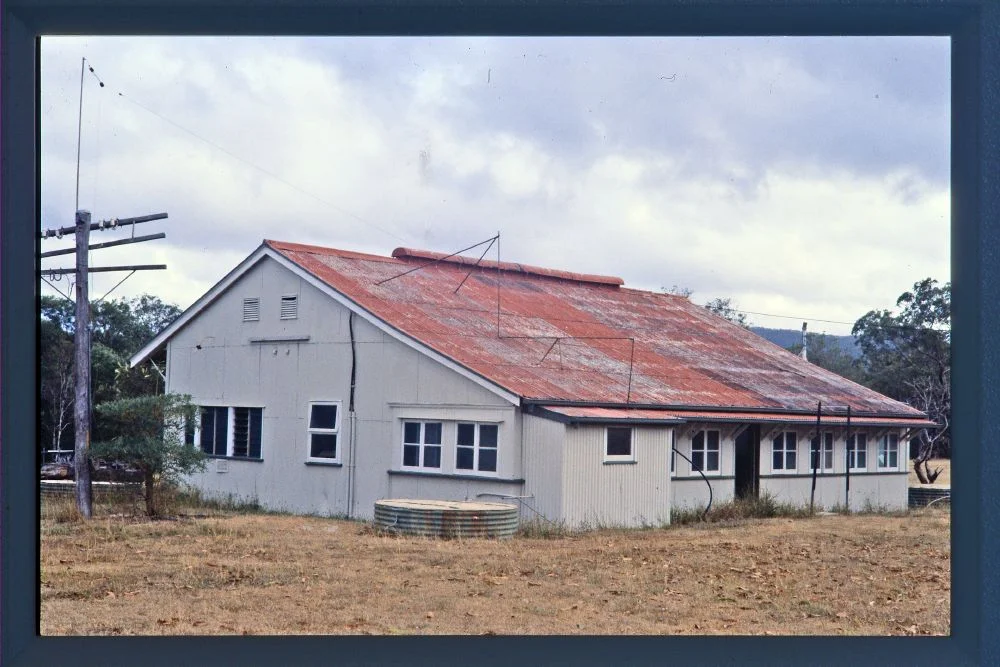
In the last weeks of 1942, with the war in the Pacific turning on the campaigns at Coral Sea and Midway, a small prefabricated building of steel frame and ripple iron was bolted together at the edge of Coen, a speck of a town in the middle of Cape York Peninsula. It was finished, fittingly for such an improvised effort, on Boxing Day - after the rest of the line had already gone live. The Coen Carrier Station looks like nothing: a rectangular shed with a verandah, sitting where the Coen River meets Lankelly Creek. But it was a vital node in the nervous system of a continent at war, and of the four built across the peninsula, it is the one that still stands most intact.
The Wire Up the Cape
Coen had been wired to the world long before the war. When the overland telegraph line was strung from Laura up to Thursday Island in the 1880s, opening to traffic on 25 August 1887, a telegraph station went up at Coen in 1886. That thin copper thread did extraordinary work for an isolated goldfield: it linked the scattered communities of the peninsula to each other and, via Cooktown, to the southern capitals. It was also an instrument of control and defence, carrying Brisbane's administration north and connecting the colony to British New Guinea and the Torres Strait. For more than half a century, the line up the Cape was the difference between isolation and connection - the slender nerve running the length of the peninsula.
A War Comes North
By the late 1930s the old line was hopelessly inadequate for what was coming. As war with Japan loomed, two things mattered most on Cape York: airfields and communications. Yet as late as 1941 the Coen station had only Morse and a six-line switchboard. Then the war arrived in earnest. The Japanese bombed Darwin and Townsville in 1942; American troops poured into north Queensland; and the peninsula, suddenly, became a frontline corridor linking the airfields of the far north to the fighting in New Guinea and the command centres in Townsville and Brisbane. Adequate telecommunications were no longer a convenience. They were a weapon, and the creaking line up the Cape had to be rebuilt at speed.
Built by an Army
The upgrade was an extraordinary feat of improvisation. Because carrier equipment could not be imported during the war, the Postmaster-General's own workshops in Melbourne designed and built a prototype four-channel system - the R Type - that let a single pair of copper wires carry voice, telegraph, and a telephone carrier all at once, over more than a thousand miles from Townsville to the tip. The labour was massive: around 1,200 men of the US Army Signal Corps, 600 from the Australian Army Signals, and 60 PMG supervisors. They began in August 1942 and drove the whole line through by 23 November. At Coen, a carrier station of prefabricated steel and corrugated iron was raised beside the old 1886 telegraph office and wired to it, staffed by a PMG officer and two army signallers living in its few small rooms. The improved network across the peninsula went on to play a real part in the war against Japan.
What the Iron Remembers
After the war the circuits opened to the public, and for the first time people on Cape York could place a trunk call to the rest of Australia. The technology marched on. Broadband radio reached Coen in 1982, and the old open-wire line was finally abandoned north of the town in 1987. The 1886 telegraph station that the carrier station once served has vanished entirely - moved to a cattle property, reused as a house, and eventually destroyed. But the carrier station endured. Of the four built in 1942 at Mount Surprise, Fairview, Coen, and Cape York, it is the most complete survivor, listed on the Queensland Heritage Register in 1997 and now sitting within a national-park ranger base. Its equipment rooms are empty, the wires long dead. Yet at the gable ends the old fixtures for the telegraph lines are still bolted in place - small iron memories of the day this shed carried the voice of a war.
From the Air
The Coen Carrier Station stands on the north side of Coen at 13.94°S, 143.20°E, on a gently sloping site where the Coen River meets Lankelly Creek, near the geographic centre of Cape York Peninsula. From the air, find the town of Coen on the Peninsula Developmental Road, with the rainforested McIlwraith Range rising to the east; the heritage site sits just north of town within a ranger base. Coen Airport (ICAO: YCOE, IATA: CUQ) lies about 22 km northwest. The building itself is too small to spot from cruising altitude - this is a low-and-slow target, best appreciated below 2,000 ft AGL. Fly the area in the dry season (May-October) for stable air; the wet (December-March) brings monsoon downpours and can flood the river flats.
Nearby Stories
- Princess Charlotte Bay 30 km away
- Musgrave Telegraph Station 65 km away
- Bathurst Bay 70 km away
- Wenlock Goldfield 77 km away
- Shire of Aurukun 116 km away
- Archer River 129 km away
- Aboriginal Shire of Pormpuraaw 141 km away
- Raine Island 237 km away