
Collinsville Mine Disaster
For weeks the floor of the mine had been trying to tell them something. Near the coal face, in the wet, low part of the workings they called the dip, water bubbled up through the ground, and in the days before 13 October 1954 the bubbling grew into what miners described as fountains. Drill holes spat their dust straight back out. Men found themselves short of breath and said nothing, because being short of breath underground was the ordinary price of the job. They were approaching a fault, and they knew it. What none of them could see was the thing the fault was holding back: a pocket of carbon dioxide, compressed for ages inside the crushed coal, waiting.
The Outburst
It came in the early evening, around 5:50, in the deepest part of the Collinsville State Coal Mine, roughly a kilometre and a half from the mouth of the No. 1 tunnel. The fault gave way and flung out some 900 tonnes of coal and stone, and with it a flood of gas that was later found to be almost pure carbon dioxide, about 98 per cent. Carbon dioxide is not an explosive gas; it does not burn or flash. It simply takes the place of the air. It rolled silently through the workings and pushed out the oxygen, and the men in its path could not breathe. Seven of them died. Two others, Robert Munro and J. A. Baker, were overcome and dragged out alive, and taken to hospital to recover.
Seven Men
They are worth naming, because they were not a statistic but a shift, neighbours and workmates from a small town who went underground that day and did not come home. Alex Parkinson. Peter Miller. Henry Petersen. Frederick Ernest Walker. James Reid Logan. Arthur Shrubsole. Herbert Ruff. They were Collinsville men with families in the streets above the mine, in a town small enough that everyone would have known at least one of them, and probably all seven. When they were buried, the funeral drew union officials from across Queensland and beyond: the Miners' Federation president Idris Williams, Queensland officers, the Waterside Workers' Federation, and representatives of unions that had no direct stake here except the oldest one of all, that a worker's death is every worker's grief.
The Warnings and the Dispute
The disaster did not fall from a clear sky. For three years the miners and the State Government had been at odds over how the pit was run. In 1951 the government appointed Athol Lightfoot to manage the State Coal Mines, and Lightfoot pushed to mechanise Tunnel No. 1, the very tunnel that worried the men most, with its steep grades and its constant seep of carbon dioxide. The union argued that if any tunnel were to be mechanised it should be the safer No. 2, and asked that an experienced check inspector, Jack Barrett, be allowed to examine the mine. The government refused. The work went ahead in No. 1 regardless. In the month before the outburst, Lightfoot resigned. It should be said plainly: the official inquiry found the mechanisation itself was not the cause of the disaster. But the long argument over who decided what, and whose warnings counted, hung over everything that followed.
The Royal Commission
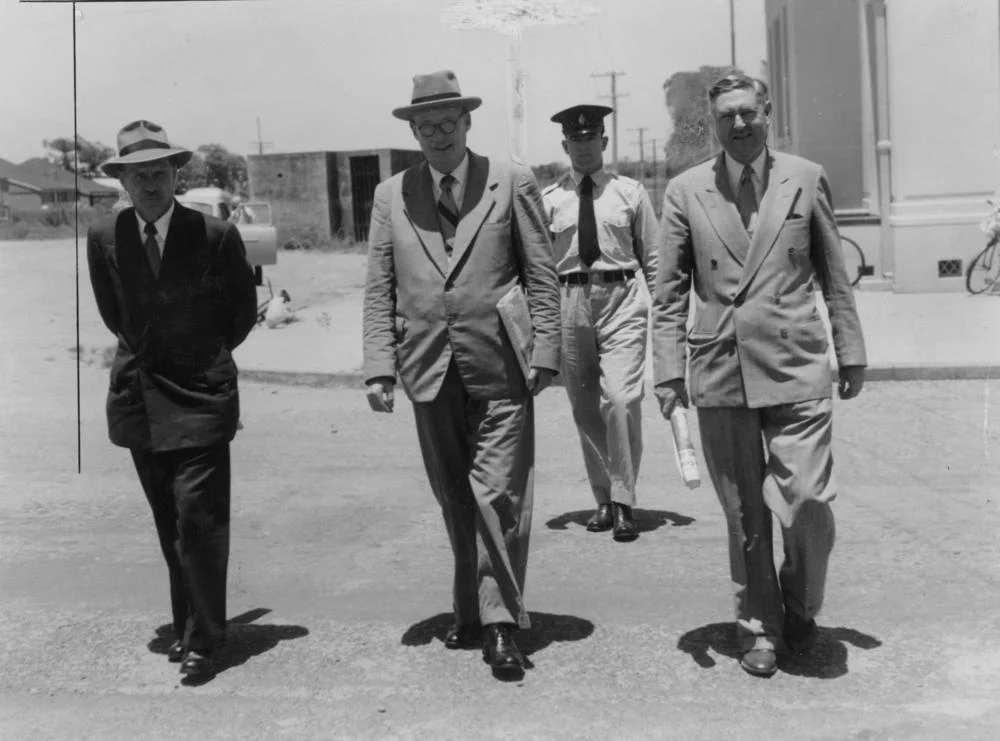
When the union asked that one of its own sit on the board of inquiry, that request too was refused. The Royal Commission into the disaster was established on 2 December 1954 under Judge Sheehy, with Walter Scott and Septimus Flowers and the Solicitor-General assisting. It was a serious and lengthy effort to understand what had happened, sitting for thirteen days in Bowen and sixty-six more in Brisbane through 1954 and into 1955. It confirmed the brutal simplicity of the event: a gas outburst, carbon dioxide of extraordinary purity, releasing hundreds of tonnes of coal and stone and stealing the air from the men working below. The geology of the fault, with its grinding intrusion of rock decomposing the coal into compressed gas, was the kind of hazard that nineteenth and twentieth century coal mining understood only after it had killed.
Remembered Each October
Collinsville did not let the seven men slip into the general blur of history. Every year on 13 October the people of Collinsville and neighbouring Scottville hold a memorial service for them. In a coal town, that date is not abstract. It belongs to the same web of memory as the pit ponies the town fought to protect and the union banners carried through its streets, all of it bound up in the understanding that the coal which built Collinsville was never given freely. It was taken from the ground at a cost, and in October 1954 that cost was seven lives. The mine kept working for decades afterward, but the men who go down still carry those names with them, whether they know each one or not.
From the Air
The Collinsville mine and the town it served lie at 20.57 degrees south, 147.75 degrees east, in the Bowen Basin coalfields of North Queensland, inland from the town of Bowen and the Whitsunday coast. From the air the area reads as dry, hilly cattle and mining country, with the dark scars and infrastructure of open-cut and underground coal workings around the town grid; the 1954 disaster occurred deep underground, so the site itself is unremarkable from above, but the surrounding mine landscape is distinctive. The nearest airfields are Bowen (ICAO YBWN) on the coast to the northeast and Proserpine / Whitsunday Coast (YBPN) to the east-southeast; Townsville (YBTL) lies farther north. Best viewed at 2,500 to 5,000 feet AGL in the dry season's clear inland air.
Nearby Stories
- Proserpine 25 km away
- Eungella National Park 34 km away
- Ravenswood School of Arts 45 km away
- Bowen 47 km away
- Hayman Island 58 km away
- Imperial Hotel, Ravenswood 60 km away
- Cape Hillsborough National Park 122 km away
- Lake Dunn 267 km away