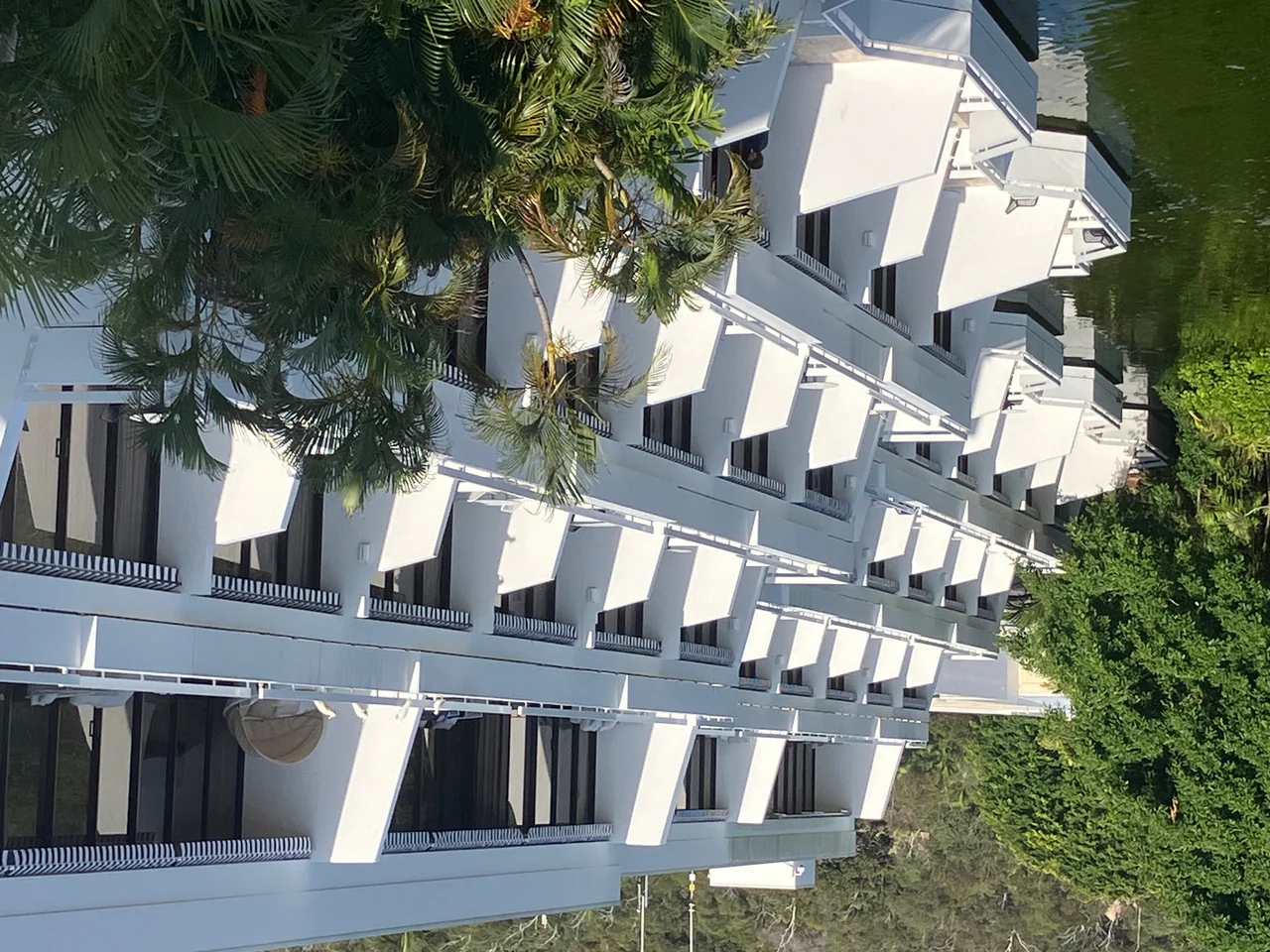

Hayman Island
Guests used to arrive by flying boat. In the 1950s a Catalina or a Sandringham would drop out of the tropical sky, settle onto the Coral Sea off Hayman Island, and taxi toward a small motor launch that ferried the passengers the last stretch to shore. There was no other way in worth the trouble. Hayman is the most northerly of the Whitsundays, just 294 hectares of granite and forest tucked north-west of Hook Island, close enough to the Great Barrier Reef that the best coral lies a short boat ride away. That combination of remoteness and reef has shaped the island's entire modern life: a private place that the world's well-connected go to considerable expense to reach.
Older Than the Resort by Nine Millennia
Long before the flying boats, this was Ngaro sea country. The Ngaro people moved through the Whitsundays for at least nine thousand years, among the earliest continuously recorded Aboriginal groups in Australia, navigating the channels in bark canoes and harvesting the reef. The luxury that defines Hayman now is a thin and recent layer over that deep history. The island's English name arrived in 1866, when the hydrographer Commander George Nares charted these waters aboard HMS Salamander and named the island for Thomas Hayman, the ship's master. The wildlife and the nearby reef made it an early magnet for naturalists and anglers, a place valued first for what lived in its waters rather than what could be built on its shore.
The Novelist and the First Palm
In 1935 two local fishermen, Bob and Bert Hallam, founded the Great Barrier Reef Game Fish Angling Club, and the big-game crowd began arriving by coastal steamer. Among them came Zane Grey, the American novelist whose Westerns had made him rich and whose obsession with giant fish carried him across the Pacific. Grey planted the first coconut palm on Hayman, and in 1936 the island stood in as a tropical backdrop for his film White Death. It was an unlikely overture for what came next. The angling club drew attention to the island's possibilities, and within a decade the fishing camp gave way to ambitions of a different scale entirely.
A Hotel Fit for a Queen
In 1947 Ansett Transport Industries bought the island, and work began on the Royal Hayman Hotel. It opened in 1950, christened by Deputy Prime Minister Arthur Fadden in anticipation of a royal visit, with a royal charter to match the name. For decades it traded on that pedigree. A two-year, three-hundred-million-dollar transformation began in 1985, and in 1987 Hayman joined The Leading Hotels of the World. Cyclones forced repeated reinvention: after Tropical Cyclone Anthony and Cyclone Yasi battered the coast in 2011, the resort closed for five months of repair. A further repositioning, reported at around 135 million dollars, relaunched it in 2019 as the InterContinental Hayman Great Barrier Reef. The whole island is private; without prior arrangement, you cannot even dock.
A Schoolhouse and a Guest List
For all its exclusivity, Hayman runs an ordinary necessity: a government primary school, opened in 1956, for the children of the workers and guests who live on the island. Enrolment is tiny, sometimes only a handful of students, and turnover is high as families rotate through resort jobs. Children arrive from overseas with varying English, learn together for a season, and move on. The guest register, by contrast, reads like a celebrity index, with names from Bill Gates and Nicole Kidman to Rod Stewart and Slash. In 1995 the British Labour leader Tony Blair flew here to address Rupert Murdoch and the leaders of News Corporation, a meeting that helped shape Murdoch's eventual backing at the 1997 election. Even island politics, it seems, happen offshore.
From the Air
Hayman Island sits at roughly 20.05 degrees south, 148.88 degrees east, the most northerly of the Whitsunday group, north-west of the larger Hook Island. From the air it reads as a compact, hilly green island with a sheltered resort bay on its southern side and excellent fringing reef off its north-west shore. There is no public airstrip on Hayman itself; guests arrive by private yacht, helicopter, or Air Whitsunday seaplane. The nearest airports are Great Barrier Reef Airport on Hamilton Island (ICAO YBHM), about 30 km south, and Whitsunday Coast Airport at Proserpine (YBPN) on the mainland. Expect tropical haze in the December-to-March wet season; the dry winter brings the clearest light. The surrounding reefs and shallow channels demand caution at low tide.
Nearby Stories
- Lindeman Island 17 km away
- Bowen 18 km away
- Collinsville, Queensland 56 km away
- SS Gothenburg 64 km away
- Great Barrier Reef 74 km away
- Pine Islet Light 164 km away
- Coral Sea Islands 178 km away
- Canal Creek Air Crash 336 km away