
SS Gothenburg
She was meant to be one of the safe ones. The Gothenburg had a reputation for reliability across two decades and three oceans, a well-built iron steamer with a captain known for sobriety and care. None of it mattered on the night of 24 February 1875, when she drove onto the Great Barrier Reef at full speed in a rising cyclone. By morning around a hundred people were dead, among them the wives and children, the judges and premiers, the clerks and miners aboard, and one of colonial Australia's worst maritime disasters had written itself into the reef off North Queensland.
A Well-Travelled Ship
The Gothenburg began far from the tropics. Built of iron at Millwall on the Thames and launched in 1854, she ran between England and Sweden before sailing out to Australia in 1862. There she worked the Tasman crossing to New Zealand, then the Australian coastal trade, rigged as a barquentine with a single funnel set well aft, driven by a modest two-cylinder engine. She was considered one of the more modern vessels in Australian waters, dependable enough that people chose her gladly. In November 1874 her owners took a government contract: ten round trips between Adelaide and the colony's far outpost at Port Darwin, a thousand-pound payment riding on each completed run.
South from Darwin
She left Port Darwin in mid-February 1875, her captain, Robert Pearce, under orders to make best possible speed. The cargo was heavy with consequence: roughly three thousand ounces of gold bound for an Adelaide bank, and a passenger list that read like a register of the young Northern Territory's officialdom, returning home from the frontier. Pearce took the inner route, the sheltered passage between the Queensland coast and the reef, calmer than the open sea but threaded with reefs only half charted. As the ship pressed south the weather worsened. Wind and rain rose, cloud blotted out the sun, and a cyclone closed around her in waters where a captain needed to see.
The Night on the Reef
She struck Old Reef and stuck fast. Pearce tried everything: lightening the bow, shifting ballast and passengers aft, dumping cargo, finally reversing the engine hard to wrench her off. She came half free, then holed herself badly and slewed broadside to the waves, worse off than before. Around midnight the rising sea drowned the boiler fires, the engine died, and water poured down the hatchways. The end came fast and merciless. Lifeboats capsized as seas broke over them. A survivor remembered the water on the lee side covered with human heads bobbing like corks. Some passengers carrying their life savings in money belts refused to let the gold go, and went down quickly with it.
The Lost and the Saved
Only twenty-two people lived, twelve crew and ten passengers. All twenty-five women and children aboard drowned, and every ship's officer. The dead included Thomas Reynolds, a former Premier of South Australia, and his wife Anne; the French Vice-Consul Eduard Durand; a circuit court judge and crown solicitor; a newspaper editor; and several Overland Telegraph men. In Darwin a magistrate, Edward Price, learned he had lost his wife and six children in a single stroke. Most of the crew came from Melbourne, leaving eleven widows and thirty-four children destitute in Victoria. Never before had so many of a colony's senior figures died together. The grief reached deep into Adelaide and Darwin alike, and the loss touched ordinary families as surely as eminent ones.
What the Reef Keeps
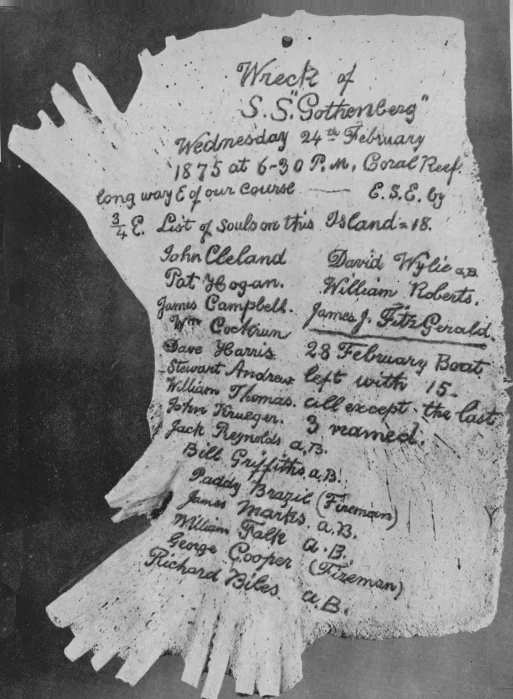
The survivors who reached Holbourne Island killed a turtle to eat, and decades later one of them inscribed the names of the saved on its shell, a quiet act of remembrance now held in the South Australian Museum. Streets across the Darwin suburbs of Millner and Coconut Grove carry the names of the drowned, so that a northern city still murmurs the dead of 1875. Only after the Titanic sank, thirty-seven years on, were British ships finally required to carry lifeboats enough for everyone aboard. The Gothenburg herself lies on Old Reef, southeast of Townsville, her iron hull and square boilers going slowly to coral, a protected grave that divers may visit but must not disturb.
From the Air
The wreck of SS Gothenburg lies on the western side of Old Reef on the Great Barrier Reef, at roughly 19.37 degrees south, 148.06 degrees east, about 130 km southeast of Townsville and some 75 km northeast of Ayr, in 9 metres or so of water. There is no land at the site; it is open reef, marked on charts and surrounded by a 200 m protected zone that divers may enter only by permit. The nearest major airfield is Townsville Airport (YBTL / TSV), with Bowen and Ayr closer to the coast. From cruising altitude in clear weather the reef line and its coral gardens stand out against deep blue water; the ship struck in cyclonic conditions, a reminder that this passage turns deadly when the wet-season weather (December to April) closes in.
Nearby Stories
- SS Yongala 14 km away
- Radar Station, Charlie's Hill 20 km away
- Bowen 37 km away
- Hayman Island 44 km away
- Hook Island 80 km away
- Fort Complex, Magnetic Island 83 km away
- Magnetic Island 142 km away
- Coral Sea Islands 230 km away