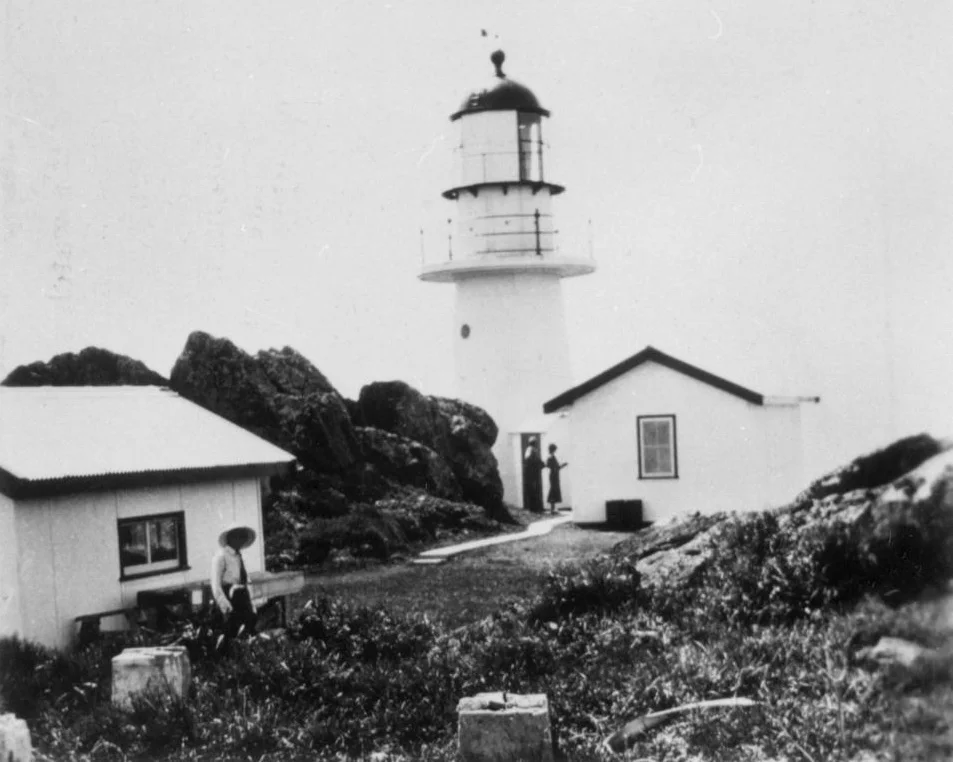

Pine Islet Light
Every other great lighthouse of its age was electrified, automated, or left to rust. Pine Islet Light was not. Its lamp still burns vapourised kerosene, hissing through an incandescent mantle exactly as it did in 1885 - the last fully operational kerosene lighthouse on Earth. To find it, you don't sail 130 kilometres out to the Percy Isles where it spent a century warning ships off the reefs. You walk down to the Mackay marina, where the whole iron tower was carried, piece by piece, and rebuilt by people who could not bear to watch it die.
A Tower Shipped From Britain
In 1885, the contractor W. P. Clark assembled Pine Islet Light from a kit. The internal frame was hardwood; the skin was riveted galvanized iron plate, imported from Britain and prefabricated in Brisbane before being shipped to the islet to be bolted together on site. Clark knew this work - he had already raised Queensland's first colonial lighthouse at Bustard Head in 1868, and others at Low Isles, Cape Cleveland, and Dent Island. The original lamp was a humble oil wick burner, fed on whale or vegetable oil, throwing a beam visible twenty nautical miles out to sea. A red shade marked Normanby Rock, a hazard a mile and a half to the southwest. For sailors threading the Whitsunday passages in the dark, that flash was the difference between safe water and a hull torn open.
The Keeper's Clockwork
Lighthouse keeping was not poetry. It was labour, repeated through every night for a hundred years. In 1923 the light was converted to a Chance Brothers kerosene burner, brighter and more reliable. In 1934 the apparatus was replaced with a clockwork mechanism salvaged from North Reef Light - a system of weights that rotated the great lens. Because the tower stood so tall, the weights fell their full length in just two hours, which meant a keeper had to climb the stairs and rewind the mechanism every two hours, all night, every night. Electricity reached the islet in 1950 and again, upgraded, in 1965. The cottages got power. The light did not. It kept burning kerosene, by then a deliberate act of stubbornness against a world that had moved on.
Refusing the Dark
On 27 August 1985, the authorities switched Pine Islet off and raised a small fibreglass tower in its place. By then it was the last kerosene-powered lighthouse in Australia, and the decision could have been the end. Between October and November 1986 the original light and tower were dismantled and crated. Then a group of locals - the Pine Islet Lighthouse Preservation Society - went to work. After persistent lobbying, the lighthouse and its apparatus were loaned to them in 1989 for reconstruction at Mackay. Volunteers began the rebuild on 18 August 1989. It took six years. In late 1995 the relit lamp once again threw its beam across the water, and Pine Islet became the last operational kerosene light anywhere in the world. It was formally reopened on 20 January 1996.
Two Lights, One Name
There are now two Pine Islet Lights, and they tell opposite stories. Out on the islet, a twenty-foot fibreglass daymark carries a solar-powered VRB-25 beacon, a halogen lamp flashing white every ten seconds, tended by no one and visible to passing ships. The Australian Maritime Safety Authority runs it; the island is closed to the public, reachable only by boat. The other light stands at the Mackay marina, lovingly maintained, its kerosene flame a living museum piece. One is the efficient present. The other is the stubborn, gleaming past - proof that a community can refuse to let history go quietly into the dark.
From the Air
The original Pine Islet site sits at 21.66°S, 150.22°E in the Percy Isles, roughly 130 km southeast of Mackay; today only a low fibreglass daymark with a white flash every ten seconds (range 18 nm) marks the spot. The restored cast-iron lighthouse stands onshore at the Mackay marina (about 21.10°S, 149.22°E). Nearest airport is Mackay (YBMK / MKY), about 6 km from the marina; Hamilton Island (YBHM / HTI) lies to the north. The Percy Isles group is low and scattered - approach in clear daylight, and watch for the surrounding reefs that the light was built to mark.
Nearby Stories
- Sarina, Queensland 57 km away
- Bakers Creek Air Crash 84 km away
- Keswick Island 111 km away
- Canal Creek Air Crash 114 km away
- Great Keppel Island 135 km away
- Brigalow Belt 170 km away
- Cape Capricorn Light 202 km away
- Stirling Castle (1829 brig) 222 km away