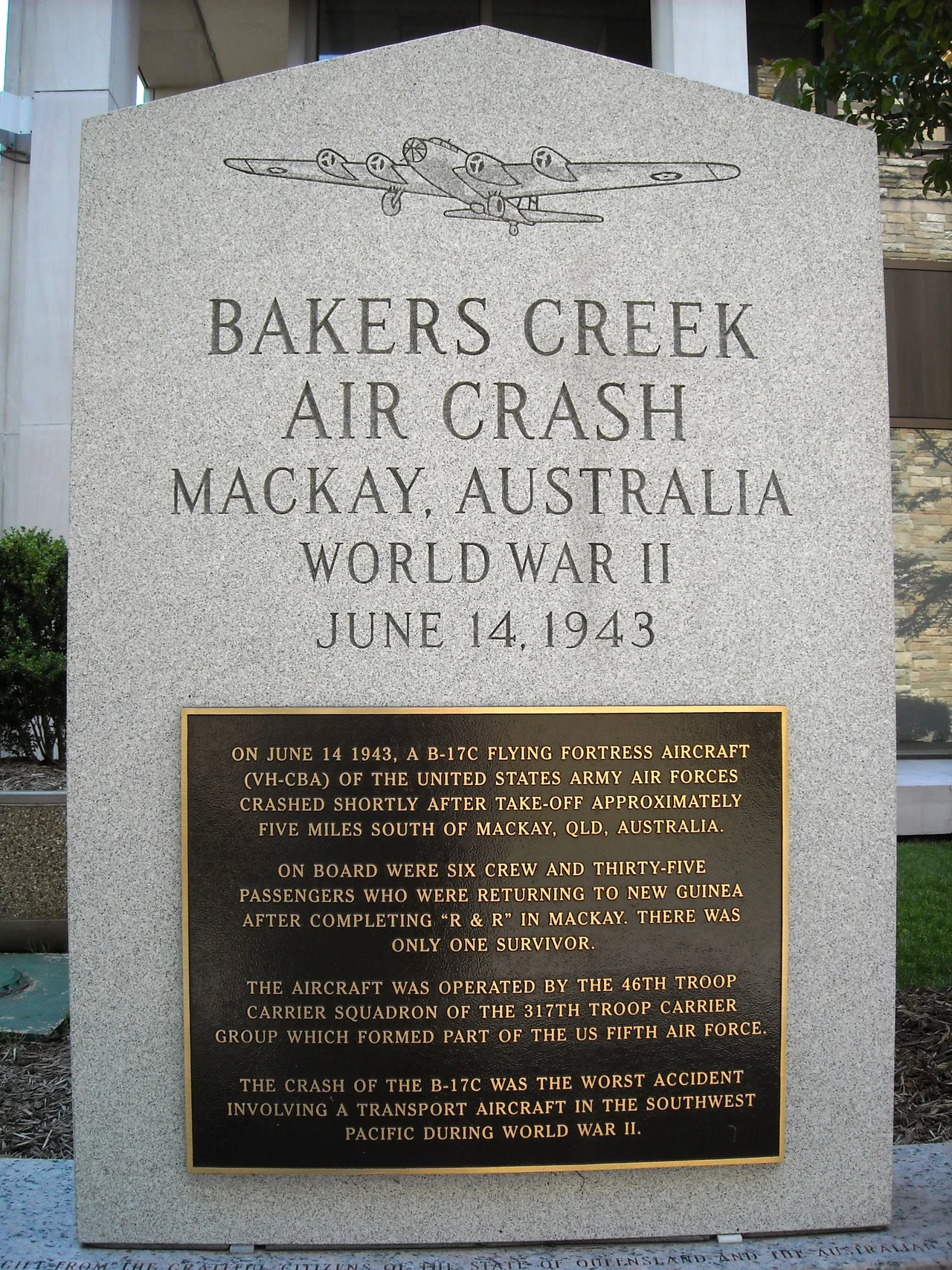

Bakers Creek Air Crash
Forty-one men climbed aboard a worn-out bomber before dawn on 14 June 1943, going home from the war for a little while. They had spent ten days in Mackay on rest leave, a reprieve from the fighting in New Guinea, and now the Flying Fortress was to carry them back across the Coral Sea to Port Moresby. It lifted off into fog at around six in the morning and almost at once banked low over the dark country south of the airfield. Minutes later it went down at Bakers Creek, about eight kilometres from the runway. Forty of the forty-one men were killed. It remains the deadliest aviation disaster in Australian history, and for fifteen years almost no one was allowed to know it had happened.
Miss Every Morning Fixin
The aircraft was a Boeing B-17C, serial number 40-2072, an early Flying Fortress long past its prime as a bomber and pressed into service ferrying men. Its crews had given it a name that was half joke and half complaint: Miss Every Morning Fixin. A former maintenance chief reckoned that for every eight hours the plane flew, it needed at least twelve hours of work to stay airworthy. By 1943 it had been converted to carry passengers, shuttling American personnel between the New Guinea front and the relative safety of Australia. On this flight it held a crew of six and thirty-five passengers, all of them part of the United States Fifth Air Force, the men flown by the 46th Troop Carrier Squadron of the 317th Troop Carrier Group. The cause of the crash was never established, and remains unknown to this day.
Forty Men Going Home
These were not strangers to danger; they had survived combat in the islands to the north. That is part of what makes the loss so hard. They had been pulled out of the fighting and given ten days in a quiet Queensland town, the kind of ordinary peace that war makes precious, and they died on the journey back, in the first grey minutes of a flight that should have been routine. Forty families would eventually receive word, though many would receive almost nothing else. The men are named on plaques at the memorial that now stands near the crash site, each one a person with a home somewhere in America who had been promised, in effect, that the worst was behind him for a while. The fog over Bakers Creek took them within sight of the airfield they had just left.
The Man Who Lived
One man walked away from it. Foye Kenneth Roberts was the sole survivor of the forty-one aboard, pulled living from the wreckage of a disaster that killed everyone else around him. He carried that distinction for the rest of a long life, dying in Wichita Falls, Texas, in February 2004, more than sixty years after the morning the Fortress fell. To survive alone is its own kind of weight, and Roberts bore it through decades in which the crash itself was officially unspeakable. He outlived the silence, lived to see memorials raised to the men he had flown with, and became the single human thread connecting the modern commemorations back to that foggy dawn outside Mackay.
A Secret Kept Too Long
The disaster vanished into wartime censorship almost before the wreckage cooled. No newspaper could report it; only the people of Mackay, who had seen the men in their streets, knew what had occurred, and even they were expected to stay quiet. The wider world learned nothing until after VJ Day in 1945, and the United States military did not formally declassify the crash until 1958. Some families never received an honest account of how their sons and husbands had died, told only that the man had been killed in an air crash in the south-west Pacific. The reckoning came late. A memorial was unveiled at Bakers Creek in 1992, with a propeller and a model Fortress and the forty names; another was dedicated in the United States and now stands near the gate to Arlington National Cemetery. Each June, the men are remembered at last, openly, the way they should have been all along.
From the Air
The crash site lies at roughly 21.22 degrees south, 149.15 degrees east, near Bakers Creek about 8 km south of central Mackay on the central Queensland coast. The aircraft had departed the wartime Mackay airfield, near the site of today's Mackay Airport (ICAO YBMK), bound across the Coral Sea for Port Moresby. From the air the area is low coastal country south of the Mackay urban grid, cut by Bakers Creek and surrounded by cane fields; the memorial stands inland of the coast. This is a place to overfly with respect rather than spectacle. Note the conditions that contributed to the 1943 disaster: pre-dawn fog and poor visibility are realistic hazards on this coast, and the dry winter months generally offer far clearer air than the December-to-March wet season.
Nearby Stories
- Eungella National Park 7.9 km away
- Brampton Island 13 km away
- Pine Islet Light 52 km away
- Brigalow Belt 86 km away
- Proserpine 88 km away
- Canal Creek Air Crash 213 km away
- Coral Sea Islands 235 km away
- Great Keppel Island 262 km away