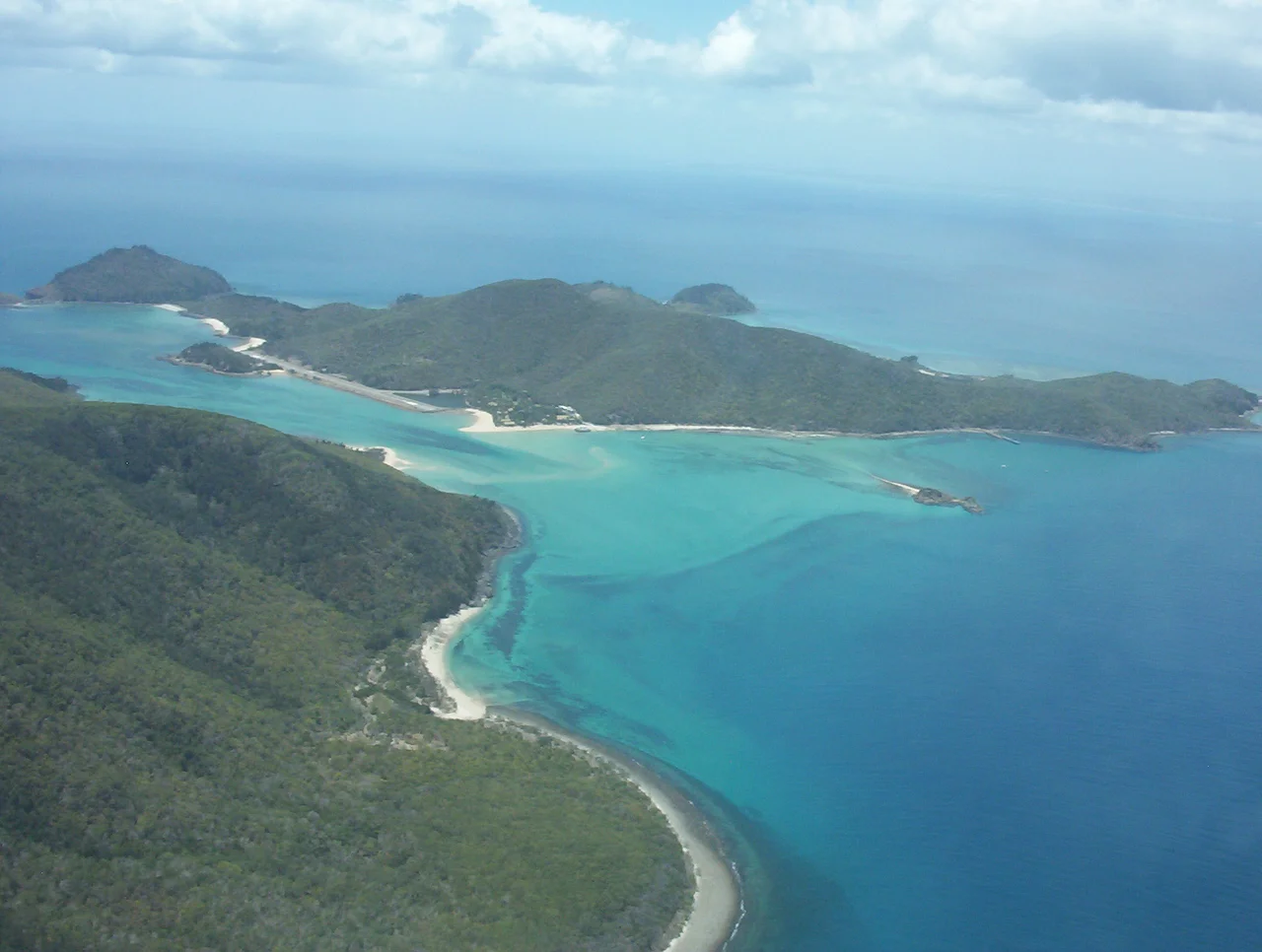

Brampton Island
At low tide, you can walk off Brampton Island. A sand spit reaches across the shallows toward neighbouring Carlisle Island, and for a few hours twice a day the sea pulls back to let you cross between two peaks rising from the Cumberland Group. For decades, holidaymakers came here for exactly that kind of magic - a Queensland island resort with its own airstrip and a fleet of cruise boats. Today the resort is a ruin, the villas standing silent under Brampton Peak while the national park takes the island back, tree by tree.
Ngaro Waters
Long before any resort brochure called it paradise, these waters belonged to the Ngaro people, the Traditional Owners whose seafaring culture ranged across the Whitsunday and Cumberland islands. They navigated this maze of peaks and passages in bark canoes, fishing and moving between islands across some of the same shallow channels that strand walkers today. When Captain James Cook sailed past in June 1770, no permanent settlement stood on Brampton itself - but the island sat within a living seascape that the Ngaro had read and travelled for thousands of years, a depth of presence no European map recorded. The island's name and the resort brochures came later, layered over a country that already had its own names and its own stories.
The Resort That Flew
European settlement began in 1916, when Joseph Busuttin and his family arrived. In December 1933 two of the Busuttin sons opened the island to tourists, welcoming passengers off the P&O ship Canberra. The resort came into its own under the McLean family, who bought the island in 1961 for 80,000 pounds. Tom McLean, a former wartime Army Engineer, already ran Roylen Cruises out of Mackay, and his fleet fed guests to the island under a clever "Cruise n Stay" scheme. A small railway hauled supplies from a deep-water jetty that, unlike the resort's own pier, stayed usable through the enormous six-metre tides. In 1965 came a genuine feat of engineering - an airstrip carved into the island - served through the 1970s by Trans Australia Airlines, including Twin Otters. The strip was short and unforgiving; several aircraft crashed there over the years, though remarkably no one was ever killed.
A Murder Solved by Science
Not every story here is a holiday memory. On 1 September 1983, a young British resort worker named Celia Douty was murdered at Dinghy Bay. The case went cold for eighteen years - until 2001, when it became the first murder in Australia solved using DNA profiling, a landmark moment in forensic history that finally brought her killer to account. Other dramas were lighter in their endings: in April 2008 a single-engine Piper Cherokee crashed into the sea just after takeoff from the island's airstrip, and all five people aboard were plucked from the water by helicopter, alive.
Paradise, Abandoned
The resort changed hands again and again - Trans Australia Airlines bought and upgraded it in 1985, Qantas inherited and then sold it to P&O in 1997, and Voyages took it over in 2004. In November 2010 the owners announced a grand redevelopment and closed the doors on 24 January 2011, promising to reopen by Christmas. They never did. By 2016 the resort stood abandoned, its blue-lagoon accommodation block empty, its corridors filling with leaf litter and the patient green of returning rainforest. What remains is the better part of the island anyway: Brampton Islands National Park, with nearly eighteen kilometres of walking tracks threading up toward the 214-metre summit of Brampton Peak. A permit-only campsite lets the determined sleep where holidaymakers once dined, and the tracks open onto views across the Cumberland Group that no resort ever improved on. The cruise crowds are gone. The Ngaro seascape, the granite peak, and the sand bridge to Carlisle at low tide remain - the island quietly returning to what it was before the seaplanes came.
From the Air
Brampton Island sits at 20.80°S, 149.28°E in the Cumberland Group, roughly 32 km northeast of Mackay and joined to Carlisle Island by a sand spit exposed at low tide. Brampton Peak rises 214 m, making the island a clear, mountainous landmark against the reef-flecked Coral Sea. The old resort airstrip is disused and unmaintained - do not plan to land there. Nearest airports are Mackay (YBMK / MKY) to the southwest and Hamilton Island (YBHM / HTI) to the north. The huge local tidal range (up to about 6 m) dramatically reshapes the surrounding shallows; best viewed in clear weather, with afternoon wet-season storms a hazard from December to March.
Nearby Stories
- Eungella National Park 6 km away
- Mackay 7.5 km away
- Proserpine 23 km away
- Lindeman Island 25 km away
- Pine Islet Light 78 km away
- Brigalow Belt 117 km away
- Coral Sea Islands 203 km away
- Canal Creek Air Crash 250 km away