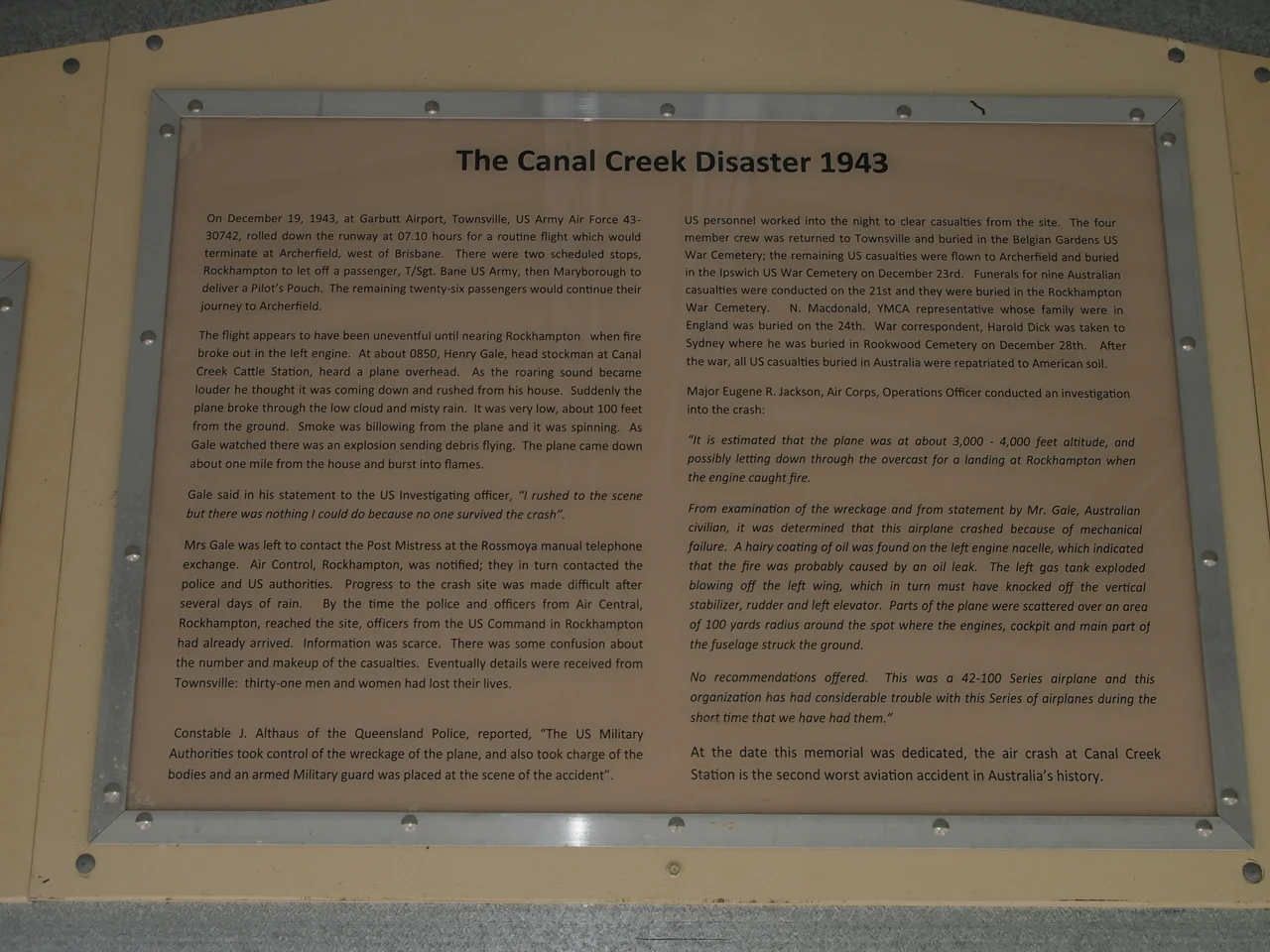

Canal Creek Air Crash
Six days before Christmas in 1943, a C-47 Skytrain lifted off from the airfield at Townsville and turned south down the Queensland coast. It was a milk run by the standards of the war in the Pacific: Townsville to Brisbane, a routine hop for an aircraft and a pilot that had survived far worse. On board were thirty-one people, most of them young, none of them in combat. Somewhere north of Rockhampton, near a place called Canal Creek, an engine caught fire. The explosion tore the aircraft apart in the air. Everyone aboard was killed, and then, because there was a war on, almost no one was allowed to know.
The Men in the Cabin
The thirty-one were a cross-section of the war effort behind the front line. Twenty were United States servicemen, eight were Australian personnel, and the rest were the people who supported the troops without firing a shot: an Australian war photographer named Harold Dick, a YMCA representative named Nigel James MacDonald, and a Salvation Army adjutant named William Tibbs. These were not anonymous casualties of a distant battle. They were a cameraman, a welfare worker, a chaplain's colleague, men whose job was to bring comfort, news and a little ordinary humanity to soldiers far from home. They climbed aboard a transport plane on a quiet domestic route and did not climb off.
The Pilot
At the controls was 2nd Lieutenant William Randall "Randy" Crecelius, born in 1918 in Gibson County, Indiana, the eldest of five children. He was no novice. He had enlisted in 1940, flown the Douglas C-47 Skytrain across the South West Pacific, and by the day of the crash had logged more than 150 combat missions, with some 137 flights out of Townsville alone, dropping supplies and ferrying troops over country patrolled by enemy fighters, often landing on rough fields within miles of Japanese bases. For that he had been awarded the Distinguished Flying Cross. The aircraft he flew that last day, a C-47A nicknamed Hoosier Traveler, was a workhorse he knew intimately. He had flown through the worst the theatre could throw at him and come home each time. He died on a routine flight over friendly soil. It took more than four years to bring his body back to Indiana, where he was buried in 1948 in the family plot at Warnock Cemetery.
A Disaster Kept Quiet
The crash happened in the middle of a coastline at war, and wartime censorship clamped down hard. The few newspaper notices that ran focused on the civilians aboard and said only that they had been "killed in a plane accident," with no hint of the scale of it. It was the third such tragedy on this stretch of Queensland in months: just weeks earlier the Rewan crash near Rolleston had killed nineteen, and six months before, the Bakers Creek crash near Mackay had killed forty in what remains one of Australia's worst air disasters. All of it unfolded under a blanket of official silence, the dead grieved privately by families who were never told quite how their sons and husbands had died.
Bringing Them Back
It would take generations for Canal Creek to be remembered out loud. Local RSL members and historians pushed for years before, in 2012, a monument was finally unveiled at the site. World War II veterans Neville Hewitt and Wayne Carter, the Yeppoon RSL president, pulled the cover from the stone, with Rockhampton mayor Margaret Strelow and the Governor of Queensland, Penelope Wensley, looking on. In 2018 the community gathered again for the seventy-fifth anniversary. The censorship that hid the crash in 1943 had, in a way, lasted longer than the war itself. The memorial answered it at last, turning thirty-one men who were once a forbidden subject into thirty-one names a country was finally free to honour.
From the Air
The crash site lies near Canal Creek, around 50 km north of Rockhampton, close to 22.98 degrees south, 150.48 degrees east, in low coastal hills inland of the Capricorn Coast. Rockhampton Airport (ICAO YBRK) is the nearest major field, about 50 km south; the original flight had departed Townsville (YBTL) bound for Brisbane. The terrain is rolling grazing country threaded with creeks. View at 2,000 to 4,000 feet; the same coastal weather and afternoon build-ups that challenged wartime transports still apply, so morning offers the steadiest air.
Nearby Stories
- Cape Capricorn Light 32 km away
- Heron Island 94 km away
- Pine Islet Light 122 km away
- Sarina, Queensland 168 km away
- Bakers Creek Air Crash 216 km away
- Cullin-la-ringo Massacre 225 km away
- Lady Elliot Island 234 km away
- Stirling Castle (1829 brig) 256 km away