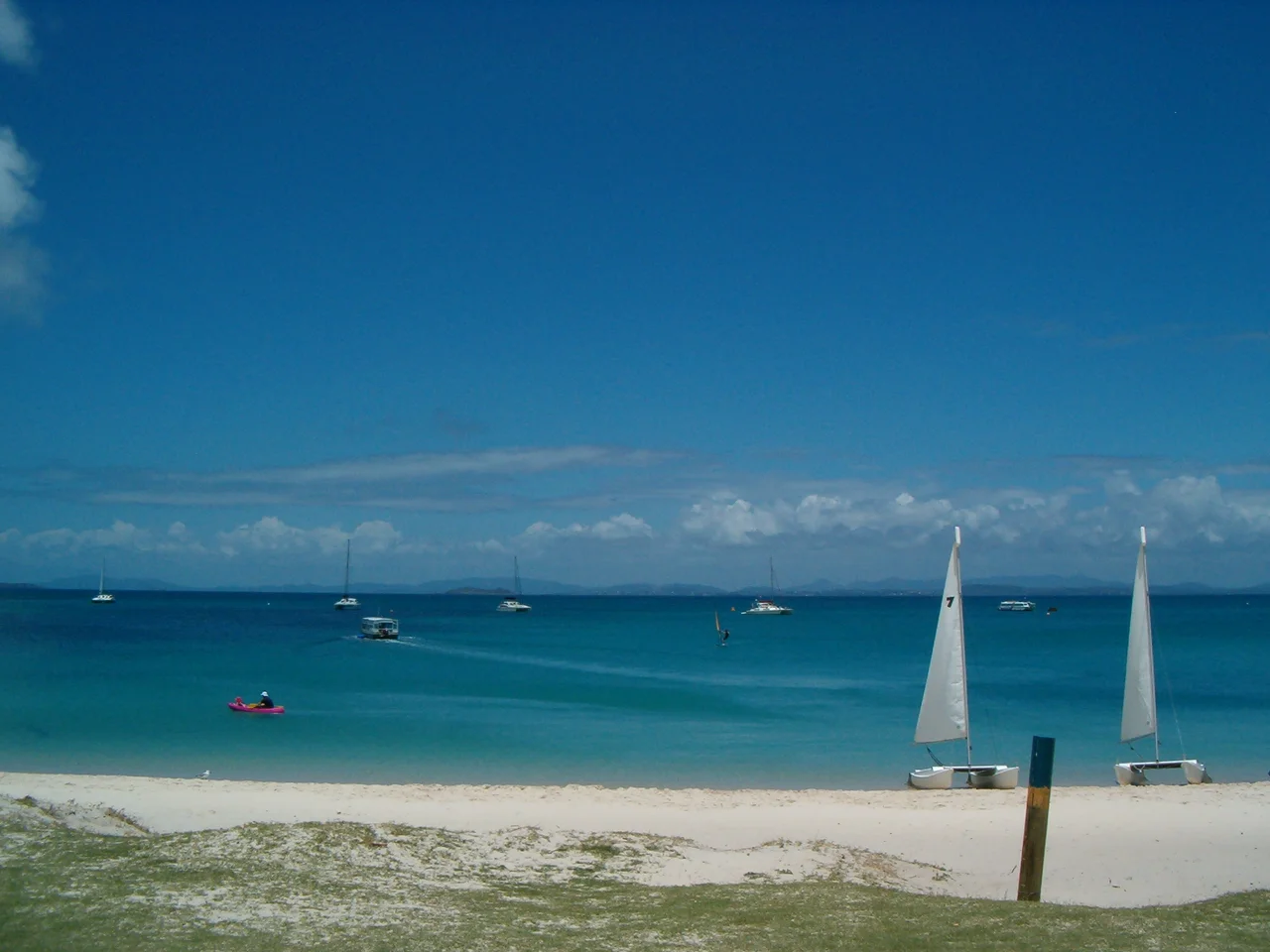

Great Keppel Island
Seventeen beaches of squeaking white sand, water so clear the coral shows through, fringing reef whose diversity rivals the Whitsundays far to the north. Fifteen kilometres off Yeppoon, the largest of the eighteen Keppel islands looks, from the air, like the postcard the marketing campaigns always promised. But Great Keppel has two names, and the older one carries the truer story. To the Woppaburra people it is Wop-Pa, and they were here for something like ten thousand years before any of the rest of it happened. The white sand is the easy part. The history beneath it is not.
Wop-Pa
Long before James Cook sailed past in April 1770 and named the group for an English admiral, the Woppaburra lived on these islands in numbers estimated at sixty to eighty people. Centuries-old shell middens still ring the shores, mute ledgers of all the seafood these waters once gave. The Woppaburra read this place the way you read a home you have known for a hundred generations: which reef at which tide, which season for which fish. They are recognised today by the Australian Government as the island's traditional owners, and in recent years their Native Title rights over the Keppels have been formally acknowledged, a recognition that arrived long after almost everything else had been taken.
What the Pastoral Era Cost
European leaseholders came for grass in the 1860s and turned the island over to sheep, and the Woppaburra paid for it. The first permanent white resident, stock-keeper William Wyndham, treated them fairly and dealt with them justly; he left the island in disgust after watching the lessee forcibly remove thirty people following the killing of some sheep. Those who remained were made to work in squalid conditions, their numbers falling year by year. In the late 1890s a protector named Archibald Meston was shocked by the degraded state to which they had been reduced. By 1902 the last survivors, only a handful, mostly women and children, were forced off their own country to a mainland mission. By the end of the nineteenth century, settlers had killed or removed nearly all of the island's first people. This was blackbirding and dispossession on a small island scale, and it was no gentler for being out of sight.
Sheep, Then Sunseekers
For decades the island belonged to graziers. After her husband Michael O'Neill died in 1923, Lizzie O'Neill stayed on and ran the sheep herself, later remarrying a young fisherman named Ralph Leeke; their names survive on Leeke's Homestead, now heritage-listed, and on Leeke's Beach. The marriage failed and Ralph left, but Lizzie stayed, mustering alone into the 1940s. After the Second World War the sheep gave way to sunseekers. A fishing camp at Fisherman's Beach grew into a rough resort called Silver Sands, and by the 1970s Great Keppel had become a byword for tropical hedonism, immortalised in the cheerfully shameless "Get Wrecked on Great Keppel" advertising campaign that drew planeloads of young Australians to its sand.
The Empty Resort
Then the dream stalled. The resort that once housed 350 guests was closed by its owner, Tower Holdings, in 2008, cleared for a billion-dollar redevelopment of hotels, villas, a marina and a golf course. Federal authorities rejected the grandest versions over the threat to the World Heritage values of the Great Barrier Reef, of which the island is part. Buildings were demolished in 2018; the leases sat in limbo until the Queensland Government cancelled them in 2023. So Great Keppel today is caught between its pasts and its futures: a national-park island where more than fifty thousand visitors a year still come for the beaches and reef, where the resort's bones lie quiet, and where Wop-Pa, the oldest name of all, has at last been spoken back into the record.
From the Air
Great Keppel Island lies in Keppel Bay near 23.18 degrees south, 150.96 degrees east, about 15 km off Yeppoon on the Capricorn Coast. Rockhampton Airport (ICAO YBRK) is roughly 55 km west-southwest; the island has a short unattended private airstrip requiring 24 hours' prior approval. From the air the island reads instantly: a green continental hump rimmed with brilliant white beaches and pale fringing reef, set among the scattered Keppel group. Best viewed late morning at 2,000 to 4,000 feet when sun lights the reef shallows turquoise; afternoon sea breezes are common.
Nearby Stories
- Cape Capricorn Light 27 km away
- Heron Island 41 km away
- Pine Islet Light 135 km away
- Lady Elliot Island 165 km away
- Sarina, Queensland 228 km away
- Stirling Castle (1829 brig) 248 km away
- Cullin-la-ringo Massacre 253 km away
- Bakers Creek Air Crash 263 km away