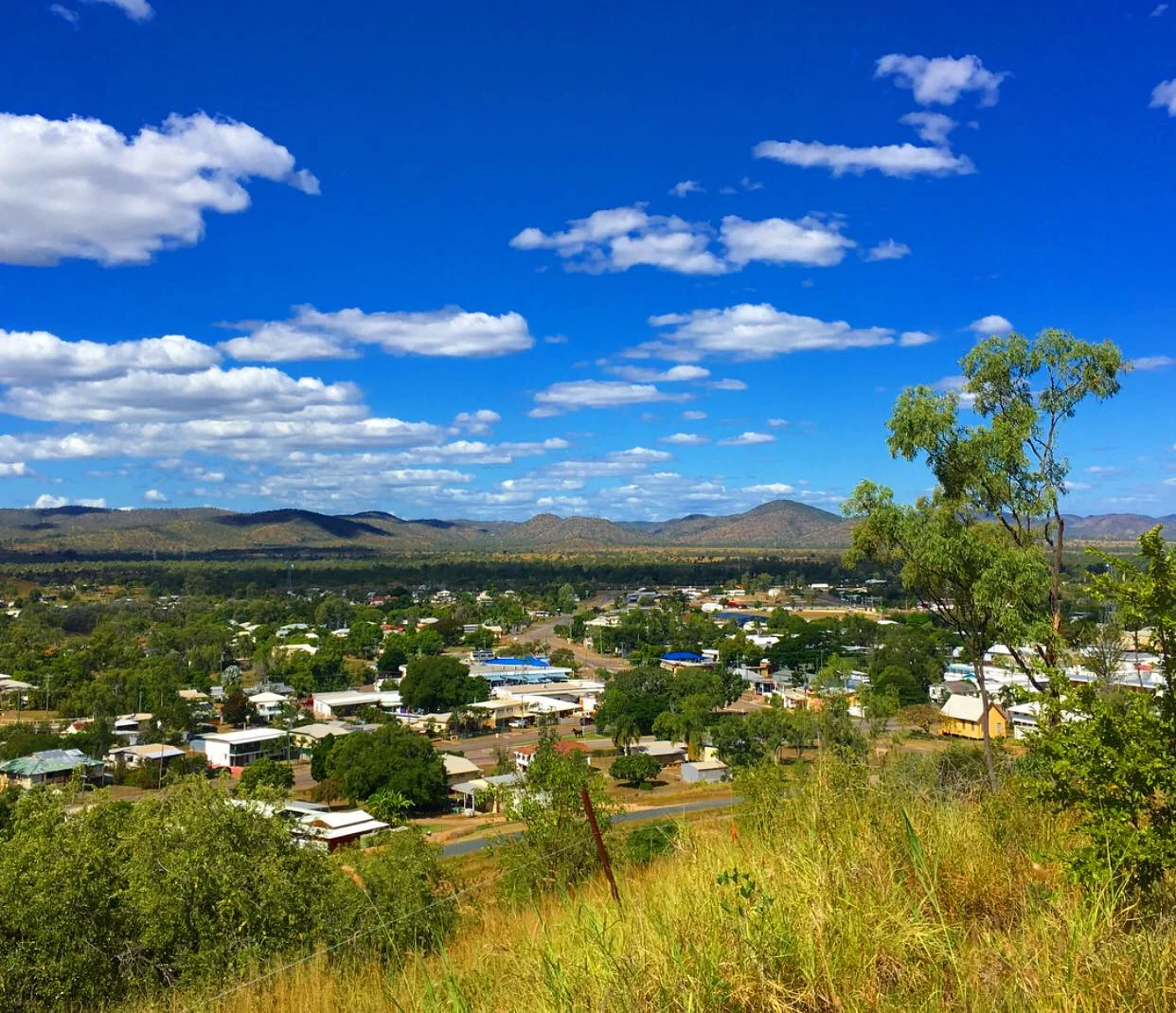

Collinsville, Queensland
The land knew it held coal long before the surveyors did. The people who lived here first, speakers of Biri, called this place Moongunya, a name that translates roughly as the place of coal. They were right about what lay beneath the dry inland hills west of Bowen, though it would be European hands and a long century of unions, strikes and disasters that turned that knowledge into the town of Collinsville. Today around fifteen hundred people live here, and the place still introduces itself the way it always has: by what it digs out of the ground, and by the people who do the digging.
Place of Coal
Biri, sometimes written Birri, is an Aboriginal language whose country reaches across Central and North Queensland, taking in the land around Bowen, Ayr, Nebo and Collinsville. The Biri name for this spot, Moongunya, recorded what mattered most about it. Europeans arrived from 1861, opening the country to pastoralists and their cattle, some of whose stations still run today. Coal was found in 1866, but the seams sat too far inland to be worth much without a way to move them. Large-scale mining did not begin until 1912, and the town proper grew up around it through the 1920s. The post office opened in 1923; churches and schools followed, including the St John Bosco Catholic School under the Sisters of Mercy in 1936, named for a priest who gave his life to teaching poor children.
A Union Town
Collinsville became, and remains, a union town in the deepest sense, where the labour movement is not an abstraction but the spine of community life. Coal is dangerous, demanding work, and the men who did it organised early and held together hard. When the Collinsville State Coal Mine ran into a long dispute with the government in the early 1950s over how the pit should be mechanised, it was the miners' union arguing, correctly as it turned out, that safety should outrank schedule. That solidarity showed in grief as well as in struggle. When tragedy came, union banners from across the state and the country came with it. To understand Collinsville, you have to understand that the pithead and the union hall were two halves of the same town.
The Day the Air Vanished
On 13 October 1954, in the deepest reach of the No. 1 tunnel about a kilometre and a half underground, a sudden outburst dislodged some 900 tonnes of earth and released a flood of nearly pure carbon dioxide. Seven men died where they worked, smothered as the gas drove out the air. They were Alex Parkinson, Peter Miller, Henry Petersen, Frederick Ernest Walker, James Reid Logan, Arthur Shrubsole and Herbert Ruff, Collinsville men whose families lived in the streets above. It was the worst loss of life in a Queensland mine since the Mount Mulligan explosion of 1921 had killed seventy-five. Every year on that October date, Collinsville and neighbouring Scottville still gather to remember the seven. In a town this size, the dead are never strangers.
Wharrier and Mr Ed
Not every Collinsville story ends underground. For most of the twentieth century, sturdy ponies hauled the coal in the mines here, and by the late 1980s the very last working pit ponies in Australia, named Wharrier and Mr Ed, were still going down at Collinsville Coal's No. 2 Mine. When management decided to retire them, the miners struck on their behalf and did something quietly magnificent: they signed the two ponies up as honorary members of the Queensland Colliery Employees Union. As members, the ponies had seniority, and under the rules they could not be laid off ahead of the human workforce. The company gave in. Wharrier and Mr Ed worked a while longer, then were retired around 1990 to live out their days in a paddock, the end of an era for the whole country.
The Pony in the Square
Collinsville chose to remember that story the way it remembers its dead, by building something permanent. In November 2015, to mark twenty-five years since Wharrier and Mr Ed were retired, the town unveiled a life-size bronze pit pony in its centre. The community paid for it themselves, raising more than 190,000 dollars in just sixty days, and behind the statue stands a wall carrying the names of every resident, expatriate and business that chipped in. That, in the end, is what Collinsville is: a place that knows the cost of coal in both lives and loyalty, and insists on naming what it owes, whether the debt is to seven lost miners or to two stubborn ponies who earned the protection of a union card. The mines still run, at the Collinsville and Sonoma pits, and the town still keeps its accounts.
From the Air
Collinsville lies at 20.55 degrees south, 147.85 degrees east in the Bowen Basin of North Queensland, inland and southwest of the coastal town of Bowen. From the air it is a compact town grid surrounded by dry pastoral hills and the dark workings of coal mines, including nearby open-cut operations; the Bowen River runs through the broader district. The nearest airfields are Bowen (ICAO YBWN) on the coast to the northeast and Proserpine / Whitsunday Coast (YBPN) to the east-southeast, with Townsville (YBTL) farther north. The town is best viewed at 2,500 to 5,000 feet AGL in the clear, dry winter air; the summer wet season brings haze, humidity and afternoon thunderstorms.
Nearby Stories
- Proserpine 25 km away
- Eungella National Park 34 km away
- Ravenswood School of Arts 45 km away
- Bowen 47 km away
- Hayman Island 58 km away
- Imperial Hotel, Ravenswood 60 km away
- Cape Hillsborough National Park 122 km away
- Lake Dunn 267 km away