Ravenswood School of Arts
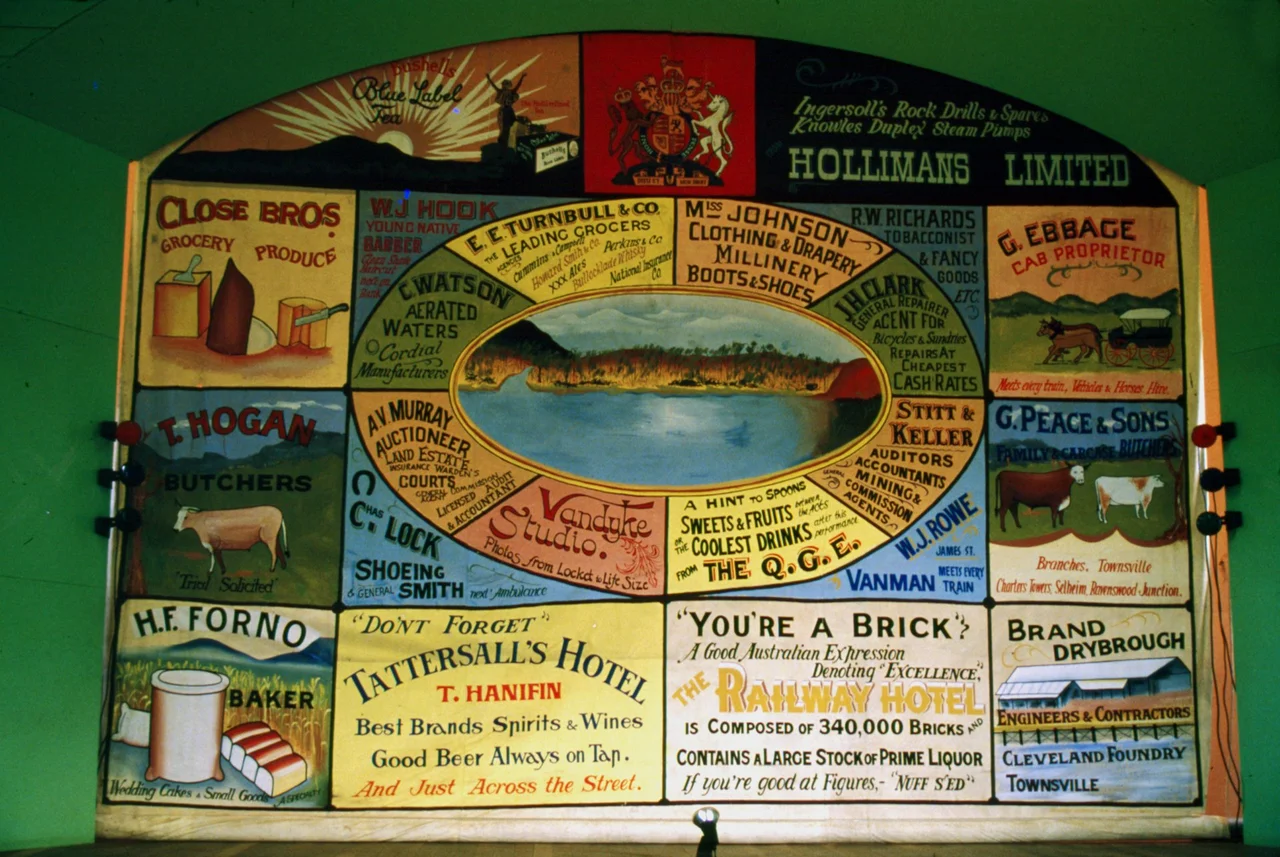
Pull back the stage curtain in the Ravenswood School of Arts and you are looking at a list of the dead, or at least the long-departed: shops, hotels and tradesmen who paid to have their names painted across the cloth around the turn of the twentieth century. Most of those businesses are gone, and so are most of the people who once filled this timber hall on Macrossan Street for plays, dances and concerts. But the curtain survives, the hall survives, and on the right weekend the people come back. That is the strange persistence of this plain weatherboard building in a North Queensland gold town that very nearly ceased to exist.
Improvement, by Subscription
The idea behind the building is older than the building itself. Schools of Arts, also called Mechanics' Institutes, began in Britain in the early 1800s as a way for ordinary working people to better themselves through lectures, debate and, above all, books. In an age before public libraries, when a single volume could cost a labourer days of wages, a subscription library was a genuine ladder. Queensland's first such committee formed in Brisbane in 1849. As goldfields and farming districts took root across the colony, nearly every town of any consequence raised its own School of Arts. Ravenswood started early, forming a small one in 1872, only a year after the town was gazetted, and adding a separate library building beside it in 1875.
The Hall the Railway Built
The current hall went up in 1884, the same year the railway finally reached Ravenswood. The two arrivals were connected. The railway and improved gold-extraction methods lifted the town's fortunes, and a new generation of public buildings, a courthouse, a post office, a hospital, replaced the rough structures of the early diggings. The timber hall, built beside the old library, became the town's principal venue for everything that mattered after the working day ended. It served as meeting hall, dance floor and live theatre. An amateur dramatic society staged annual productions. A School concert and a St Patrick's Day concert were fixtures of the calendar. In a remote town surrounded by mullock heaps, this room was where Ravenswood gathered to be a community rather than just a workforce.
A Plain Box With a Dressed-Up Face
Architecturally, the School of Arts is honest about what it is. A single-storey rectangular timber building on low stumps, it sits with its long axis running back from the street under a gabled roof of corrugated iron. The sides and rear show their exposed stud frame, unclad and frankly utilitarian. The front, though, puts on its best clothes: weatherboard cladding, a symmetrical facade divided into bays by pilasters, and an arched parapet echoed in the arched heads of the central door and the windows flanking it, a touch of classical dignity for the public face. Inside is one large open space and the stage with its advertisement-covered curtain, a frugal, practical room that did everything a small town asked of it.
Decline, Cyclone and Return
Ravenswood faded as its gold did. When the New Ravenswood Company closed in 1917, the town began to empty; in the 1920s whole timber buildings were dismantled and carted off to other towns. By the 1960s only about seventy people remained. The library beside the hall met a violent end: in 1989 Cyclone Aivu tore at the facade of the School of Arts and collapsed the library entirely. The community propped the ruined library for a time, but it was finally demolished in 1992 as unsafe. The hall itself was luckier. The Dalrymple Shire Council and Carpentaria Gold paid for extensive repairs, the front was reconstructed to resemble its original appearance, and the building reopened on 29 September 1991.
Still the Heart of Town
What makes this modest hall worth a heritage listing is not its architecture but its constancy. It is one of a tight cluster of surviving public and commercial buildings near the town centre, close to the Imperial Hotel, that together give Ravenswood its streetscape. The painted curtain is treasured precisely because it is so ordinary, a commercial record of a working town stitched into the fabric of its social life. Today the hall once again hosts community events and celebrations, including the annual "Back To Ravenswood Weekend," when former residents and their descendants return. For a building that has outlived the boom it was built to celebrate, that may be the most fitting use of all.
From the Air
The Ravenswood School of Arts stands at 20.10 degrees south, 146.89 degrees east on Macrossan Street, the main street of Ravenswood, roughly 85 km south of Townsville in inland North Queensland. From the air it is a small rectangular tin-roofed building set within the compact town grid, surrounded by the distinctive pale mullock heaps and tall mine chimneys of the surrounding goldfield. The nearest major airport is Townsville (ICAO YBTL); Charters Towers aerodrome (YCHT) lies to the west. The town reads best at 2,000 to 4,000 feet AGL in the dry season's clear light; expect heat haze and storm buildup in the summer wet.
Nearby Stories
- Radar Station, Charlie's Hill 24 km away
- Bowen River Hotel 31 km away
- Strathmore Homestead 53 km away
- Stewart's Creek Gaol 57 km away
- Collinsville Mine Disaster 103 km away
- Cardwell UFO Festival 179 km away
- Porcupine Gorge 190 km away
- Hinchinbrook Island 211 km away