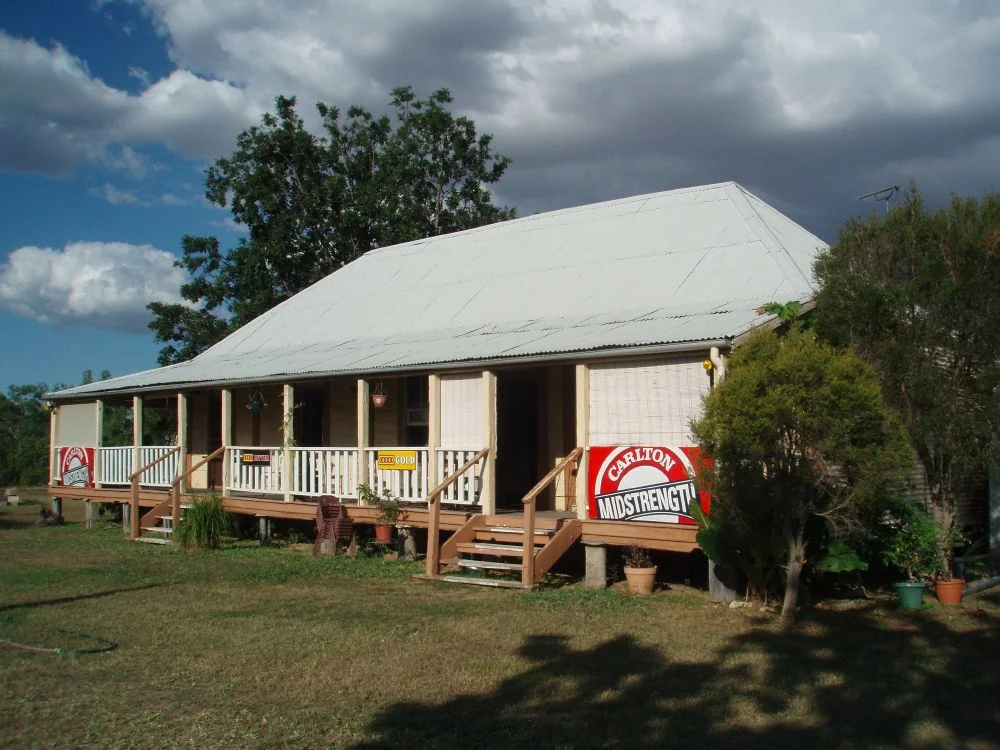

Bowen River Hotel
Drive far enough up the dirt road toward Mount Wyatt, well past the last sealed turn, and the country empties out into open grazing land and silence. Then a low timber building appears beside the Bowen River, its verandah wrapping three sides, white cedar and Burdekin plum trees crowding close, oleanders leaning over a post-and-rail fence. The Bowen River Hotel has stood on this spot since the 1860s. Cattle still pass; the droving mobs that once made it essential are long gone. The beer, remarkably, is still cold.
Pioneers and a Run Called Heidelberg
The pub's story is older than the pub. In 1862 Phillip Sommer and his partner John Harvey pushed into this corner of the Kennedy district and took up a sheep and cattle run on Heidelberg - a vast 95-square-mile selection that another man, James Mead, had claimed a year earlier in 1861 but never stocked. The German place name stuck, and the hotel still carries it as a second identity: the Heidelberg Inn. By 1865 Sommer's Heidelberg homestead had a licensed hotel running out of it, with a publican named George Burnes pulling the drinks, even as Sommer himself moved on to Dotswood Station up near Charters Towers. A watering hole in country this remote was not a luxury. For drovers, teamsters and stockmen on the long inland routes, it was a fixed point in an enormous emptiness.
Bush Carpentry
What makes the Bowen River Hotel extraordinary is not its history but how it was made. This is a building put together with bush skill and almost nothing else - hand-split slabs of local timber, careful jointing, and wooden pegs in place of nails, the roof originally clad not in iron but in sheets of bark. Two structures stand connected by a covered walkway, both raised on low stumps with a rough timber frame holding the floor clear of the ground - some of those stumps fitted with ant caps to keep the termites out. That detail matters more than it sounds: a floor lifted off the bare earth, in a slab hut of this age, is an early sign of a building technique evolving toward something new. Only the hipped roof and the verandah skillions, of corrugated iron, came later.
A Survivor of a Vanished Trade
Buildings like this were once everywhere in the Queensland bush, and now they are almost nowhere. The Bowen River Hotel is one of a tiny handful of surviving country hotels still standing as bush carpentry built them - which is precisely why Queensland added it to its Heritage Register in 1992. Heritage assessors describe it as a transitional form, a homely link between the rough slab huts of first settlement and the distinctive Queenslander architecture that would follow, with its stumps and broad shady verandahs. It is a physical record of how people learned to build for the heat, the wet and the white ants of the tropics, written in split timber by hands that had no architect and no hardware store.
Still Open
The remarkable thing is that the Bowen River Hotel never became a relic. The droving era that sustained it faded, the railways and trucks took the cattle elsewhere, and a lesser pub would have collapsed into the grass long ago. Instead it was renovated and reopened in 2003, and it carries on as exactly what it has always been: a remote outback pub where the road runs out. Travellers who make the trip find cold drinks, country meals, music nights and an annual rodeo, all served from a building old enough that locals wrote a book about it - The Bowen River Saga, published by the Bowen Historical Society in 1973. The river still runs past. The verandah still offers shade. More than 150 years on, the lights are still on at the end of the track.
From the Air
The Bowen River Hotel lies at 20.53 degrees south, 147.56 degrees east near Mount Wyatt, on the Strathbowen-Leichhardt Range Road in the Whitsunday Region of inland north Queensland, well west of the coast. From the air it is a small pair of timber-and-iron buildings on cleared grazing land beside the Bowen River, framed by the Leichhardt Range, in country with very few roads or settlements. The nearest coastal airfields are Bowen (YBWN) and Hamilton Island (YBHM) to the east, with Charters Towers (YCHT) to the north-west and Mackay (YBMK) to the south-east; the area itself is sparsely served, so any approach relies on the river line and ranges for navigation. The dry season (April to October) gives the clearest air over this inland country, while the summer wet brings storms, haze and the risk of flooding along the Bowen River.
Nearby Stories
- Ravenswood School of Arts 14 km away
- Bowen 32 km away
- Ravenswood Mining Landscape and Chinese Settlement Area 42 km away
- Radar Station, Charlie's Hill 56 km away
- Proserpine 60 km away
- Eungella National Park 70 km away
- Brigalow Belt 153 km away
- Lake Dunn 245 km away