.jpg)
Ravenswood Mining Landscape and Chinese Settlement Area
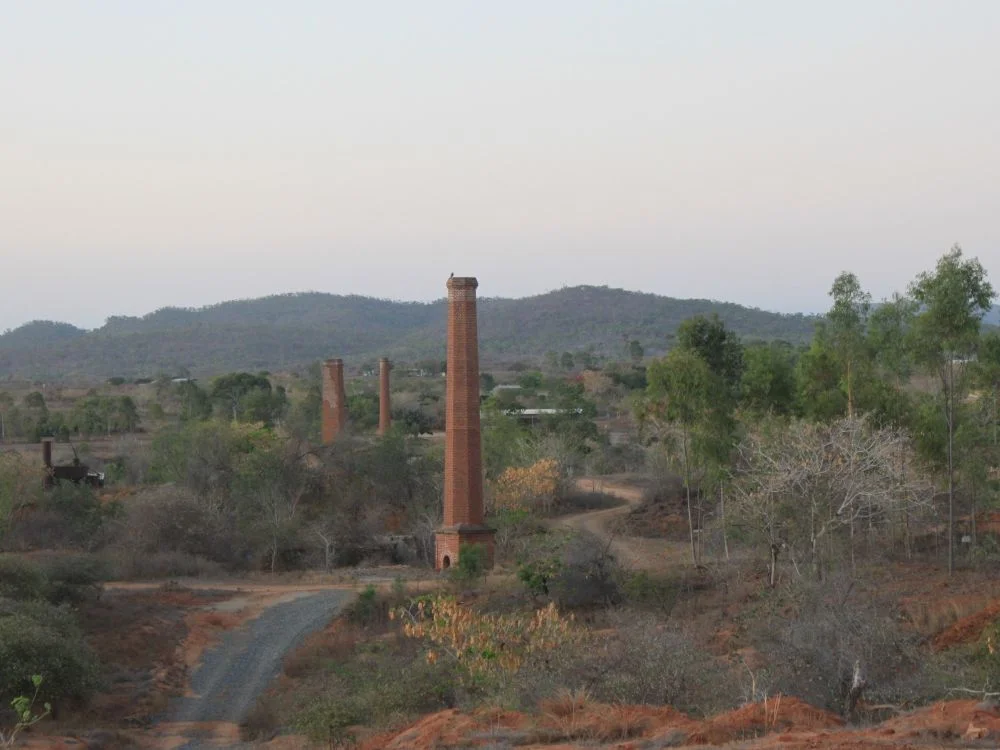
The chimneys give it away from a distance. Five of them, red brick, square and round and octagonal, stand among low hills of broken rock as if a town once grew here and then thought better of it. This is Ravenswood, the oldest surviving inland town in North Queensland, and the undulating ground around it is not natural. Every rise is mullock, the waste rock that miners hauled up and dumped while chasing gold through reefs with names like the Sunset, the General Grant, and the Duke of Edinburgh. Between 1868 and 1917, nearly a million ounces of gold came out of the little triangle of dry gullies beneath your feet.
Gold That Would Not Come Easily
The first rush, in 1869, was the easy kind. Alluvial gold lay in three dry creek beds, Nolan's, Jessop's and Buchanan's gullies, and the reefs near the surface gave up their gold to simple crushing machines. Then the mines hit the water table at about seventy feet, and the gold changed. Below that line it was locked inside sulphide ores, what the miners called mundic, fine particles tangled with iron, lead, copper, zinc and arsenic that defeated mercury and acid alike. A method that worked on one reef failed on the next. Ravenswood became a kind of open-air laboratory: it was probably the first place in Australia to use the cyanide process, and the first in Queensland to use chlorination and the Wilfley table. Solving the chemistry was the only way the town survived after most of its miners drifted off to Charters Towers and the Palmer.
Deighton Street and the Chinese Gardens
By 1872 around 1,500 Chinese people lived and worked on the Ravenswood field, matched by a similar number of Europeans. Many had been forcibly evicted from diggings further north and arrived here looking to begin again. Deighton Street, just west of the main road, became the heart of their community. They worked alluvial claims, ran hotels and stores, laboured in the mines, and above all they gardened: by 1885, thirty-seven Chinese market gardens covered more than a hundred acres along Elphinstone Creek, supplying fresh vegetables that kept the whole goldfield fed. They faced real discrimination, their numbers and rights squeezed by law and prejudice, yet when miners struck in 1912 it was the Chinese community's vegetables and credit that helped the town hold on. These were settlers building lives, not passing through.
The Earliest Temple in Queensland
South of Deighton Street, a series of low concrete and stone platforms is all that remains of a Chinese temple. It is easy to walk past. But this temple appears on a survey plan drawn in 1874, which makes it the earliest known Chinese temple anywhere in Queensland, older than those at Cooktown, Cairns, or Brisbane's Breakfast Creek. A temple was never only a place of worship. It was where the community gathered, checked a horoscope before a risky venture, honoured ancestors, and feasted on festival days. Eighteen metres away stand the collapsed brick courses of a pig roasting oven, its cylindrical hearth still visible, where whole pigs were cooked for those gatherings. The pairing of temple and oven, surviving together, is rare enough that heritage assessors singled it out.
The Wilson Boom and the Long Quiet
The town's last great surge belonged to one man. Archibald Lawrence Wilson raised capital in London and floated the New Ravenswood Company in 1899, reworking the old mines and tailings with modern machinery. Shareholders made their money back in two years, the news travelled the world, and Ravenswood's population peaked at 4,707 in 1903. Brick hotels, brick shops, new headframes and smokestacks rose across the town. Not everything paid off; the Deep mine sank Queensland's deepest shaft on the field, 512 metres, and recovered barely 240 ounces, costing Wilson's investors at least 65,000 pounds. World War I drove up costs, and on 24 March 1917 the company ceased work, ending large-scale mining for seventy years. What it left behind, the chimneys and shafts and tailings dyed yellow and grey by old chemical processes, is now the heritage landscape itself.
Reading the Ruins
Walk the unsealed tracks today and the landscape reads like a textbook of mining you can touch. Caved shafts ringed by modern fences. Winding-engine mounts of brick and concrete with their metal fixtures still embedded. Rusting Cornish boilers, one stamped "John Danks & Son Pty Ltd, Melbourne." Settling tanks stained orange by the cyanide that once trickled through them. The General Grant and the Duke of Edinburgh sit high on ridges with long views across the town; the Sunset, the field's richest reef, produced almost a quarter of all the gold ever raised here. Carpentaria Gold returned in 1987 to mine the Buck Reef by open cut, and modern operations still work the southern edge of the historic ground, a reminder that in Ravenswood the gold story never quite ended.
From the Air
The Ravenswood Mining Landscape sits at 20.10 degrees south, 146.89 degrees east, about 85 km south of Townsville and 65 km east of Charters Towers in North Queensland's dry inland. From the air, the giveaway is the cluster of tall red-brick chimneys rising from pale, lumpy ground that contrasts sharply with the surrounding eucalypt scrub; Elphinstone Creek curves along the north and west of the site. The nearest major airport is Townsville (ICAO YBTL), with Charters Towers aerodrome (YCHT) closer to the west. Best viewed at 2,500 to 4,500 feet AGL in the clear, dry winter air typical of the region; summer brings the wet-season haze and afternoon storms.
Nearby Stories
- Radar Station, Charlie's Hill 24 km away
- Bowen River Hotel 31 km away
- Strathmore Homestead 53 km away
- Stewart's Creek Gaol 57 km away
- Collinsville Mine Disaster 103 km away
- Cardwell UFO Festival 179 km away
- Porcupine Gorge 190 km away
- Hinchinbrook Island 211 km away