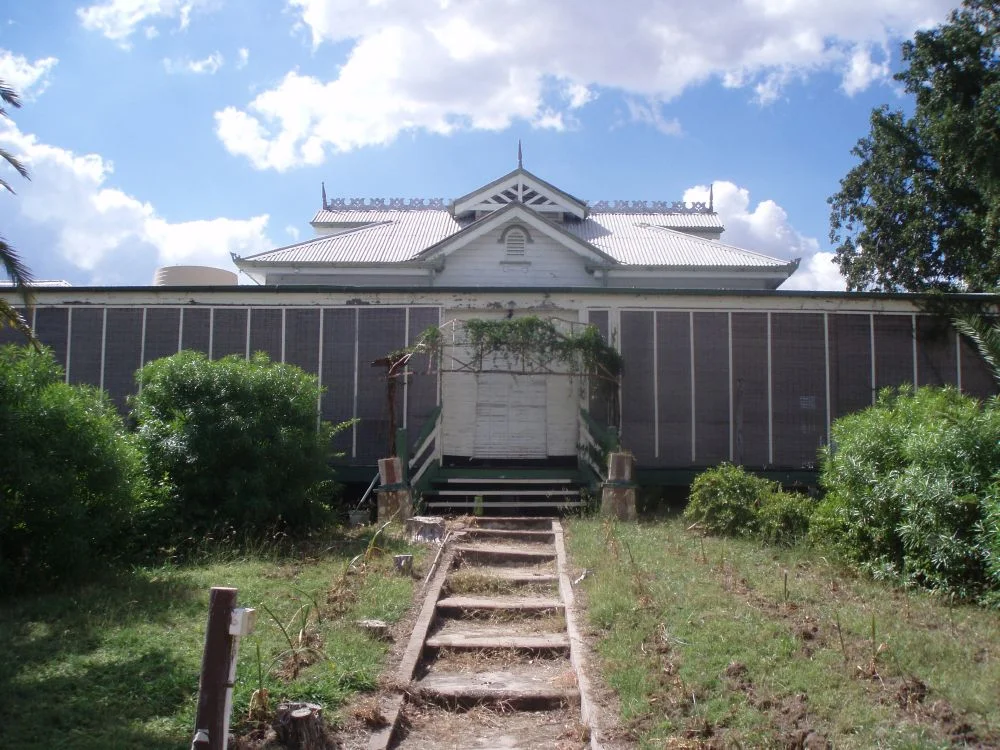

Strathmore Homestead
Drive twenty-seven kilometres of red dirt north-west of Collinsville and you reach a place that measures time in generations rather than years. Strathmore is a working cattle station of forty-one thousand hectares, but it is also a small world unto itself: a homestead wrapped in deep verandahs, an avenue of Canary Island date palms, a disused swimming pool, a private cemetery, and the bones of a former zoo that once held a camel and a crocodile. At its heart sits a hut of vertical timber slabs that may date to the 1860s, when this corner of the Kennedy District was raw frontier and the Cunningham family who still hold the lease had not yet arrived.
Opening the Kennedy
In April 1861, Edward Cunningham rode out of Port Denison with four other men, looking for grass. The country west of Bowen was newly opened to pastoralists, and the men who got there first could take up vast leases of unfenced land. Strathmore itself was first leased in 1862 by P.F. Selheim, then passed through a string of hands: Tucker and Stewart, then the pastoralist-politician Leopold De Salis, who spent decades consolidating thirteen separate runs into one great holding before debts of over a hundred thousand pounds broke him. He was declared insolvent in 1898, and the Union Bank held the land until a new partnership took it on. Strathmore's early history is the early history of North Queensland itself, written in lease transfers and failed fortunes.
A Family Takes Root
The Cunninghams came to Strathmore in 1902, and they have never left. Arthur Henry Wickham Cunningham had been managing the nearby Woodhouse Station when a brutal season killed eighty-five percent of the herd, and he needed fresh country to rebuild. On his recommendation the firm of Gilchrist, Watt and Cunningham bought the Strathmore lease for fifty thousand pounds. He moved in and built a life. The main house, raised on timber stumps with leadlight panels in an Art Nouveau pattern over its front door, dates from around this time. More than a century later, his great-grandson Edward Thomas Cunningham holds the lease, making this one of the longest unbroken family associations of any station in the region.
Horses, Cattle and a Camel
A.H.W. Cunningham loved racing. He kept a thoroughbred stud, and the Strathmore colours of green and orange were a familiar sight at North Queensland meetings; he helped found the local amateur turf club and served as its president until he died in 1942. His son Edward took the station in a different direction, pioneering the Poll Devon strain in Australia from 1955 and filling the station office with trophies. And somewhere along the way the family built a zoo. The enclosures still stand, some roofed in corrugated iron, some topped with barbed wire, and the records show what once lived inside: buffalo, deer, monkeys, a camel, and a crocodile penned off near the swimming pool.
Reading the Station
What makes Strathmore rare is that almost nothing was thrown away. An 1888-era slab hut survives as staff quarters. Drop-slab meathouses still hold their chopping blocks, meat hooks and draining tables, with flat iron tacked over the gaps in the timber to keep flies off the carcasses. There are meathouses, a brick station oven, a blacksmith's legacy, stables painted in the station's traditional white, and a schoolhouse where the children of the property once learned their lessons. To walk the complex is to read, building by building, how a great pastoral station actually worked. When Baz Luhrmann needed an authentic set for his 2008 film Australia, part of Strathmore's bush-timber cattle yards was dismantled and trucked to Bowen for the shoot.
The Cemetery by the Creek
Several hundred metres east of the homestead, on the southern bank of Crush Creek, three graves mark three generations of one family. Edward Cunningham, killed in an accident in 1993, lies beneath a stone carved with a horse and a bull and the words 'Don't fence me in.' Beside him is the infant Margaret, who lived six weeks in 1945, and young Wyatt, who died at three in 1999, his headstone inscribed with a lullaby. The cemetery is the quietest argument for what Strathmore really is. This is not a museum that happens to be lived in. It is a home that happens to be a century and a half old, and the people who built it are buried within sight of the verandah.
From the Air
Strathmore Homestead sits at approximately 20.498 degrees south, 147.630 degrees east, in open North Queensland grazing country about 27 km north-west of Collinsville and roughly 70 km south-west of Bowen on the coast. From the air, look for the homestead complex on a rocky rise on the north side of Strathmore Road, beside the thin green line of Crush Creek, with the distinctive avenue of tall Canary Island date palms leading to the main house. A recommended viewing altitude is 2,000 to 4,000 feet AGL for the homestead and its surrounding paddocks and cattle yards. The nearest airfields are Collinsville Airport (YCWL) to the south-east and Bowen Airport (YBWN) on the coast to the north-east; Townsville Airport (YBTL), the major regional gateway, lies about 200 km to the north. The terrain is low and open, with generally good visibility in the dry season (roughly April to October); summer can bring heat haze and storm cells.
Nearby Stories
- Ravenswood School of Arts 14 km away
- Bowen 32 km away
- Ravenswood Mining Landscape and Chinese Settlement Area 42 km away
- Radar Station, Charlie's Hill 56 km away
- Proserpine 60 km away
- Eungella National Park 70 km away
- Brigalow Belt 153 km away
- Lake Dunn 245 km away