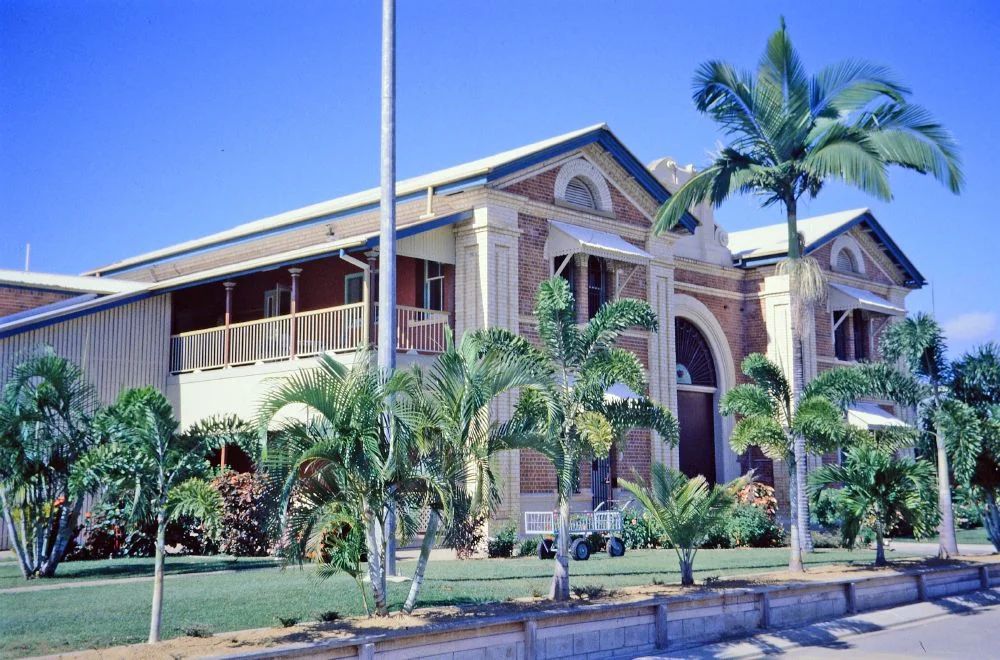

Stewart's Creek Gaol
Drive out to Stuart, on the southern edge of Townsville, and you reach a working prison ringed in razor wire. Tucked inside that modern facility are two structures that have watched over this ground since the 1890s: a red-brick gatehouse with an ornate pediment, and a tall cylindrical tower locals still call the Trig Tower. They are the oldest surviving prison buildings in Queensland - older even than the famous Boggo Road gaol in Brisbane - and they have outlasted nearly everything built around them.
A Gaol for the North
By the 1880s, Townsville had outgrown its first prison at North Ward. The town was booming on pastoral wealth, gold and sugar, and residents complained that the gaol now sat too close to the heart of a growing city. It was also dangerously overcrowded. In 1889 the Prisons Department took up 150 acres of former sheep-quarantine ground near Stewart's Creek, about eight kilometres out, conveniently beside the Great Northern Railway so prisoners and supplies could move by rail. Designed in the Queensland Colonial Architect's office and built by contractor Thomas Matthews for £31,600, the new gaol was occupied in 1893. It became the only maximum-security prison in North Queensland in the nineteenth century, ending the costly, hazardous business of escorting the north's convicted felons all the way south to Brisbane.
The Tower and the Architect
The watchtower came a few years after the cell blocks, designed in 1897 by John Smith Murdoch. The structure is curious - a tall cylinder topped by an octagonal cabin with covered walkways radiating from it, a spiral stair winding up inside to a small room fitted with a basin and lavatory so a warder could keep watch for hours. Townsville named it the Trig Tower because surveyors took trigonometrical readings from its height. Murdoch went on to a remarkable career: by 1919 he was Chief Architect in the Commonwealth Works Department, helping plan the new capital at Canberra and designing its provisional Parliament House, the building Australians now know as Old Parliament House. The tower at Stuart is a small, sturdy ancestor of that national work.
Judgment in the North
A prison this size sat at the hard end of colonial justice, though it is a common misunderstanding that executions took place here - they did not. Capital cases were tried in Townsville's Supreme Court, but those sentenced to death were sent south to be hanged in Brisbane. The most haunting case belongs to Ellen Thomson. Tried in Townsville in 1887 alongside John Harrison for the death of her husband, she was denied the chance to testify and defended by a lawyer who apologised to the jury for his inexperience. Both were taken to Boggo Road and hanged in June that year. Ellen Thomson remains the only woman ever legally executed in Queensland, and many historians since have doubted her guilt. Hers is a story told best soberly, a reminder of how unevenly justice could fall on those without money or a strong defence.
What Survives
The original gaol was largely swept away in the 1990s. When the site was redeveloped as the Townsville Correctional Centre and works finished in 1996, the cell blocks, administration buildings and the six-metre perimeter wall were demolished, the wall replaced by a modern razor-wire fence. The Gatehouse and the Observation Tower were spared and carefully refurbished in 1995 and 1996, the gatehouse exterior rebuilt to its original lines with open verandahs and latticework. Added to the Queensland Heritage Register in 2008, they endure as rare physical evidence of how a colony built, and thought about, its prisons - a forbidding brick gate and a watchtower, still standing guard over a century and a half of north Queensland history.
From the Air
Stewart's Creek Gaol stands at roughly 19.35°S, 146.85°E, in the suburb of Stuart on the southern outskirts of Townsville, set within a large prison reserve off Centenary Drive. The site lies on the coastal plain inland of Cleveland Bay, near the line of the old Great Northern Railway. The cylindrical Observation Tower is the most identifiable feature from above. Nearest airport is Townsville (YBTL / TSV), a few kilometres to the north. As an active correctional facility, it is best appreciated from a respectful distance; clear dry-season skies give the best visibility over the flat surrounding country.
Nearby Stories
- Magnetic Island 6.6 km away
- Radar Station, Charlie's Hill 17 km away
- Ayr 20 km away
- Imperial Hotel, Ravenswood 47 km away
- Cardwell UFO Festival 102 km away
- Hinchinbrook Island 133 km away
- Porcupine Gorge 207 km away
- Coral Sea Islands 378 km away