
Cologne Cathedral Quarter
For most of its existence the Cologne Cathedral was hidden. Medieval Cologne built up against the half-finished walls of the Dom the way a forest grows up to a cliff: tightly, with no room left over. The archbishop's prison was on one side. Pilgrims' hostels and canons' houses crowded the others. A guillotine briefly stood in the courtyard during the French occupation. The cathedral was not so much a monument as the largest building in a neighborhood. The image we have today - the twin spires rising clean from an enormous granite plaza, with the Hauptbahnhof a flight of steps down and the Rhine just beyond - is barely 150 years old, and almost all of it was negotiated, torn down, and rebuilt in living memory. The story of the Cathedral Quarter is the story of how a city emptied itself out around its own greatest building, and then could not agree on what to put back.
When the Dom Was Just a Block
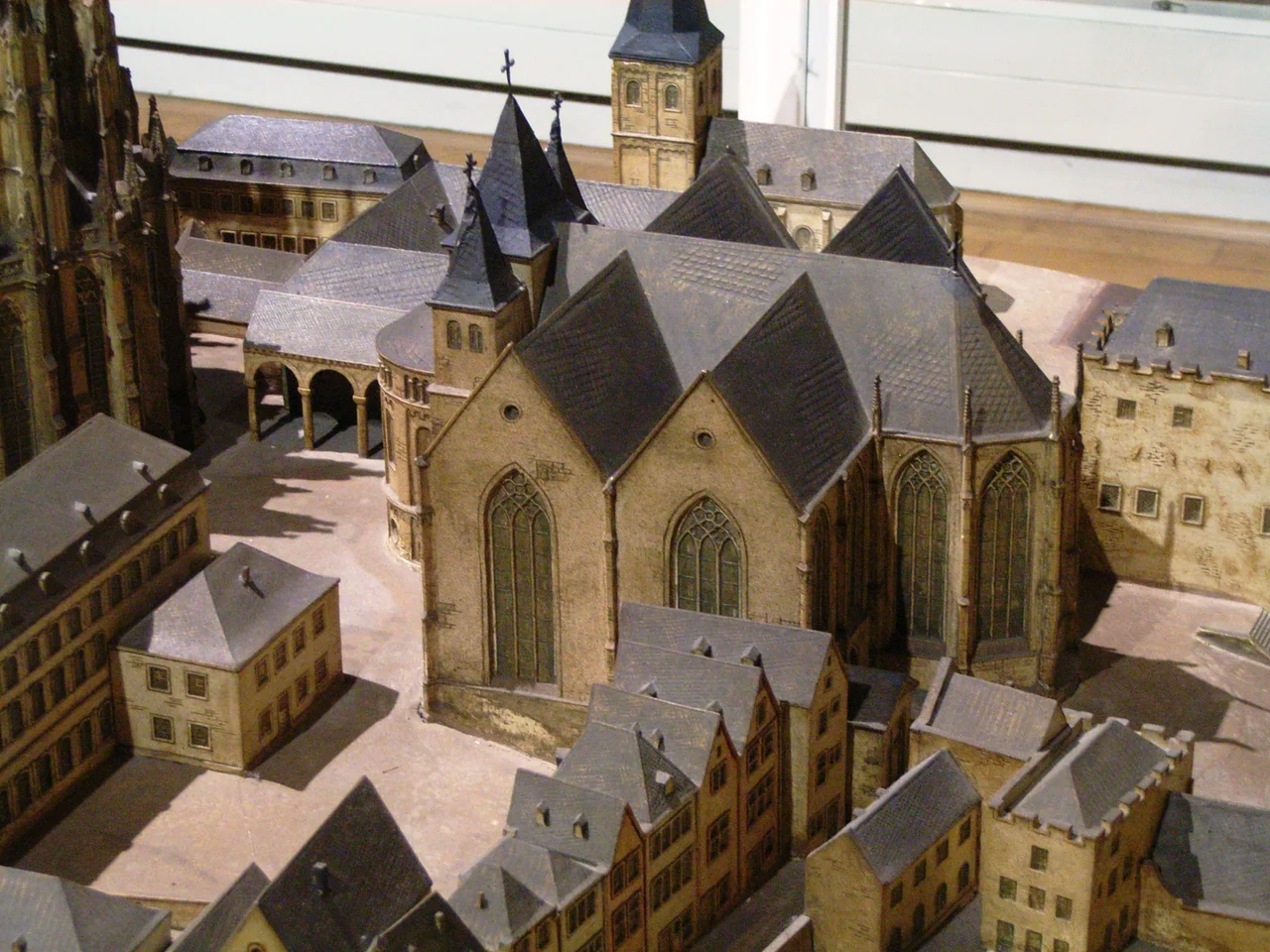
Arnold Mercator's 1571 map of Cologne shows the cathedral, then still half-built and stuck for centuries with a wooden crane on its south tower, hemmed in by buildings on every side. Houses ran right up to the choir. The archbishop's palace stood to the north, the prison called the Hacht - built around 1165 - on Domhof, with the women accused of witchcraft tortured inside its walls. The Heiliggeisthaus, a twelfth-century pilgrims' hospital, sat next to the prison. To the west, the Reinaldscher Palast, a three-story Romanesque palace from 1164, served as the archbishop's residence until it was demolished in 1674. There were canons' houses, a basalt block called the Blue Stone where the archbishop's high court rendered judgment, and the collegiate church of St. Maria ad Gradus halfway between the cathedral and the Rhine, which had stood since 1062 and held the tomb of Richeza, Queen of Poland. The cathedral was a presence inside a dense urban fabric, not above it.
The French, the Guillotine, and the Demolitions
On 16 October 1798, French occupiers set up a guillotine in the cathedral courtyard, which they had renamed Place Metropole, and executed more than thirty people there. The secularization of 1802 expropriated and tore down the sacred buildings around the Dom. After Napoleon, the great Prussian architect Karl Friedrich Schinkel sketched the first vision of a freed cathedral in 1816, proposing terraces sloping down to the Rhine, with a two-winged staircase to bridge the height difference between the choir and Frankenplatz. Little of it was built immediately, but the idea took hold: clear the ground, let the cathedral breathe. The dilapidated provostry came down in 1830. Two houses on Domhof vanished in 1857. In 1863 the Köln-Mindener Eisenbahn-Gesellschaft and the Colonia insurance company donated their buildings to the city for demolition. In 1880, after 632 years, the cathedral was finally completed - and the work of clearing it had become indistinguishable from the work of finishing it.
Stübben Finishes the Job
On New Year's Eve 1885, the first Dom-Hotel collapsed - an event that, in retrospect, the cathedral-clearing partisans seem to have welcomed. The city architect Josef Stübben had submitted plans only weeks earlier for the full exposure of the Dom, and the rubble of the hotel was an unanswerable argument. The hotel was rebuilt at a respectful distance and reopened in April 1893. By the time the demolitions ended that year, two churches and sixty-nine houses had been removed between 1826 and 1893 to give the cathedral its solitude. The Gründerzeit consensus was absolute: no new building should crowd the Dom. The cathedral would sit enthroned on the Domhügel, the cathedral hill, and the city would arrange itself around it. For a brief generation - perhaps fifty years - the Dom looked the way Schinkel had imagined.
The Domplatte
Then came the bombing, the rebuilding, and the cars. By the 1950s, Cologne's main station and its busiest tram lines wrapped the cathedral so tightly that you had to climb stairs from a traffic island to reach the portals. In 1956 an international competition tried and failed to redesign the area. When excavation began in 1964 for the Cologne Stadtbahn, planners seized the moment. Between 1968 and 1970, a vast concrete platform - the Domplatte - was poured around the entire cathedral, raising the pedestrian level to meet the cathedral portals and burying a two-storey, 613-space parking garage beneath. The Roman-Germanic Museum opened beside it in 1974; the Museum Ludwig in 1986. Frank Sinatra played his farewell concert on the Domplatte on 6 June 1993. Liza Minnelli followed in 1997. A 70-meter-wide flight of granite steps, designed by Christian Schaller, opened in 2005 down to the main station. The Domplatte was voted, in a 2006 ZDF poll, the most popular place in Germany.
The Concrete and Its Critics
It is also called the city's biggest eyesore, and not only by cranks. The barren concrete creates dead corners, the famous remark goes that the cathedral has been robbed of its feet, and the granite platform that solved the traffic problem created social ones the city has struggled with for half a century. Since 2009 an overall redesign has crept through the Quarter in phases: the eastern surroundings between the cathedral, the museums, and the station were rebuilt from 2013 with wider walkways and natural-stone cladding; the northern phase began in 2019. The four named squares around the Dom - Roncalliplatz to the south, Kardinal-Höffner-Platz to the west, Heinrich-Böll-Platz to the east (designed by Dani Karavan between 1982 and 1986), and the Bahnhofsvorplatz to the north - each have their own argument about what an empty space around a great cathedral should feel like. The argument has been going on, in one form or another, since Schinkel sketched his terraces in 1816. There is no sign of it ending.
From the Air
The Cologne Cathedral Quarter centers at 50.9408 N, 6.9570 E in Cologne's Altstadt-Nord, immediately west of the Rhine and across the river from the Deutz district. From cruising altitude the twin 157-meter spires of the cathedral are the unmistakable landmark of the Lower Rhine - visible from 30+ km in clear weather. The Hohenzollern railway bridge crosses the Rhine just east of the cathedral; the Hauptbahnhof is a step to the north. Cologne Bonn Airport (EDDK / CGN) is 12 km southeast; Düsseldorf (EDDL / DUS) is 35 km north. Best viewing 2,500 to 6,000 ft.
Nearby Stories
- Diamond Interchange: How a Simple Idea Reshapes Towns Like Julich 2.8 km away
- Dusseldorf-Unterbach 6.1 km away
- Baumwollspinnerei Ermen & Engels 11 km away
- RAF Bruggen 15 km away
- Hagen Open-air Museum 21 km away
- Belgium 130 km away
- Marcinelle Mining Disaster 173 km away
- Zwingenberg Castle 178 km away