
Cologne Cathedral
For four hundred years, a wooden crane sat on top of the unfinished south tower, a fixture of the Cologne skyline so familiar that travelers used it for navigation. Construction had begun in August 1248. The money ran out around 1560, the work stopped, and the half-built cathedral became a strange monument to abandoned ambition - a Gothic ruin built only to belfry height, frozen mid-rise. Then in the 1840s, fueled by Romantic enthusiasm for the Middle Ages and the discovery of the original medieval drawings, the project resumed. The crane came down. The towers went up. In October 1880, six hundred and thirty-two years after that first foundation stone, the cathedral was finally complete.
The Patient Construction
Archbishop Konrad von Hochstaden laid the foundation stone on 15 August 1248, in a Cologne already pulsing with pilgrim traffic. Eighty-four years earlier, the bones believed to be those of the Three Wise Men had been carried up from Milan, gifted to the archbishop from Frederick Barbarossa's spoils of war, and Cologne had become one of the great pilgrimage destinations of medieval Europe. The old Carolingian cathedral - itself one of the largest churches of its day - was no longer adequate. The new Gothic plan, modeled closely on Amiens, called for vaults of staggering height and a facade unlike any other. The eastern arm was consecrated in 1322. After that, progress slowed, then stalled. By 1473 the south tower stood half-built with that crane perched on top, and there it would remain until the modern age caught up with medieval ambition.
Bones of the Magi
The reason the cathedral exists on this scale is, fundamentally, three boxes of bones. The Shrine of the Three Kings, commissioned around 1190 from Nicholas of Verdun, is a gilded bronze and silver reliquary in the shape of a small basilica, encrusted with enamels and gemstones - one of the great masterpieces of medieval European art. When the shrine was opened in 1864, it was found to contain bones and garments, though their actual origin remains a matter of academic dispute. None of that mattered to the pilgrims who came in their thousands. To accommodate them, the medieval builders dreamed up something on the scale of Amiens, a cathedral fit for the relics of the men who, according to the Gospel of Matthew, brought gold and frankincense and myrrh to a child in Bethlehem. The shrine still sits behind the high altar, and the cathedral was built around the box.
Fourteen Hits, One Standing Building
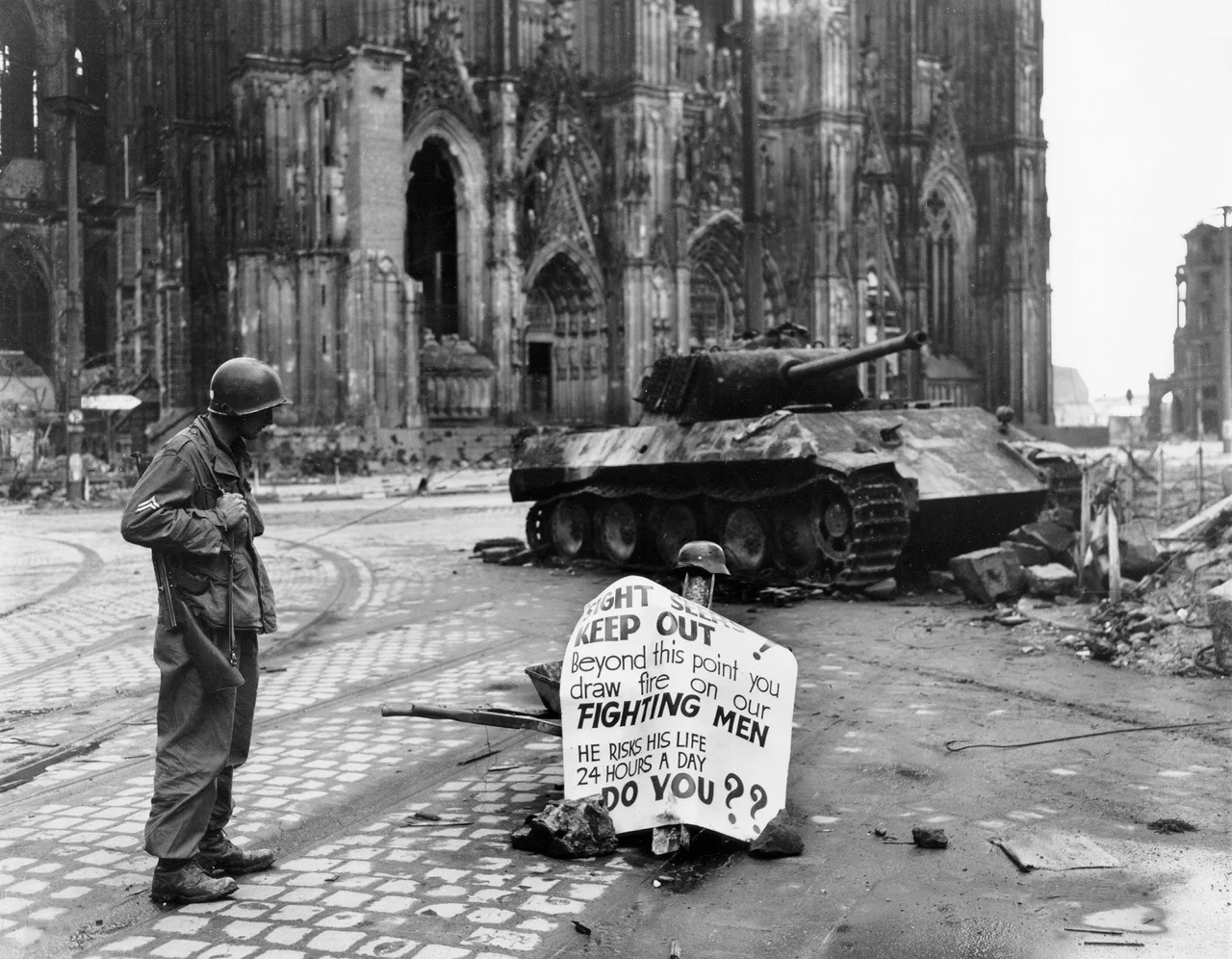
By the end of the Second World War, central Cologne had been pounded into rubble. The cathedral took fourteen direct bomb hits - the Allied aircrews used its twin spires as a navigation landmark, and the cathedral sat in the middle of the target area. Photographs from March 1945 show it standing scarred but upright in a desert of pulverized city. Just west of the cathedral, on 6 March, American Pershing and Sherman tanks fought a German Panther beside a pile of rubble at the train station; the gun-camera footage of that battle survives, with the spires looming above. After the war, a quick patch on the northwest tower used poor-quality brick scavenged from a nearby ruin. That brick scar stayed visible until 2005, sixty years - a small deliberate reminder of what the building had come through.
A Building Never Finished
The cathedral has stood for over a century officially complete, and yet it has almost never stood without scaffolding. The Schlaitdorf sandstone of the 19th-century work weathers badly, and the filigree of buttresses and pinnacles is constantly attacked by rain, sulphur, and bird droppings. Acid rain in the 1960s and 70s turned the stones black; iron anchors holding the decorative work in place have begun to rust and crack the masonry from within. "Cologne Cathedral without scaffolding," the master builder Barbara Schock-Werner once said, "is not a pipe dream, but a nightmare. It would mean that we would no longer be able to afford the cathedral." The Dombauhütte - the cathedral workshop, founded to build the thing in the first place - still employs the stonemasons who keep it from falling apart, financed in part by the same kind of civic association that completed it in the 19th century.
Light Through Pixels
In 2007, the cathedral got a new window. The original 19th-century glass in the south transept had been blown out in the war, replaced for decades by plain panes. The painter Gerhard Richter was commissioned to design a replacement, and what he produced was 11,263 identically sized squares of colored glass in 72 colors, randomly arranged by computer to create what looks, from below, like a luminous carpet of pixels. The then-archbishop, Cardinal Joachim Meisner, had wanted figures of 20th-century Catholic martyrs and refused to attend the unveiling. The window stayed. Six million visitors a year now climb the 533 steps of the south tower to the viewing platform high above the Rhine, or stand in the nave and watch the Richter window scatter color across stone that took most of a millennium to put in place.
From the Air
Cologne Cathedral sits on the west bank of the Rhine at approximately 50.94°N, 6.96°E, in the Innenstadt of Cologne. The 157-metre twin spires are visible from far out - they were used as a navigation aid by Allied bomber crews in World War II and remain one of Germany's most recognizable landmarks from the air. Best viewed from low altitudes during daylight; the cathedral sits roughly 6 nautical miles west-southwest of Cologne Bonn Airport (EDDK / CGN), and is also within easy reach of Düsseldorf International (EDDL / DUS) about 22 nautical miles to the north. Look for the twin openwork spires rising above an otherwise low-rise old town, with the Hohenzollern Bridge crossing the Rhine just to the east.
Nearby Stories
- Diamond Interchange: How a Simple Idea Reshapes Towns Like Julich 2.8 km away
- Dusseldorf-Unterbach 6.1 km away
- Baumwollspinnerei Ermen & Engels 11 km away
- RAF Bruggen 15 km away
- Hagen Open-air Museum 21 km away
- Belgium 130 km away
- Marcinelle Mining Disaster 173 km away
- Zwingenberg Castle 178 km away