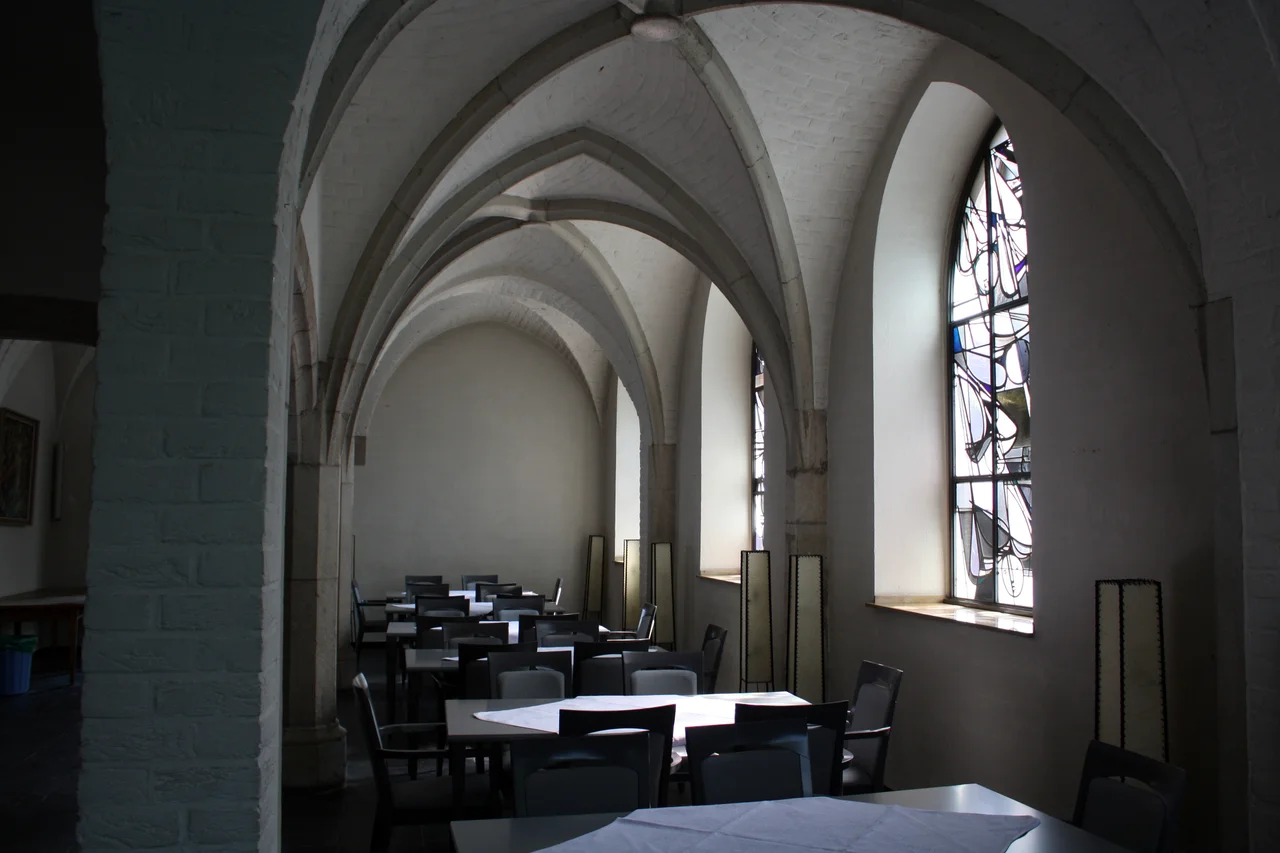

Cologne Charterhouse
The Carthusians did not preach. They did not sing during meals. They did not, in many cases, speak at all - their vow of silence was nearly absolute, and each monk lived alone in his cell, copying manuscripts in a private workshop. And yet, by the 15th century, the silent monks of Cologne Charterhouse had assembled one of the largest book collections in medieval Cologne. The monastery they built south of the city walls became, over four centuries, the largest charterhouse in all of Germany. It was founded in December 1334 by an archbishop who admired the order. It was dissolved in October 1794 by French Revolutionary troops who needed a building for a military hospital, and gave Prior Martin Firmenich exactly twenty-four hours to clear out.
A Bishop's Dream and a Saint in a Vision
Walram of Jülich became Archbishop of Cologne in 1332. He had known the Carthusians in France before his elevation, admired their discipline, and noticed that the nearby bishoprics of Mainz and Trier already had charterhouses while Cologne - the home town of Saint Bruno, the order's founder - did not. He fixed that on 6 December 1334, granting the new monastery 100 malter of wheat annually and launching its long life. The site itself came to the monks five years later, when the patrician families of Scherffgin and Lyskirchen donated a plot called Sencte Mertinsvelt - St. Martin's Field. Legend held that Saint Martin himself had appeared to Walram in a dream and told him to put the monastery there. The little chapel of Saint Barbara already standing on the land was renovated, and in February 1335 the first six Carthusians moved in from Mainz.
The Silent Library
Carthusian life was strict, contemplative, and book-shaped. Each monk lived in a separate cell with its own walled garden and an attached workshop where he could copy manuscripts in silence - unlike at most monasteries, where copyists worked together in the scriptorium. Wealthy novices arrived with entire personal libraries, which they donated upon entry. Patrons gave more. By the middle of the 15th century, St. Barbara's housed one of the largest manuscript collections in medieval Cologne. Then, on 6 November 1451, a fire destroyed the chapter house and the entire library - except for those manuscripts that happened to be out in individual cells for copying. The monks rebuilt within two years thanks to gifts from the rector of Cologne University. By 1500 they had a printing press and a bindery; a 1695 catalogue listed 6,600 volumes, and by the 18th century there were almost 8,000. The fire was a wound they spent half a century closing.
Standing Firm Through the Reformation
When Martin Luther published his theses in 1517 and the German monastic world began to come apart, only one charterhouse - Nuremberg - was dissolved. Cologne stayed put. Prior Peter Blommeveen, in office from 1507 to 1536, published defenses of Catholic doctrine. The Carthusians, bound by their silence, could not preach against the reformers, so they fought back in print: theirs was the press that put the works of Denis the Carthusian and the mystic Gertrude of Helfta into the world. Blommeveen's successor financially backed the first Jesuit community in Germany when it opened in Cologne in 1544. Cologne itself remained almost entirely Catholic, and the monks endured. By 1630 the charterhouse held 23 monks, still the largest Carthusian community in Germany, even as donations slowed and the fashion for severe piety faded.
Twenty-Four Hours to Leave
The French Revolutionary troops occupied Cologne on 6 October 1794. Just over two weeks later, on 23 October, Prior Firmenich received the order: vacate within one day; the monastery was needed as a military hospital. The monks scrambled to save what they could of the church treasures. Looting and vandalism took care of the rest, and the archives, manuscripts, and artworks that had survived fire, reformation, and four centuries of patient labor were scattered. The monks lived for eight more years in temporary lodgings on Martinstraße before the general secularization of 1802 dissolved every religious house in the territory. The buildings passed to the Prussian military, who used the cloisters as a laundry and the church as a stable, an arsenal, and a carriage house. By 1827 only twelve bays of the great cloister remained. Rubble was tipped down the wells.
A Protestant Afterlife
It took a peculiar set of circumstances to bring the building back to life. After the First World War, Cologne's Protestant minority lost the use of the Romanesque St. Pantaleon church to the Catholic majority and was offered, by way of compensation, the long-disused Carthusian church. Inflation delayed the work for years, but on 16 September 1928 the former charterhouse church was rededicated as Protestant - a Catholic monastic church handed to the Reformation it had once printed pamphlets against. The last major air raid of the Second World War, on 2 March 1945, again devastated the complex. The first service afterward was held in the rubble on 19 August that year - the Trümmerkirche, the ruin church. Reconstruction continued in stages, the chapter house finally rebuilt in 1985. Cologne's Protestants meet here still, in a building that has now been many things, none of them what it was originally built to be.
From the Air
Cologne Charterhouse sits in the Altstadt-Süd district of Cologne at approximately 50.92°N, 6.96°E - south of the cathedral, near the line of the medieval Kartäuserwall. From the air it appears as a discreet ecclesiastical complex within a tight urban grid, much less prominent than the cathedral spires a kilometre to the north. The nearest major airport is Cologne Bonn (EDDK / CGN), about 6 nautical miles to the southeast; Düsseldorf International (EDDL / DUS) lies roughly 24 nautical miles north. Best identified by following the curve of the Rhine south from the Hohenzollern Bridge and looking inland.
Nearby Stories
- Diamond Interchange: How a Simple Idea Reshapes Towns Like Julich 2.8 km away
- Dusseldorf-Unterbach 6.1 km away
- Baumwollspinnerei Ermen & Engels 11 km away
- RAF Bruggen 15 km away
- Hagen Open-air Museum 21 km away
- Belgium 130 km away
- Marcinelle Mining Disaster 173 km away
- Zwingenberg Castle 178 km away