
Cologne City Hall
Look up at the 61-metre Gothic tower of Cologne's town hall and you will find, among the rows of solemn stone figures, the seated statue of Archbishop Konrad von Hochstaden - the man who laid the cathedral's foundation stone in 1248. Look directly beneath him, and you will find something the medieval stonemasons sneaked in: a grotesque male figure performing autofellatio. It is not a famous detail of the building. It is not the reason historians come to study the Rathaus. But it captures something true about this place - that the burghers who commissioned the tower in 1406 were the same burghers who had spent three centuries fighting their archbishops for self-government, and they were not above making a permanent visual joke at the church's expense.
The Praetorium Beneath
The town hall stands on bedrock laid by Rome. Until the year 475, this was the site of the Praetorium - the seat of the Roman Governor of Germania Inferior. Merovingian kings used the building as a royal residence into the eighth century, when an earthquake brought it down. The stones above ground level changed, but the address did not. By the early 12th century, documents refer to "a house in which citizens convene" on this exact spot. The coat of arms of Cologne, first mentioned in 1114, is the oldest municipal coat of arms in Europe. By the time the medieval Saalbau - the oldest surviving part of today's building - was raised in 1330, the citizens had been governing themselves from this corner of Cologne for over two centuries.
Fighting the Archbishop
Cologne's burghers won their independence the hard way, in increments. Armed conflicts in 1074 and 1096 set the pattern. Trade guilds and fraternities organized themselves into a commune. In the 1106 war of succession, the citizens took the side opposite their archbishop and emerged with new territorial rights. By 1180 they had successfully sued Archbishop Philip I for permission to extend the city walls. The Battle of Worringen in 1288 broke the archbishop's political grip entirely, and on 9 September 1475 Cologne was formally recognized as a free imperial city. The constitution of 14 September 1396 handed real power to the gaffs and guilds, and from then until 1797 the council was led by two elected Burgomasters - mayors, plural - chosen on the model of Roman consuls. Few cities anywhere in medieval Europe had wrested this much from their bishops.
The Hansasaal
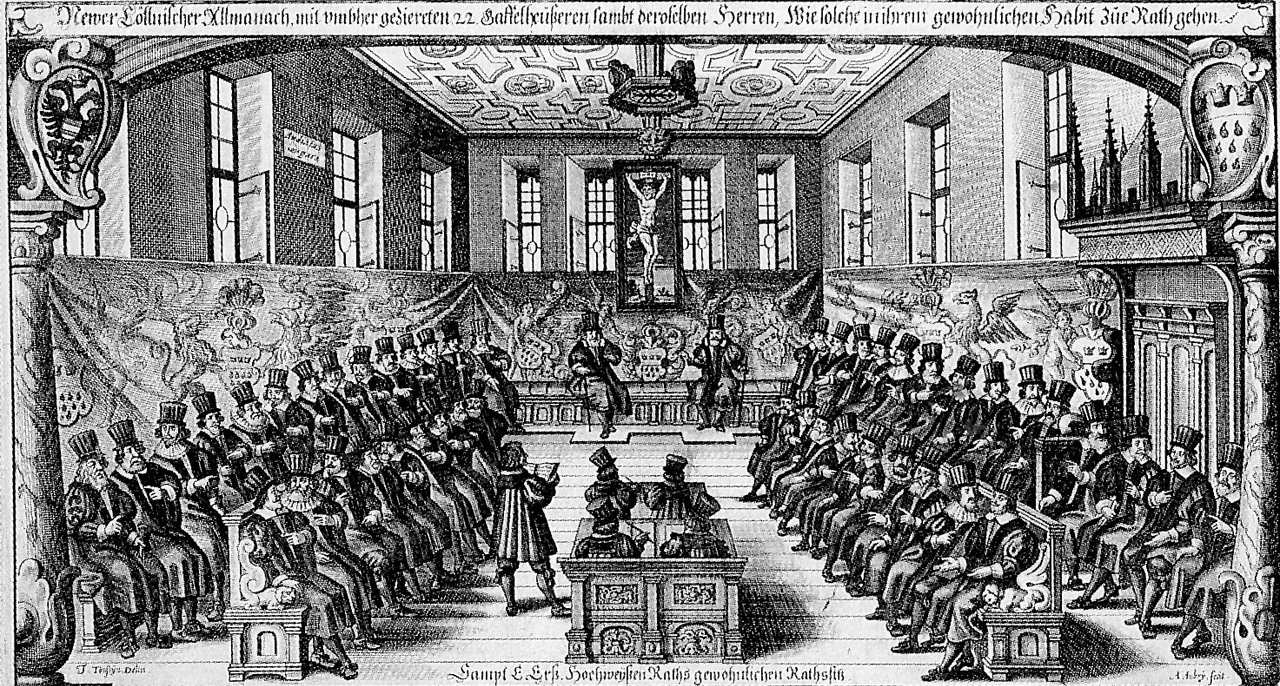
Inside the 14th-century Saalbau is the Hansasaal, a great assembly hall nearly thirty metres long and just under ten tall. Its name comes from 19 November 1367, when an important summit of the Hanseatic League convened in this room. Stone figures of the Nine Worthies look down from the walls - the legendary embodiments of chivalry, three pagan, three Jewish, three Christian - alongside figures of the Emperor and personifications of the city's hard-won privileges. The decoration is a kind of stone manifesto: this room belongs to the merchants and the empire, not to the archbishop. When the council needed a tower in 1406, the guilds commissioned it themselves; Master Mason Gerhard finished it in 1414, five storeys of Gothic verticality crammed with rotational stone portraits of emperors, popes, and prophets. Four times a day, a carillon of bells plays from the top.
The Renaissance Doorway
By the mid-1500s the medieval loggia was decaying and the council wanted something grander. The design process took ten years. In July 1567 the council finally approved a two-storey arcaded loggia designed by Wilhelm Vernukken from Kalkar; construction ran from 1569 to 1573. The Rathauslaube is a small architectural marvel - five bays wide, two deep, a Renaissance porch grafted onto a Gothic body. The upper level functioned as a balcony from which mayors made public speeches to the crowds in the square; the ground floor served as the formal entrance to the Hansasaal. It is the loggia that announces what kind of building this is: a working civic house, designed to face out toward the people whose elected council met inside.
Rebuilt From the Tower Up
When Allied bombs fell on Cologne, the city hall was almost completely destroyed. The front portion and part of the tower survived. Everything else - the Hansasaal interiors, the great mass of the Saalbau, the Renaissance loggia, the 17th-century Spanischer Bau next door - was rubble. Reconstruction was slow and uneven. The Spanischer Bau, heavily damaged in 1942, was fully rebuilt by 1953. The tower's many exterior stone figures, including von Hochstaden and his unfortunate companion underneath, were restored one by one. The postwar period also added something new: the Piazzetta, a 900-square-metre modernist atrium tucked into the heart of the complex. Today the building houses the city council and the Lord Mayor's offices, just as it did - in some form - 900 years ago, when the first "house in which citizens convene" stood on this same Roman ground.
From the Air
Cologne City Hall sits in the historic Innenstadt at approximately 50.938°N, 6.959°E, just off Hohe Straße between the Rathausplatz and the Alter Markt - a short walk south of the cathedral. From the air, the 61-metre Gothic Ratsturm is the most identifiable feature, standing about a third the height of the cathedral spires nearby. The nearest major airport is Cologne Bonn (EDDK / CGN), about 6 nautical miles southeast, with Düsseldorf International (EDDL / DUS) roughly 22 nautical miles north. The Rhine runs just east of the building; the Hohenzollern Bridge is a useful navigational anchor for picking out the old town.
Nearby Stories
- Diamond Interchange: How a Simple Idea Reshapes Towns Like Julich 2.8 km away
- Dusseldorf-Unterbach 6.1 km away
- Baumwollspinnerei Ermen & Engels 11 km away
- RAF Bruggen 15 km away
- Hagen Open-air Museum 21 km away
- Belgium 130 km away
- Marcinelle Mining Disaster 173 km away
- Zwingenberg Castle 178 km away