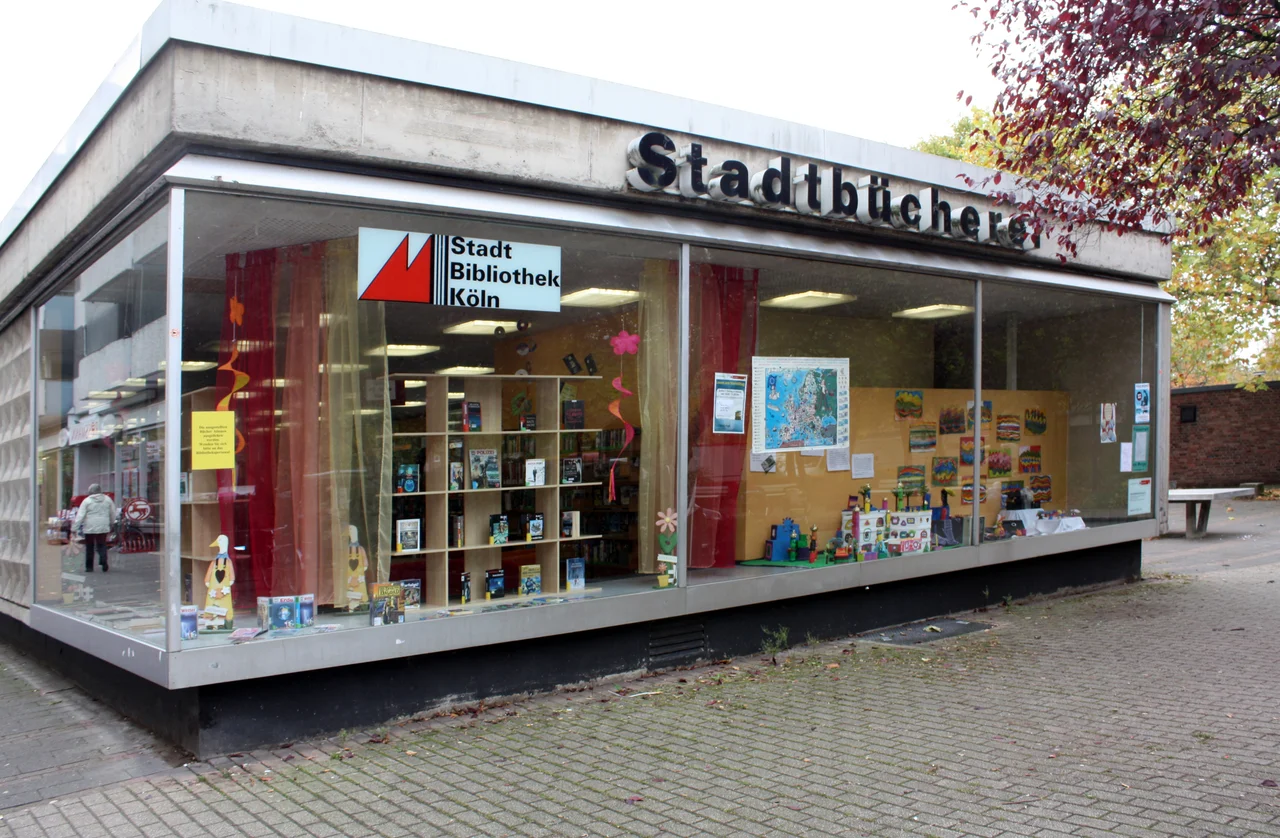

Cologne Public Library
Inside a branch library on the western edge of Cologne, in the suburb of Bocklemuend, the staff running the front desk are teenagers. The branch is operated as a junior company - the kind of arrangement German vocational training sometimes produces - where apprentice librarians manage the building under the supervision of one young employee. They order the books. They run the events. They handle the patrons. This is not a quaint side project; it is part of how the Cologne Public Library system thinks about what a library is. The same library system runs a bookmobile that serves eighteen neighborhoods, a permanent exhibition containing the entire last work room of the Nobel laureate Heinrich Boell, and a maker space where you can borrow a 3D printer or digitize your old VHS tapes. In 2015, the German library community named it Library of the Year.
From the Volksbibliothek
The story begins in 1890 with a single Volksbibliothek - a "people's library" - opened to give working-class Cologners access to books that bourgeois reading rooms did not. Over the decades, donations and municipal money produced a network of Volksbibliotheken and Lesehallen (reading halls) across the city. In 1931 Cologne introduced a mobile library, one of the first in Germany. The Second World War destroyed much of the collection; book donations from abroad, especially from American libraries, helped rebuild it. In 1966 the system was renamed Stadtbuecherei Koeln. The new central library at Josef-Haubrich-Hof opened in 1979, modeled deliberately on the Anglo-American public library tradition - bright, open, oriented toward browsing rather than scholarly research. The Cologne public library would later become the first public library anywhere with its own web server.
The Kulturquartier
The central library is part of what Cologne calls its Kulturquartier, a cluster of cultural institutions near the Neumarkt. The building has eleven storeys - four of them for storage, five for the public - and just over eleven thousand square metres of floor space. It sits beside the Rautenstrauch-Joest-Museum, Cologne's museum of world cultures. On the third floor is a study zone designed specifically for school pupils, equipped with computers and meeting rooms for group work. The music library houses an e-piano, e-drums, and - in a separate room - a baby grand piano that patrons can sit down and play. The entrance hall has a window-projection system that throws images of upcoming cultural events onto the storefront glass. From June 2024 through 2028, the Josef-Haubrich-Hof building is closed for renovation, and the entire central library has decamped to a temporary home in a converted department store at Hohe Strasse 68-82.
Heinrich Boell's Last Room
Among the central library's most unusual special collections is the Heinrich-Boell-Archiv, dedicated to the Cologne-born novelist and 1972 Nobel laureate. The exhibition includes Boell's last work room - the entire room, every piece of furniture intact - reassembled inside the library. Beside it is a photo exhibition of writers from Cologne. The collection sits alongside the Germania Judaica, Cologne's library for the history of German Jewry, founded after the war as part of the city's reckoning with what had happened to its Jewish community. The LIK-Archiv preserves materials on art and literature; the special library for the blind, served by the Medibus mobile service, brings reading material to patrons who cannot easily come in person. None of these collections feels segregated; they exist inside an ordinary working public library that any Cologne resident can walk into and use.
The Library of Things
The Cologne library was an early adopter of the Bibliothek der Dinge concept - the "library of things," where the collection includes objects you might own but rarely need. There are robots and STEM kits. There are 3D printers, cutting plotters, and VR headsets in maker spaces scattered across the branches. The central library houses a fully equipped social-media studio. Several branches let patrons digitize old VHS cassettes and vinyl records. The principle is partly environmental - shareconomy in practice, fewer purchases, less waste - and partly democratic: a 3D printer in the library is available to anyone with a card. The library education programs reach into Cologne's schools through a school service apartment, and an integration project called Bi-IN brings the library into German-language integration courses for new immigrants. The library is, to use the official description, a multicultural meeting place.
A Multilingual City and Its Books
Cologne has about a million inhabitants, and the library serves them in many languages and registers - from preschool reading-promotion projects like the Koelner Buchbabies, to teen-managed branches, to advanced database access for university students through platforms like Statista and LexisNexis. The Bochkemuend junior-company branch is unusual, but so is the branch in the Suedstadt called Haus Balchem, housed in a building reconstructed after the war in 17th-century baroque style. The Foerderverein StadtBibliothek Koeln keeps a network of "minibibs" running - including one in a water tower and another in a city park - operating entirely on trust, without memberships or check-outs. Borrowers take what they want and bring it back. It works. In a country with a long tradition of taking public libraries seriously, Cologne's earned its 2015 Library of the Year award by treating its collection, and its patrons, with a kind of openhanded generosity that other systems study and try to copy.
From the Air
The Cologne Public Library's main building sits at Josef-Haubrich-Hof near the Neumarkt at approximately 50.934°N, 6.949°E, about a kilometre southwest of the cathedral - though during the 2024-2028 renovation, the central collection has temporarily relocated to Hohe Strasse 68-82. From the air the original building is unremarkable among the dense Innenstadt blocks, with the neighboring Rautenstrauch-Joest-Museum a slightly more identifiable presence. The branch libraries are scattered across Cologne's outer districts - Chorweiler, Ehrenfeld, Kalk, Muelheim, Nippes, Porz, Rodenkirchen, Suelz - covering most of the city. The nearest major airport is Cologne Bonn (EDDK / CGN), about 6 nautical miles southeast; Düsseldorf International (EDDL / DUS) is roughly 22 nautical miles north.
Nearby Stories
- Diamond Interchange: How a Simple Idea Reshapes Towns Like Julich 2.8 km away
- Dusseldorf-Unterbach 6.1 km away
- Baumwollspinnerei Ermen & Engels 11 km away
- RAF Bruggen 15 km away
- Hagen Open-air Museum 21 km away
- Belgium 130 km away
- Marcinelle Mining Disaster 173 km away
- Zwingenberg Castle 178 km away