.jpg)
Cologne Zoological Garden
The Victorians who founded the Cologne Zoo in 1860 thought animals deserved palaces. The first elephant house went up looking like a Moorish temple. The bird house borrowed the silhouette of a Russian cathedral. The cattle and ox barns were Swiss log cabins. A century and a half later, much of that whimsy has been replaced by quieter, kinder enclosures, but the impulse to make the zoo feel like a small civilization of its own remains. Today it holds more than 10,000 animals from over 850 species across twenty hectares in the Riehl district, just north of the old city. It is Germany's third-oldest zoo, and it has the scars to prove it.
The Founders' Folly, the Founders' Gift
A group of Cologne citizens organized a shareholding company in 1860 and hired biologist Heinrich Bodinus as the zoo's first director. Bodinus would later go on to direct the Berlin Zoological Garden, but here, in the city's first years of operation, he oversaw the construction of the famous architectural curiosities and the establishment of the basic collection. The naturalistic baboon and polar bear rockwork enclosures, built around 1914 in the style pioneered by Carl Hagenbeck, are still visible in spirit if not in detail. The zoo struggled through the World Wars as Germany did: World War I starved both city and animals, the Great Depression starved the institution itself, and after World War II the zoo had to close for two years entirely because of bomb damage.
The Elephant Park
The current Asian elephant park opened in 2004, replacing the old combined elephant and antelope house. It is one of the largest open-air elephant facilities in Europe, and breeding has been remarkably successful: a calf was born as recently as 2023. The herd has known difficulty too. In May 2012 a female elephant named Chumpol, recently imported from Thailand, was killed in a socialization conflict with other members of the established herd; in elephant terms, she was an outsider who could not find her place. Anyone who has watched Cologne's elephants spray themselves with dust on a warm afternoon will recognize the deep deliberation in their movements. They are the slow, considered center of the zoo.
Hippodom, Rainforest, Aquarium
Three large indoor exhibits anchor the modern zoo. The Hippodom, opened in 2010, recreates a West African watering hole where common hippopotamuses share the space with Nile crocodiles, sitatunga antelopes, aardvarks, and Rodrigues flying foxes overhead. The Rainforest Hall, opened in 2000, is built around a free-flight aviary of Southeast Asian birds: palm cockatoos, Bali mynahs, wrinkled hornbills, the spectacular green peafowl. Lar gibbons swing across ropes above visitors' heads. The aquarium, opened separately in 1971 just outside the main grounds, holds the zoo's amphibian, reptile, fish, and invertebrate collections, including a Lake Tanganyika cichlid tank and a Rhine panorama tank showing the river's native species.
Conservation at the Edge
The zoo runs in-the-wild conservation projects on three continents, focused on Madagascar, Wallacea, and Vietnam. The captive breeding program for the psychedelic rock gecko, an electric-blue lizard from southern Vietnam, is a partnership with Cologne University to protect a species threatened by the international pet trade. Przewalski's horses, the only true wild horse species left on Earth, are also part of the zoo's preservation work. In 1985 Cologne launched the first European Endangered Species Programme, helping to coordinate breeding among zoos across the continent so that small captive populations remain genetically healthy. The architecture of palaces has been replaced by the quieter architecture of pedigree records and field stations.
March 2022
On 15 March 2022 a fire broke out in the Southeast Asian rainforest house. At least 130 animals died. The cause remained under investigation for months. Among those lost were birds the zoo had bred over decades and reptiles that were part of regional conservation populations. The building was eventually rebuilt and reopened, but the loss reshaped how staff thought about fire suppression in tropical houses across European zoos. Other incidents punctuate the zoo's history too: a Siberian tiger named Altai killed his keeper in 2012 after slipping through an unsecured lock; in 1985 two chimpanzees escaped and severely injured the director. The zoo, like every zoo, is a place where two species share complicated proximity. The work of making that proximity safer and more dignified for the animals never quite ends.
From the Air
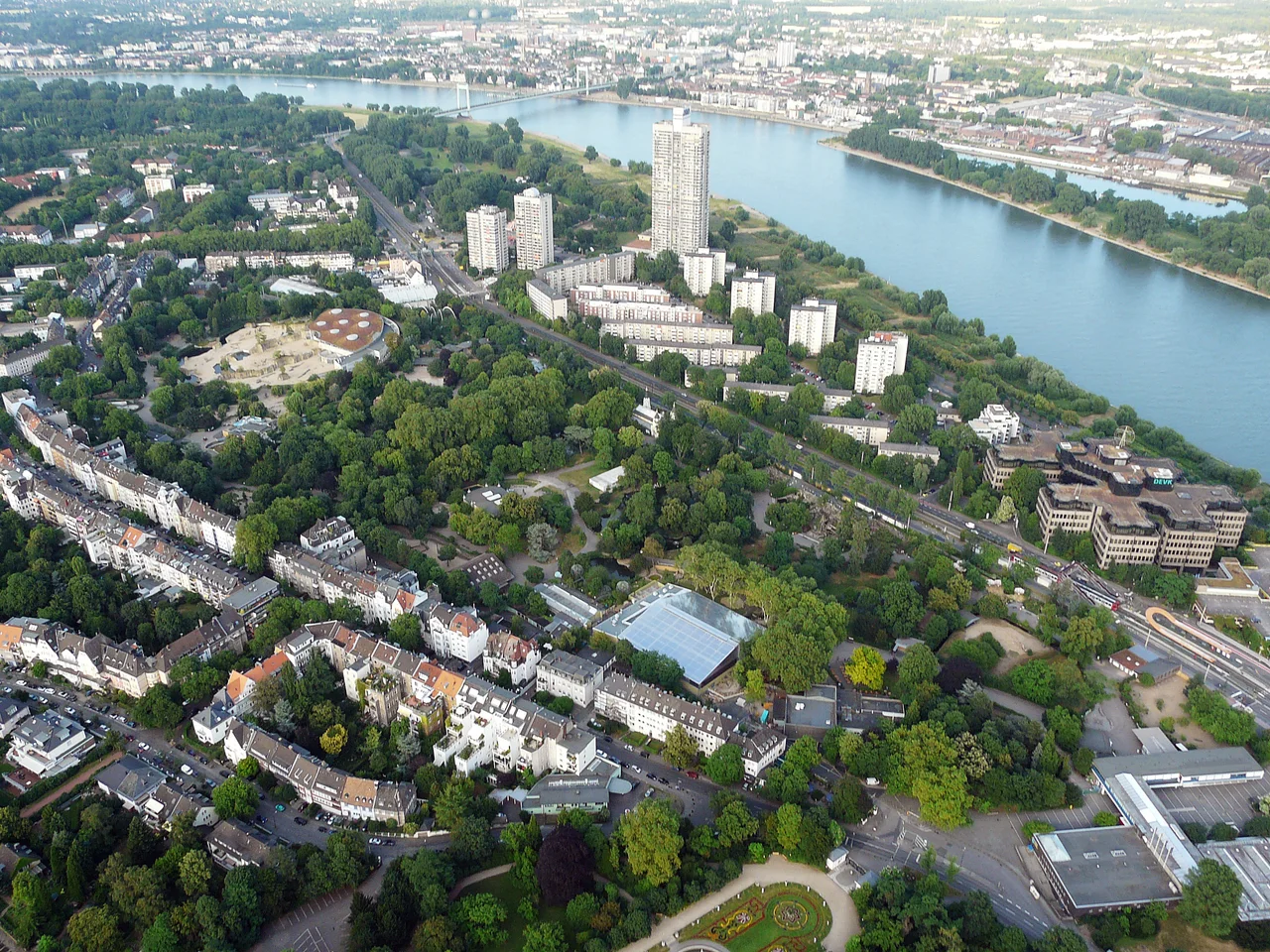
Located at 50.96 degrees north, 6.97 degrees east, in the Riehl district along the right bank of the Rhine just north of the cathedral. Cologne Bonn Airport (EDDK / CGN) lies 16 kilometers southeast; Dusseldorf (EDDL / DUS) is 37 kilometers north. From altitude the zoo is visible as a roughly rectangular green block immediately east of the Rhine, with the round Hippodom roof distinguishable from nearby city buildings. The Cologne Cable Car crosses the river just south of the zoo grounds.
Nearby Stories
- Diamond Interchange: How a Simple Idea Reshapes Towns Like Julich 2.8 km away
- Dusseldorf-Unterbach 6.1 km away
- Baumwollspinnerei Ermen & Engels 11 km away
- RAF Bruggen 15 km away
- Hagen Open-air Museum 21 km away
- Belgium 130 km away
- Marcinelle Mining Disaster 173 km away
- Zwingenberg Castle 178 km away