
Confederate Memorial (Arlington National Cemetery)
The granite foundation is still there. Section 16 of Arlington National Cemetery, on a low rise west of the visitor center, where the concentric circles of grave markers radiate outward from a circular grassy clearing. Until December 20, 2023, a thirty-two-foot bronze stood in the clearing, a figure of the South looking south, surrounded by thirty-two life-size figures sculpted by Moses Ezekiel in his Rome studio. Then a crane from a Virginia contractor that had also dismantled the Lee statues in Richmond and Charlottesville lifted the bronze off its base and trucked it away. The granite stayed because moving it would have disturbed nearby graves. By 2027 a new bronze is expected to stand there again.
A President Notices Untended Graves
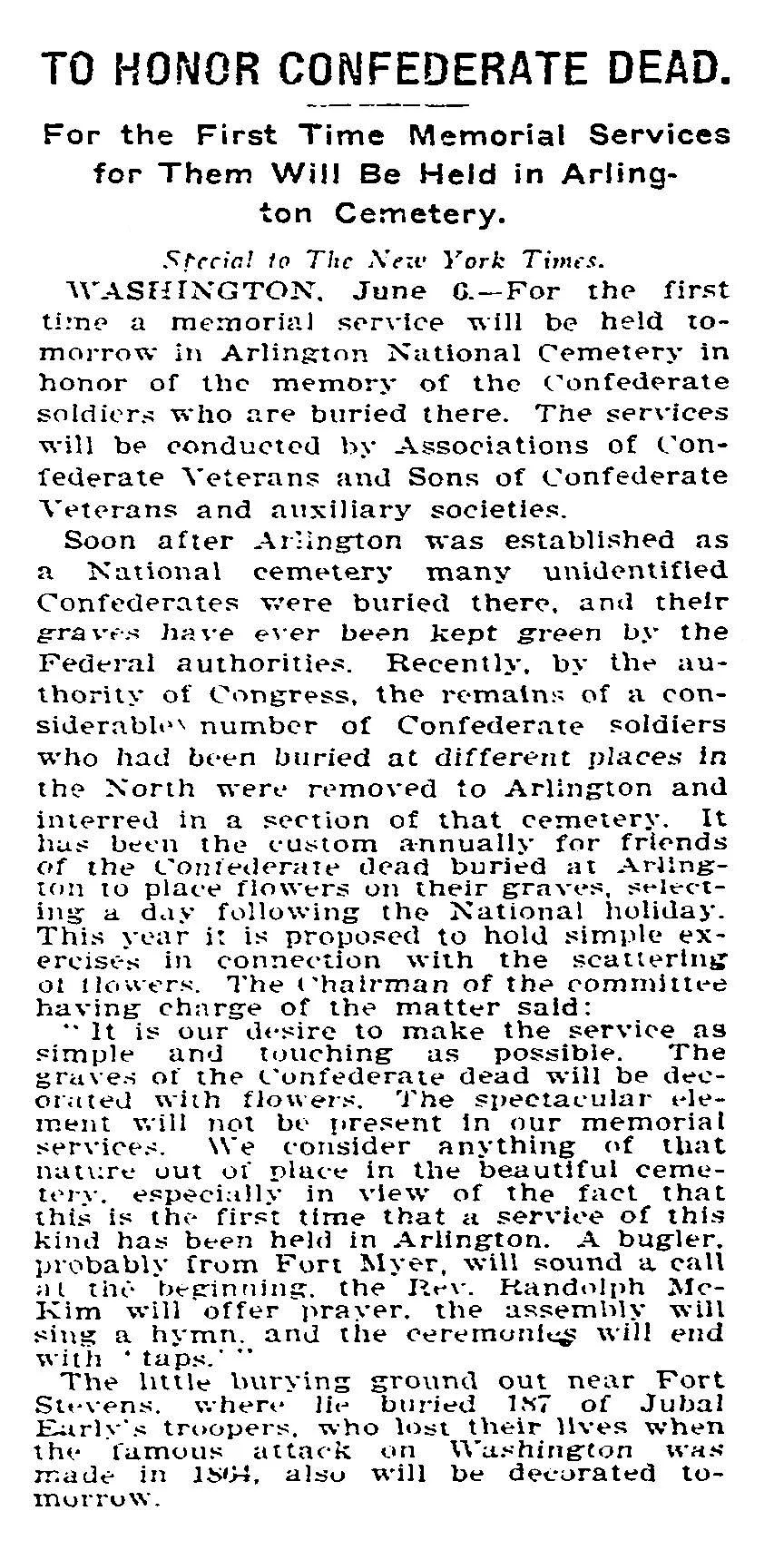
In 1896, campaigning for the presidency, William McKinley passed through Fredericksburg, Virginia and noticed Confederate graves that had been left untended. Most Civil War cemeteries in the North were carefully maintained federal property. The graves of those who had fought for the Confederacy were the responsibility of the states that had supported the rebellion, and many states could not afford the upkeep. McKinley returned to the topic in his presidency. In 1899 a group of Confederate veterans led by Marcus J. Wright petitioned him to allow the Confederate dead at various sites around Washington to be exhumed and reburied together at Arlington. McKinley approved. Congress authorized the plan in 1900 with $2,500 for the work. The Confederate dead were reinterred in concentric circles on 3.5 acres on the western side of the cemetery. Estimates of the number of bodies moved range from 128 to 500, depending on how later burials are counted under the 1912 statute that opened the section to any Confederate veteran living near Washington.
The Memorial the Daughters Built
The Army Corps of Engineers had marked the center of the new Confederate section on its plans with a single letter M, for memorial, but no memorial was specified. The United Daughters of the Confederacy, founded in 1894, requested permission to build one in 1902, 1903, and 1905, and was denied each time. The 1906 request, championed by House Minority Leader John Sharp Williams of Mississippi, succeeded. Secretary of War William Howard Taft authorized the memorial on March 4, 1906, reserving to the War Department the right to approve the design and inscriptions. The UDC raised funds over the next several years through chapter contributions, annual budget allocations, and a Christmas Seals campaign in 1910 designed by Mrs. Edgar James of Florence, Alabama. By November 1914 the UDC had raised $56,262 for the project.
Moses Ezekiel of Rome
The sculptor was Moses Jacob Ezekiel, the first Jewish cadet at the Virginia Military Institute and a Confederate veteran who had fought as a teenager at the Battle of New Market. After the war Ezekiel moved to Rome and built a career as a sculptor of public monuments. He had executed a bronze Thomas Jefferson for the University of Virginia, and on the day he sat in the White House waiting to meet President Taft in May 1910, the idea for the Confederate Memorial came to him. The UDC gave him complete artistic freedom. The thirty-two-foot bronze he sent back to Arlington is densely populated. A larger-than-life female figure crowns the top, representing the South. Below her, on a cylindrical mount, thirty-two life-size figures depict soldiers leaving for war and the people they left behind. The work was dedicated on Confederate Memorial Day, June 4, 1914, with President Woodrow Wilson speaking before a crowd of more than four thousand.
What the Bronze Said
Ezekiel's memorial is a Lost Cause artifact, made during the period when veterans of the Confederacy and their descendants were actively reshaping the public memory of the war into a story about state's rights, valor, and reconciliation rather than slavery and treason. The most contested figures on the monument are two depictions of enslaved Black Americans that the sculptor and the UDC presented as loyal servants going to war alongside their masters: a Black soldier marching behind a white officer, and a Black woman holding a white child while a Confederate soldier kisses the child goodbye. These were not historical scenes. They were Lost Cause fiction sculpted in bronze, intended to argue that slavery had been benign and that enslaved people had supported the Confederacy. In 2020 Arlington National Cemetery installed an interpretive plaque near the memorial acknowledging its highly sanitized depictions of slavery.
Removal and Return
Congress established the Naming Commission in 2021 to review Department of Defense items honoring those who had served the Confederacy. The Commission recommended removing the Arlington Memorial. The Defense Department accepted the recommendation in January 2023. After lawsuits and a brief federal court order, the bronze was taken down on December 20, 2023 by Team Henry Enterprises, the same contractor that removed the Robert E. Lee statues from Monument Avenue in Richmond and the University grounds in Charlottesville. The bronze elements were trucked to New Market Battlefield State Historical Park, on Virginia Military Institute land where Moses Ezekiel had once fought as a cadet. The granite base remained at Arlington, surrounded by the graves of Ezekiel himself and three of the men who had brought the memorial into being. In August 2025, Secretary of Defense Pete Hegseth announced that the monument would be returned to Arlington. The Army estimated the restoration cost at ten million dollars. The bronze is expected to be reinstalled by 2027. The argument the country has been having about how to remember its Civil War, and who gets to do the remembering, continues to be staged on this small circle of ground in section 16.
From the Air
The Confederate Memorial site is at 38.8761 degrees north, 77.0773 degrees west, in section 16 of Arlington National Cemetery, on the western slope just inside the cemetery walls. Best viewed at 1,500 to 2,500 feet AGL with the cemetery's hillside expanse of headstones visible to the east. Reagan National (KDCA) is about three nautical miles southeast across the Potomac. The cemetery sits just outside the P-56 prohibited area but inside the Washington Class B veil; overflight requires ATC coordination with Potomac TRACON.
Nearby Stories
- Gunston Hall 1.1 km away
- 2023 Baltimore Shooting 4.9 km away
- Battle of Middleburg 6.6 km away
- Crownsville Hospital Center 10 km away
- Battle of Loudoun Heights 13 km away
- First Battle of Rappahannock Station 20 km away
- Howard County, Maryland 21 km away
- Harriet Tubman Underground Railroad 50 km away