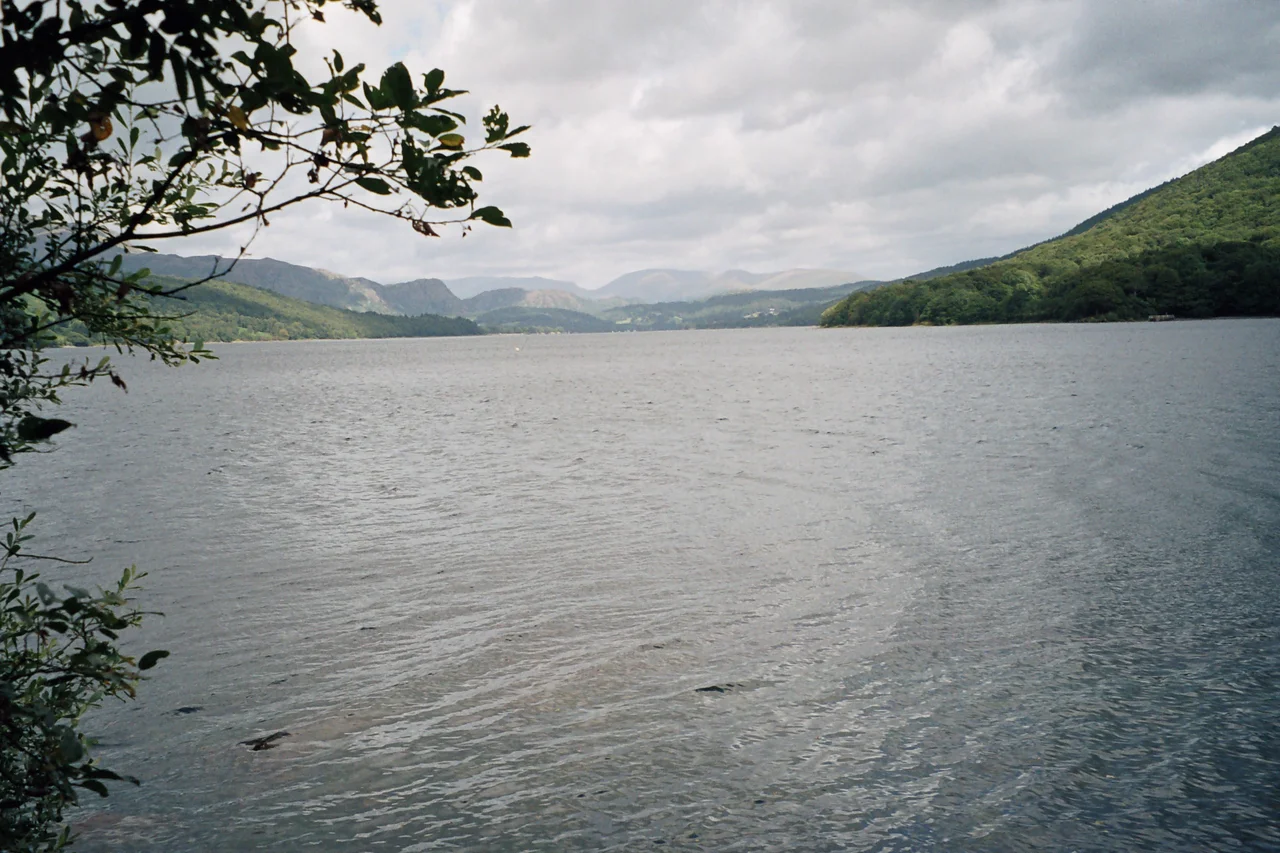

Coniston Water
On a still morning in January 1967, the surface of Coniston Water lay so flat that pilots called it a perfect mirror. Donald Campbell needed it that way. His jet-powered hydroplane Bluebird K7 had already pushed past 320 miles per hour on the lake's measured kilometre, and he wanted one more pass to make the record indisputable. The boat rose, tumbled, and broke apart. The lake that had made his family's name in speed had also, in a few seconds, taken him away. That story still sits at the heart of how visitors see Coniston Water - but it is only the most recent layer of a place that monks once fished, Romans once mined, and a Victorian sage chose for the view from his study window.
Carved by Ice, Owned by Monks
The lake is the work of a glacier. During the last ice age, a great tongue of ice gouged south down a U-shaped valley, scouring the volcanic and limestone bedrock into the long ribbon now filled with 8.7 kilometres of cold, dark water. At its deepest the lake reaches 56 metres, and its outflow becomes the River Crake, which runs on to Morecambe Bay via the estuary of the Leven. Bronze Age farmers settled the shores, and Roman prospectors found copper in the fells above. By the 13th century, the monks of Furness Abbey owned the lake and counted its fish among the abbey's reliable winter food. The medieval economy did not end with the dissolution: copper continued to come out of the surrounding hills until the 19th century, and a Norse-derived name, Thurston Water, lingered as an alternative until the late 1700s.
Ruskin's View, Ransome's Lake
In 1872, the Victorian critic and philosopher John Ruskin bought Brantwood House on the eastern shore. He lived there until his death in 1900, and chose to be buried in the churchyard at the village of Coniston rather than in Westminster Abbey. His secretary, the antiquarian W. G. Collingwood, wrote a historical novel, Thorstein of the Mere, about the Norse settlers said to have lived on the lake's islands. A generation later, the children's author Arthur Ransome stitched Coniston Water and Windermere together into the fictional lake of Swallows and Amazons. Peel Island, low and wooded near the southern end, became the Wild Cat Island of the books, and the River Crake became the Amazon River. The 2016 film adaptation returned to Peel Island to shoot, closing a loop that began in the 1930s.
The Campbells and the Mirror Surface
Coniston earned its reputation as the spiritual home of British water speed because of one family. On 19 August 1939, Sir Malcolm Campbell set the world record here at 141.74 mph in Blue Bird K4. Between 1956 and 1959, his son Donald took the record on the same lake four times in a row in Bluebird K7. The fatal 1967 run came as Donald reached for an even higher mark - over 320 mph - and lost the boat. His widow and daughter waited at the lakeside. The K7 itself, after decades on the lake bed, was raised in 2001 and is now displayed at the Ruskin Museum in Coniston village. Each November, the Windermere Motor Boat Racing Club lifts the lake's 10 mph speed limit for Records Week, a tradition kept alive by roughly sixty volunteers. In 2023 a nine-year-old from Lowestoft, Tate Mantripp, set a class record in the GT15 category, becoming the youngest competitor in the event's 51-year history to do so.
Life on the Water Today
Outside Records Week, the lake is governed by that 10 mph limit, shared with Ullswater and Derwentwater. Kayakers and canoeists treat it as the second leg of the Three Lakes Challenge, paddling its length end to end. The Victorian steam yacht Gondola, restored and back in service, tours quietly in the summer months, joined by two smaller launches named Campbell and Cygnet. Brantwood is open to visitors. The Old Man of Coniston rises behind the village to the north-west, the highest fell in the historic county of Lancashire. From the deck of a hire boat, looking north, you can see Helvellyn in the far distance on a clear day, framed by water that holds eight centuries of working life and one of motorsport's hardest-won records.
From the Air
Coniston Water sits at 54.35 N, 3.07 W in the southern Lake District, oriented roughly north-south. The lake is 8.7 km long and easy to identify from altitude alongside the parallel ribbon of Windermere to the east. The Old Man of Coniston (803 m / 2,634 ft) rises immediately to the west and demands respect in low cloud. Nearest airfield is Walney Island (EGNL), about 25 km south on the Furness coast; Carlisle Lake District (EGNC) lies about 65 km north. Recommended viewing altitude 3,000-5,000 ft AGL. Cumbrian weather can close in rapidly; rotors and low cloud are common over the Coniston Fells.
Nearby Stories
- Morecambe Bay 4.1 km away
- Caldbeck 8 km away
- Pendragon Castle 8.1 km away
- Egremont Castle 8.5 km away
- Upper Teesdale 13 km away
- Solway Firth 13 km away
- Malham Cove 21 km away
- Santon Railway Station 70 km away