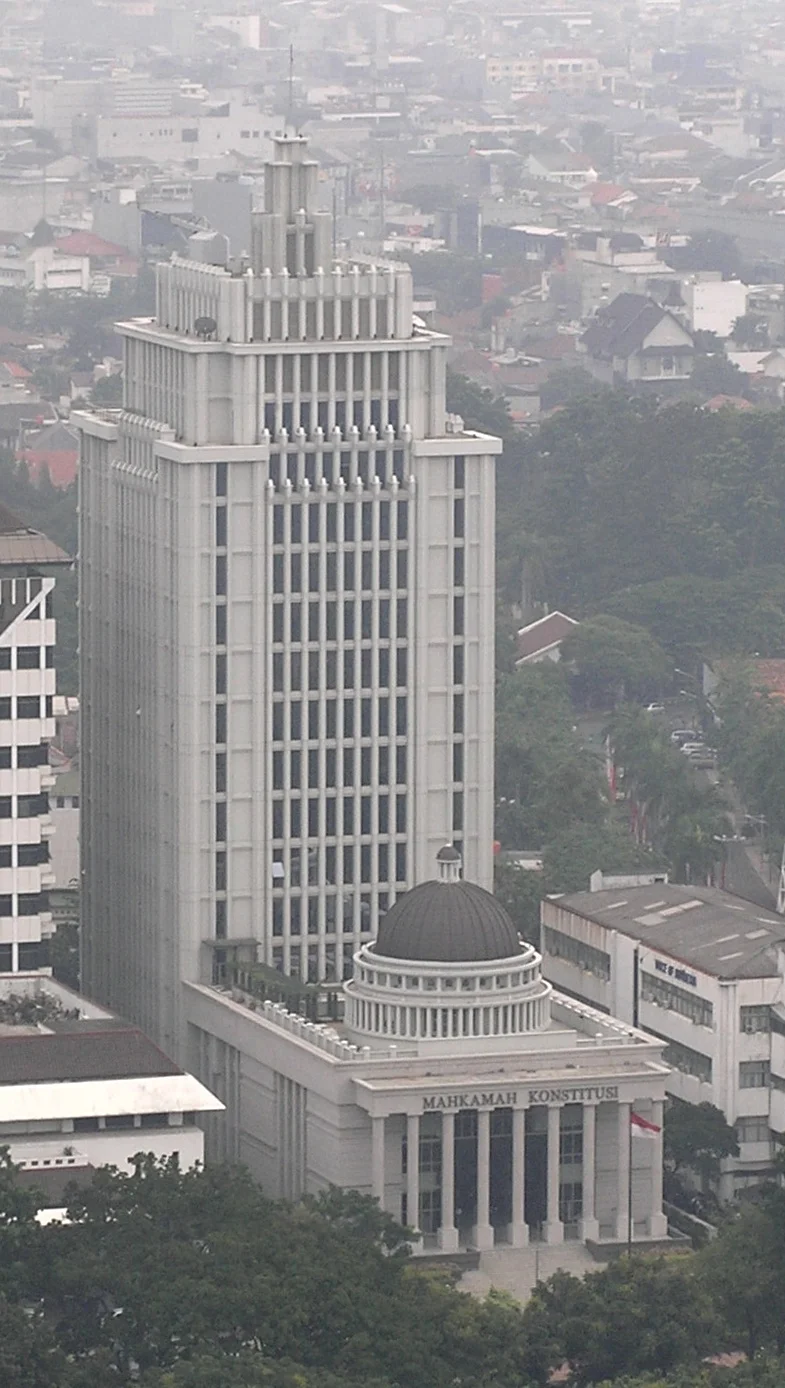

The Court That Guards the Constitution
In October 2013, Indonesian police arrested the chief justice of the Constitutional Court. Akil Mochtar, the man entrusted with guarding the constitution, was charged with accepting bribes to fix the outcomes of regional election disputes. The arrest sent a shockwave through a nation that had come to regard the court as one of the few success stories of its post-Suharto democratic reforms. The institution was barely a decade old. How the Constitutional Court of Indonesia rose from a constitutional amendment to a pillar of democratic legitimacy -- and then stumbled -- is a story about the fragility of institutional trust in a young democracy.
Born from Reform
The Constitutional Court did not exist before 2001. Indonesia's original 1945 constitution, written in the final days of Japanese occupation, concentrated power in the presidency and provided no mechanism for judicial review of legislation. For decades under Sukarno and then Suharto, no court had the authority to strike down a law as unconstitutional. The third amendment to the constitution, ratified by the People's Consultative Assembly on November 9, 2001, changed that. It created a new court with five specific powers: reviewing the constitutionality of laws, resolving disputes between state institutions, settling election result challenges, ruling on the dissolution of political parties, and adjudicating presidential impeachment proceedings. The last two powers have never been used. In August 2003, nine justices were appointed -- three by parliament, three by the president, three by the Supreme Court -- and sworn in on August 16. The Constitutional Court was open for business.
Nine Scholars and a General
The founding bench was unusual. Jimly Asshiddiqie, a law professor from the University of Indonesia who had helped draft the constitutional amendments, became the first chief justice. His colleagues included academics from universities across the archipelago -- Airlangga in Surabaya, Udayana in Denpasar, Brawijaya in Malang, Sriwijaya in Palembang -- alongside a retired Supreme Court judge, a former high court chairman from Bengkulu, and a retired lieutenant general. This mix of scholars, jurists, and a military officer reflected the breadth of Indonesia's post-reform coalition. The court wasted no time. In its first years, it delivered landmark rulings that rehabilitated the political rights of former communist party members, struck down retroactive anti-terrorism provisions, and abolished defamation laws that had shielded the presidency from criticism. During the 2004 general election and presidential vote, the court's handling of electoral disputes earned wide public respect. By the end of Asshiddiqie's tenure in 2008, the Constitutional Court was mentioned in the same breath as the Anti-Corruption Eradication Commission as proof that Indonesia's democratic experiment was working.
Cracks in the Marble
Trust, once built, proved easier to damage than to repair. When Akil Mochtar was arrested in 2013, President Susilo Bambang Yudhoyono responded with emergency regulations tightening the appointment process: prospective justices could not have had political party ties for at least seven years and would face screening by an independent panel. Parliament endorsed these changes in December 2013. But a deeper structural problem persisted. The court's jurisdiction over electoral disputes had expanded steadily since 2009, growing from national elections to include gubernatorial and regency-level contests. Each new category of dispute brought new opportunities for corruption and new political pressures. Enforcement remained weak. Local officials sometimes simply refused to comply with rulings, and the court had limited mechanisms to compel obedience -- a vulnerability shared across Indonesia's legal system.
Family Ties and the 2024 Election
The court's most controversial moment came on October 16, 2023, when it amended the Election Law in response to a student's petition. The ruling allowed candidates under 40 to run for president or vice president, provided they had experience as regional leaders. This exception appeared tailored for one specific person: Gibran Rakabuming Raka, the 36-year-old mayor of Surakarta and eldest son of President Joko Widodo. The ruling's legitimacy was immediately questioned because Chief Justice Anwar Usman was Jokowi's brother-in-law and Gibran's uncle. Gibran went on to win the vice presidency in the February 2024 election alongside Prabowo Subianto. Ganjar Pranowo, a rival presidential candidate, publicly accused the court and the General Elections Commission of ethical violations. The episode illustrated the court's central paradox: an institution designed to be the ultimate check on political power can itself be captured by the political interests it was meant to constrain. For a court that began as a beacon of Indonesia's democratic aspirations, the question now is whether institutional reforms can restore what political entanglement has eroded.
From the Air
The Constitutional Court building is at 6.17S, 106.82E in Central Jakarta, west of Merdeka Square near the intersection of Jalan Medan Merdeka Barat. From the air, locate Merdeka Square by the National Monument (Monas) obelisk at its center; the court complex is on the western side. Nearest major airport is Soekarno-Hatta International (WIII), approximately 25 km northwest. Halim Perdanakusuma Airport (WIHH) is about 12 km southeast. The building is a modern institutional structure, not easily distinguishable from altitude without contextual landmarks.
Nearby Stories
- The King's Footprints in the River 2.8 km away
- Rawagede Massacre 6.4 km away
- The Cruiser That Wouldn't Stop Fighting 14 km away
- Four Minutes Over the Java Sea 14 km away
- The Scholar's Mosque 21 km away
- Through the Cidepong Hills 37 km away
- Ujung Kulon National Park 97 km away
- The Islands That Vanished from Sight 352 km away