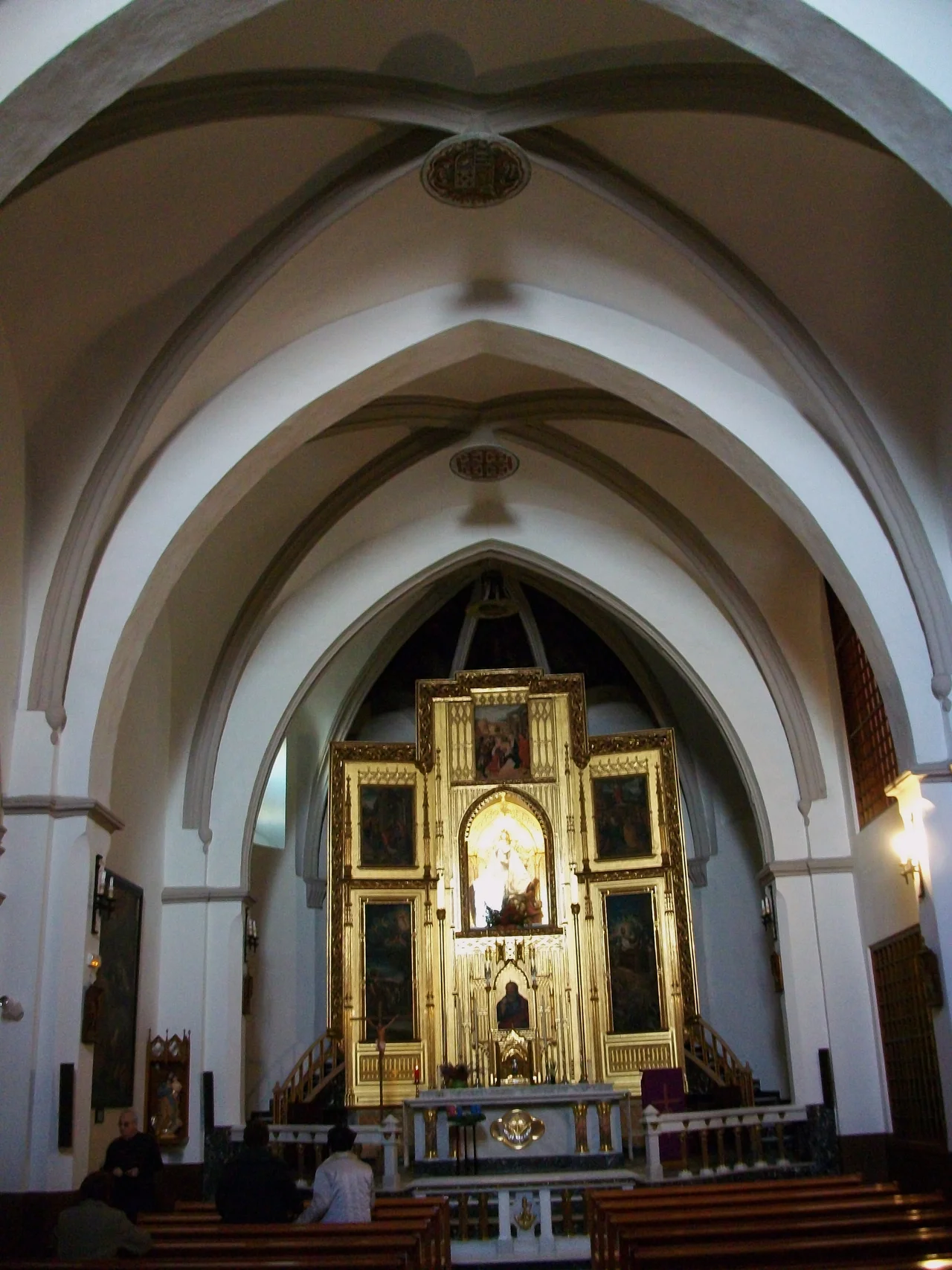

Convent of Santa Clara of Gandia
History remembers the Borgia men — the popes in Rome, the dukes and cardinals, the whispered reputation for poison and power. But a quieter chapter of the family unfolded behind a wall in Gandia, at the Convent of Santa Clara. Here, for generations, the women of the Borgias lived out their lives in enclosure: a duchess who traded her title for a nun's habit, a noblewoman in flight from a marriage she never chose, and five sisters of a saint. It is a cloistered convent still, largely closed to the world, guarding both its silence and a trove of Renaissance treasure.
Founded by a King's Daughter
The convent was founded in 1431 by Violante of Aragon, daughter of Alfonso of Aragon and Foix, the royal Duke of Gandía. She gave it to the Colettine Poor Clares, a reformed and especially strict branch of the enclosed Franciscan order, and set it in the heart of the town, a few steps from the great Collegiate Basilica of Gandia. Its Gothic church holds an altarpiece by the Italian master Paolo da San Leocadio, the painter who helped carry the Renaissance into Valencia. After Violante died, the house fell nearly empty for a time, before a Valencian noble, Luis Vich y de Corbera, took it upon himself to restore it and bring the cloister back to life.
Refuge
To refill the silent cloister, ten nuns traveled all the way from a convent in the French town of Lézignan-Corbières, carrying their community's way of life across the mountains. Among them was one remembered as María Escarlata, said to be the sister of a French prince, who had fled to Gandia to escape a marriage forced upon her. Her story hints at what these walls could mean. For some women the convent was a genuine calling; for others it was sanctuary — the one place where a woman of rank might refuse the future her family had arranged for her, and be left, at last, in peace behind a grille no one could cross.
The Borgia Women
It was the Borgia family, above all, that filled Santa Clara. María Enríquez de Luna, Duchess of Gandia, set aside her title to enter as Sister Gabriela; the community chose her as abbess in 1530, and she died nine years later. Her daughter, Sister Francisca de Jesús, became abbess in her turn in 1533 and led the house until 1548. Francisca lived to witness something extraordinary — her own mother in the same cloister, and alongside them five of her nieces, the sisters of Saint Francis Borgia, the Duke of Gandía who surrendered his dukedom to become a Jesuit and was later canonized. In the courtyard grows an ancient olive tree that tradition says the saint planted with his own hands, a living thread binding him to the women of his family who prayed here. Between them, mother and daughter turned a modest Valencian convent into a Borgia household of a wholly different kind from the one the world was watching in Rome.
A Treasure Behind the Grille
For all its austerity, the convent became a strongbox of art. The Borgias left it an extraordinary collection — paintings from the hands or workshops of José de Ribera, Juan de Juanes, Paolo da San Leocadio, Francisco Salzillo, and Francisco Ribalta, cherished behind the enclosure for more than five hundred years. The nuns also keep a venerated image known as the Virgin of Baluarte, the Virgin of the Bastion. In 2010 the community agreed to lend works to the town for a future Museum of the Poor Clares, in the old Sant Marc Hospital, finally letting the world glimpse what it had guarded so long. Yet Santa Clara remains a working, enclosed convent. Only the Valencian Gothic church can be entered — a single lit doorway into a world that has kept its own counsel since 1431. What lies beyond it — the paintings, the relics, the memory of the women who chose these walls — is a reminder that not every Borgia story ends in a palace or a papal court. Some end, quietly, in prayer.
From the Air
The Convent of Santa Clara stands in the historic center of Gandia, at roughly 38.967°N, 0.178°W, on a coastal plain about 65 km south of the city of Valencia. From the air, aim for the compact old town set back a couple of kilometers from the sea, marked by the tower of the Collegiate Basilica of Gandia and, nearby, the Ducal Palace of the Borgias; the long sweep of Gandia's beach and its port lie just to the east. Best viewed from 2,000–4,000 ft in clear weather, with the Serra de Corbera hills rising inland to the west. Nearest airport is Valencia (LEVC) to the north; Alicante–Elche (LEAL) lies to the south. Coastal light is usually bright, with occasional morning haze off the Mediterranean.
Nearby Stories
- Route of the Castles of Vinalopó 6.6 km away
- Barony of Polop 6.9 km away
- La Bastida de les Alcusses 16 km away
- Albufera Natural Park 17 km away
- La Tomatina 26 km away
- Illa de s'Espartar 73 km away
- Illa Grossa 83 km away
- Battle of Cape Cherchell 255 km away