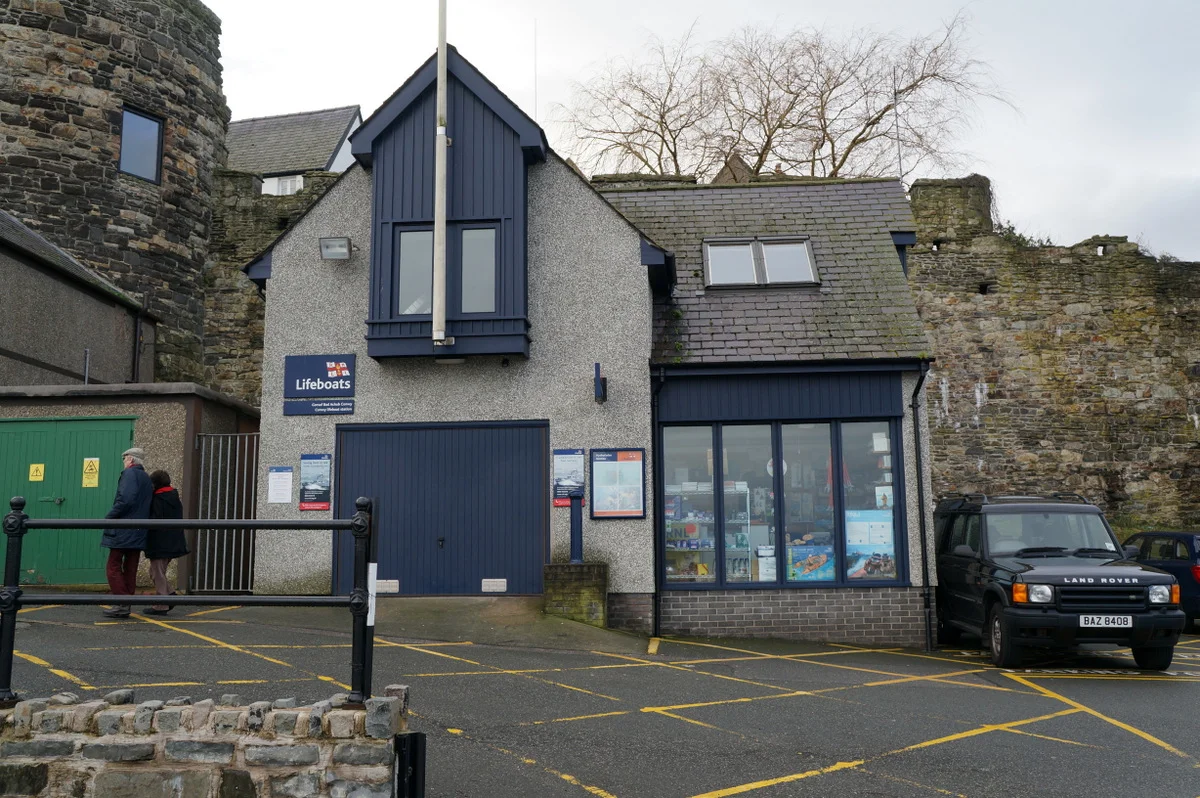

Conwy Lifeboat Station
On the afternoon of 30 August 1970 a force eight gale was tearing across the bay west of Llandudno when the Conwy lifeboat - an open inflatable, three crew aboard - launched into it. The cabin cruiser Fulmar was in trouble west of West Shore with two men aboard. Brian Jones, Ronald Craven and Trevor Jones reached the cruiser, lifted both men off it, and watched the empty boat break up on the rocks moments after. They came home wet, exhausted, and famously decorated: each received The Thanks of the Institution inscribed on Vellum. The boathouse where they had launched from - a small slate-roofed building on Lower Gate Street, in the literal shadow of Conwy Castle - is still where the Conwy lifeboat lives today.
1964: small boats, fast
The Conwy station owes its existence to a strategic shift inside the RNLI. By the 1960s leisure boating around the British coast had exploded; the old all-weather lifeboats, slow to crew up and slow under way, were missing rescues that needed an immediate response. In 1964 the institution placed twenty-five small fast inshore lifeboats around the coast - the D-class inflatable, easy to launch, easy to crew with three people, capable of getting to a casualty in minutes rather than half an hour. Conwy was one of the stations added shortly after. In May 1966 the unnamed D-97 arrived in the town and the new lifeboat station was formally established. Trevor Jones, who would later command the Fulmar rescue, joined the crew that year. He was twenty-two.
The Arthur Bate boats
Lifeboats in Britain are most often named after the donors who paid for them. In September 1995, in Conwy harbour, Miss Joan Bate named the new Conwy lifeboat in honour of her late brother Arthur, whose legacy had funded it. The Arthur Bate, D-482, served for nine years. When she was retired the same legacy paid for her replacement, Arthur Bate II, D-627, which arrived in 2004. A new boathouse had been built in 1985 on Lower Gate Street, replacing the original temporary arrangement: it added proper crew facilities, storage, and a small retail outlet, and was opened on 29 July that year by Captain S. R. Roberts, the Mayor of Conwy. The current boat on station is Enid and John Hislop, D-898, which arrived in February 2025.
Estuary, sandbar, gale
The Conwy lifeboat works one of the more treacherous estuaries on the Welsh coast. The river opens out where two railway bridges and a road tunnel cross from west to east, and a complicated set of sandbanks shifts with the tides. The Great Orme to the north generates its own weather; Liverpool Bay can build vicious chop in onshore winds. Most callouts are not 1970-scale dramas but the steady work of an inshore boat: capsized kayaks, dinghy sailors in trouble, walkers cut off by the tide on the sands at West Shore. The Conwy and Llandudno boats together cover the same coastline and often launch in tandem, the two stations a few miles apart by water though belonging to different sides of the Creuddyn peninsula.
Fifty years
The station celebrated its fiftieth anniversary on 18 June 2016. The man at the centre of the celebrations was Trevor Jones, then Lifeboat Operations Manager, who had joined as a young crewman on the day the station opened in 1966 and was still there half a century later. He had been on the boat for the Fulmar rescue. He had seen the station move from the original temporary boathouse to the 1985 building. He had watched the boats themselves evolve from open inflatables to enclosed-cabin D-class with rigid keels and inboard motors. The lifeboat service in Britain is sustained by people like this - volunteer crews who join young and stay decades, learning their stretch of coast in a way no chart can capture.
Flight Context
Conwy Lifeboat Station sits at 53.281 north, 3.826 west, on Lower Gate Street directly below the south-east tower of Conwy Castle. From the air it is the small building just outside the medieval walls at the quay. Best viewed at 1,500 to 2,500 ft AGL flying along the Conwy estuary. Nearest airports: Caernarfon (EGCK) twelve miles west, RAF Valley (EGOV) on Anglesey, Hawarden (EGNR) east toward Chester. The boat is normally on display by the quay and worth a stop for anyone visiting the castle.
From the Air
53.281°N, 3.826°W, Lower Gate Street, in the shadow of Conwy Castle. Best viewed at 1,500-2,500 ft AGL. Nearest airports: EGCK Caernarfon, EGOV Valley, EGNR Hawarden.
Nearby Stories
- Caldy 1 km away
- Moelfre, Anglesey 1.2 km away
- Pen-yr-Orsedd Quarry 2.5 km away
- Ysbyty Ifan 7.5 km away
- Birkdale Palace Hotel 9.5 km away
- Wrexham County Borough Museum 12 km away
- Celtic Array 22 km away
- Southport Lifeboat Station 45 km away