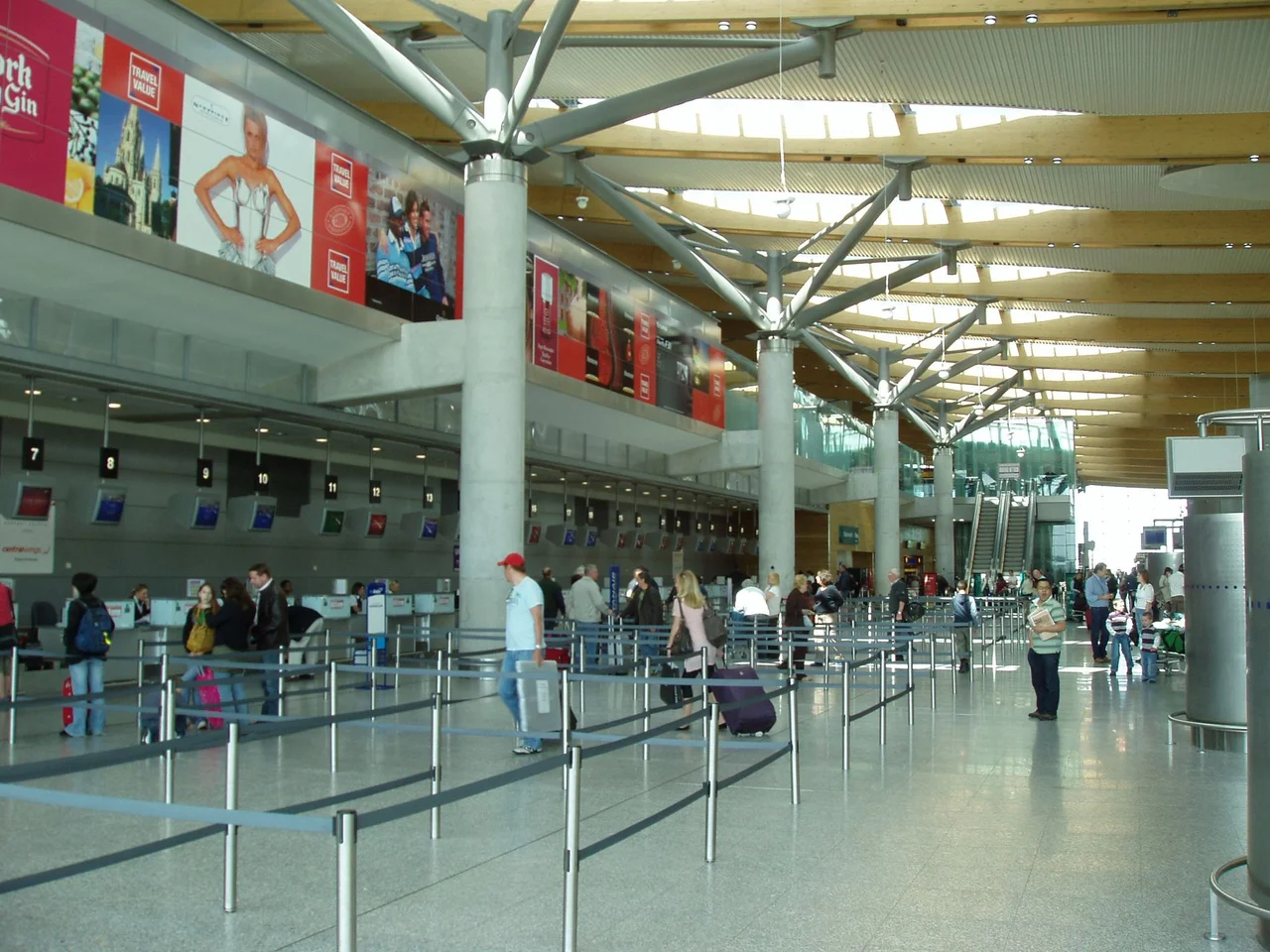

Cork Airport
The airport sits on a hill, and the hill makes weather. At 153 metres above sea level, Cork Airport sometimes wakes inside the cloud rather than beneath it, and pilots inbound to runway 17 or 35 can find the ground hidden under a soft grey ceiling that does not lift on demand. Locals know this. The morning fog at EICK is part of the airport's character, the price of its hilltop location south of the city at a place that once went by the gentler name of Farmers Cross.
From Farmers Cross to Jet Age
In 1957 the Irish government finally agreed Cork needed an airport, and after considering several sites the decision landed on a stretch of land near Ballygarvan. Tenders went out in 1959 at an estimated cost of one million pounds. Construction took two more years. On 16 October 1961 the airport opened, four days after proving flights by Aer Lingus and Cambrian Airways. That first year, the terminal handled 10,172 passengers - roughly what a single day's traffic would look like by 2007. Then came the jet. On 29 March 1964 a British Overseas Airways Corporation Comet touched down on the Cork runway, the first jet ever to land there. Within five years Aer Lingus was flying to Heathrow, Manchester, and Bristol. The fields around Farmers Cross had become a working international airport in less than a decade.
The Hill and the Fog
Geography defines the airport's daily life. That 153-metre elevation gives Cork beautiful views and persistent low cloud ceilings. The instrument landing system was eventually upgraded to Category II, and the main runway extended by 305 metres, both decisions aimed squarely at the fog problem. Diversions still happen on the worst mornings - flights peeling away to Shannon, Dublin, or Kerry when visibility collapses. Aircraft from those airports sometimes divert to Cork in return when their own weather turns. The runway length also sets a limit on what can land here. Fully loaded wide-bodies cannot use Cork, so when a Munster Rugby charter or a special long-haul service does arrive, it tends to make local news.
Three Million and Counting
Ryanair came in 1987, then made Cork its second Irish base in 2005. The current terminal opened on 15 August 2006 with eight gates, two of them equipped with airbridges. The low-cost carriers had famously told the airport authority they did not want airbridges, would not use them, and would not pay for them, so the original four planned bridges were cut to one during construction, with provisions left in case attitudes changed. Passenger numbers climbed steadily for a decade, fell during the late 2000s and again during COVID-19, and then surged. By 2024 Cork was handling 3.07 million passengers. The 2025 figure reached 3.46 million. The airport has been named Best Airport in Europe under 5 million passengers by Airports Council International three times - 2017, 2019, and 2025. In 2025 the operator announced a 200 million euro investment plan including a new pier, additional gates, a solar farm, expanded parking, and modern security screening. The old terminal and air traffic control tower will come down. Capacity will rise to five million passengers a year.
Sky Above, Roads Below
Cork Airport is a working hub more than a destination, but its lines reach widely. Bus Éireann routes 225 and 226 connect Kent Station in the city to the terminal, and route 226 carries on to the harbour town of Kinsale - the same Kinsale whose star forts kept watch over Spanish galleons four centuries before anyone dreamed of jet engines. The N27 and N40 link the airport to the M8 northbound and the wider motorway network. From the threshold of runway 17, on a clear morning, you can see the gentle Cork hills rolling south toward the sea and the harbours that gave this place its first reasons to matter to the wider world.
From the Air
Cork Airport (EICK / ORK) is located at 51.84 N, 8.49 W, elevation 153 m (502 ft). The main runway is 17/35. Field is known for morning fog and low cloud; ILS Cat II is available. Cork lies 18 km north of Kinsale and 260 km southwest of Dublin. Best aerial views of the terminal complex come from the south on approach to runway 35, with Cork City visible 7.5 km to the north.
Nearby Stories
- Ballycotton 8.7 km away
- West Cork 8.8 km away
- Cloghan Castle, Lough Hyne 11 km away
- Mourne Abbey 12 km away
- The Sinking of the Lusitania: The Torpedo That Changed the War 12 km away
- Headford Ambush 14 km away
- Lismore Castle 16 km away
- SM U-27 101 km away