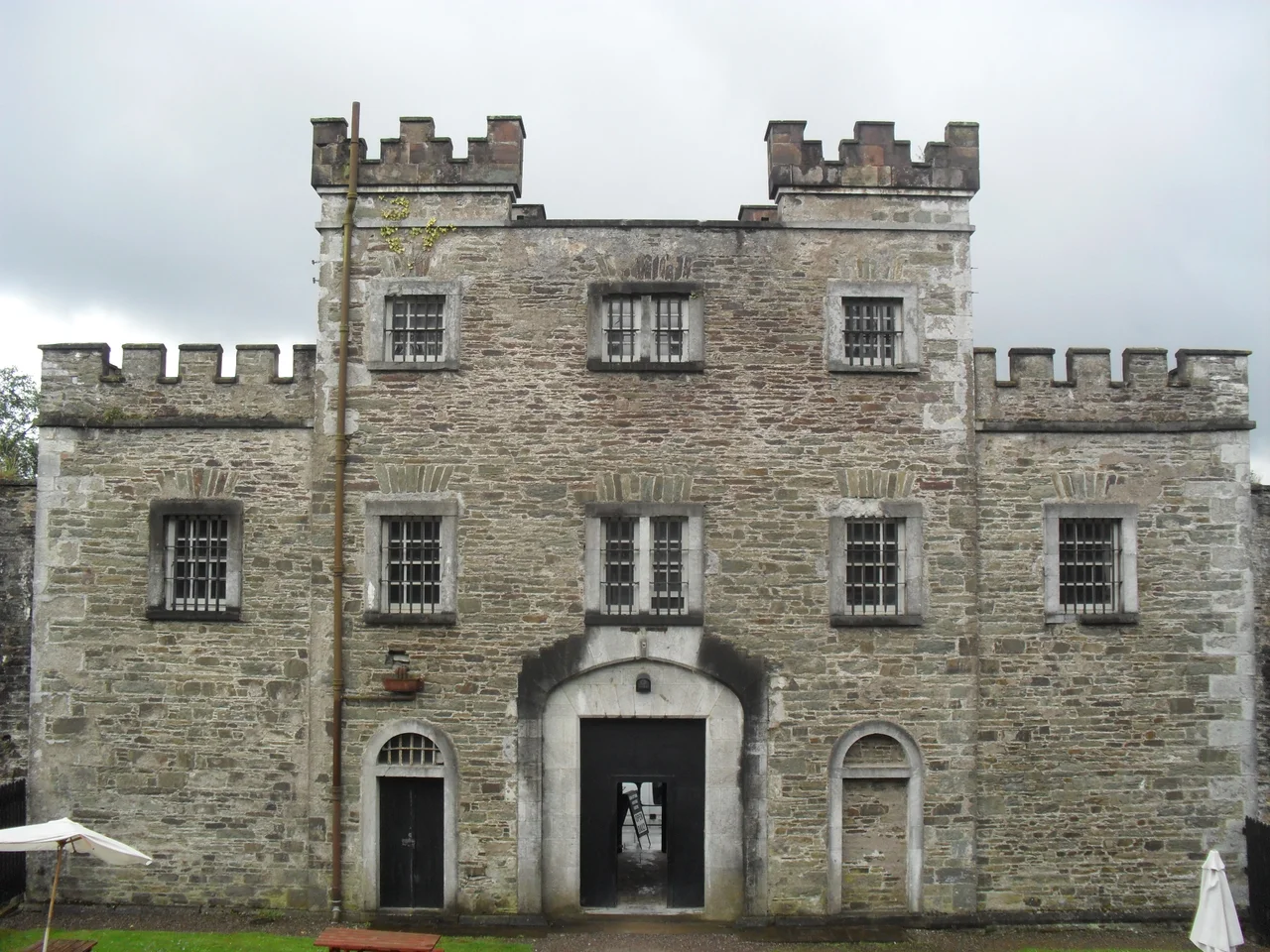

Cork City Gaol
On a frosty November night in 1923, forty-two prisoners climbed a rope ladder over the outer wall of Cork City Gaol and ran into the city in stockinged feet. They went over in three batches of fourteen, the maximum number that could hide together in the shadow of the wall while waiting for the moon to move. Each batch took fifteen minutes. All the men in the first group were facing the death penalty, and they cast lots for the order in line - first out had the best chance, last out had the worst. When prisoner number nine went over, the sentry on the wall heard something, and the man balked. After a few seconds of silence the work resumed. By morning, some of the escapees were already free of the city; others were recaptured later that day. The jail closed for good a few months earlier and the escape was, in a sense, its closing ceremony.
A Replacement for the Old Jail
An Act of Parliament in 1806 authorised the construction of a new Cork City Gaol to replace the cramped, unhygienic North Gate Bridge prison that had served the city for nearly a century. The first site selected was at Distillery Fields. That site was abandoned when surveyors realised it was prone to flooding - not what you want in a building meant to hold large numbers of people you cannot easily evacuate. A new location was found on a hill above the River Lee in the Sunday's Well district, and the gaol that rose there was designed to look like a castle: castellated walls, gothic gates, four cell blocks radiating from a central hub. It was a prison built to perform its authority architecturally. From the river below, the building reads as a fortification.
The Women's Prison
In 1877 the General Prisons (Ireland) Act reorganised the Cork system. The Cork City Gaol on Sunday's Well became the women's prison for both Cork City and Cork County, and the Cork County Gaol on Western Road near University College Cork became the men's prison. On the day the change took effect, male prisoners were marched out of Sunday's Well and walked across town to Western Road, while the women were walked in the opposite direction - a peculiar moment in Cork's history when two columns of people in chains passed one another on the streets of the city. The Sunday's Well building served as the women's jail for decades, with all the additional implications that came with women's incarceration in late-Victorian Ireland: poor children, abandoned mothers, women caught up in the politics of the rising republic.
Republican Prisoners
During the Irish War of Independence, the women's prison held Republican women. Constance Markievicz, the suffragist and socialist revolutionary who had been sentenced to death after the 1916 Easter Rising and then had her sentence commuted, was imprisoned there in 1919. So was Mary Bowles, a member of Cumann na mBan, locked up that January for arms offences. Another prisoner, Dolly Burke, escaped the same month. During the Irish Civil War of 1922-1923 the gaol opened to both male and female anti-treaty Republican prisoners - the side that rejected the partition compromise with Britain. Among those held during this period was the writer Frank O'Connor, then Michael Francis O'Connor O'Donovan, who would later draw on the experience in his fiction. The earlier inmate Brian Dillon, a Fenian, had been held in 1865, and his cell is now restored as a museum exhibit.
The Rope Ladder Escape
The November 1923 escape happened because the men were too valuable to lose and the building, despite its castellated walls, was not actually escape-proof. They were considered high-value enough that they had been sent to the Sunday's Well prison precisely because it was thought to be the safest place to hold them. Some had feigned illness the night before to be moved into a more accessible part of the building. A rope ladder was assembled, bedclothes were used to lower the men inside the wall, and the moon's position was calculated to keep them invisible in the shadow. Three batches went over. Forty-two men escaped. Some who were natives of Cork City got clear of the area before daylight; others in the later batches were recaptured. The jail closed in August 1923, just months before the escape - a coincidence that meant the building was effectively empty by the time the recaptured men were sent elsewhere.
Silent Decades and a Second Life
From 1927 the top floor of the Governor's house was put to a strange new use: a radio broadcasting station. 6CK was the first official radio station in Cork, and it broadcast from the gaol from 1927 until it closed in September 1930, when it was absorbed into the national 2RN network that would later become Radio Éireann, now RTÉ. After that the buildings drifted toward dereliction, used for storage by the Department of Posts and Telegraphs. The complex was allowed to crumble. Restoration began in the early 1990s. The gaol reopened to the public as a visitor attraction in 1993, with cells restored, audio guides walking through prisoners' stories, and waxwork figures sitting at their lonely tasks. It is now one of the most-visited heritage sites in Cork - which is to say, a former women's prison has become a place where families spend a Sunday afternoon.
From the Air
Located at 51.90°N, 8.50°W on the north side of the River Lee in the Sunday's Well district of Cork city. Cork Airport (EICK) lies about 5 nm south. From the air the castellated building is visible as a star-shaped or radial structure with multiple cell wings extending from a central hub, surrounded by a high perimeter wall. Recommended viewing altitude 2,500-3,500 ft for catching both the prison architecture and the hilltop position above the river bend. The location is roughly 1 km west of the Shandon district and St Anne's Church.
Nearby Stories
- Ballyvourney 1.6 km away
- Castlemartyr 3.9 km away
- Ballybeg Priory 4.1 km away
- Kilbrittain 5.2 km away
- Shanbally Castle 10 km away
- Skibbereen 17 km away
- Castleisland 22 km away
- SM U-27 118 km away