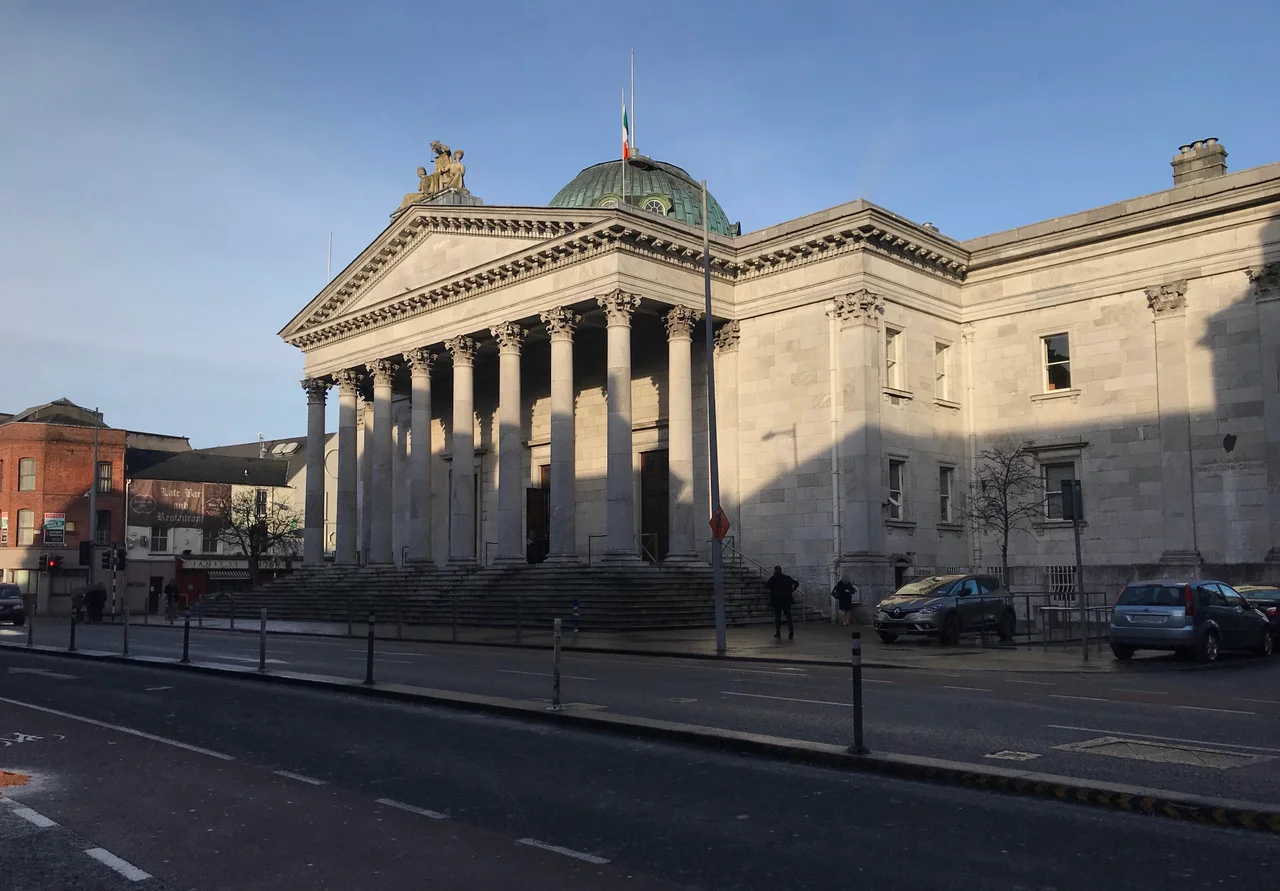

Cork Courthouse, Washington Street
On 23 June 1917, ten thousand people gathered at Glanmire railway station to welcome the Cork prisoners who had been released from British internment after the Easter Rising. About two thousand of them formed an escort and marched the freed men into the city. Speeches were given on the Grand Parade. A crowd of about five hundred peeled off and walked to the men's prison on Western Road to shout encouragement to the inmates still inside. Then they walked to the courthouse on Washington Street. One man set a ladder against the building, climbed onto the roof, and ran an Irish tricolour up the flagpole. He then walked over to the statue of Lady Justice that crowns the portico, removed the bronze scales of justice she held, and threw them down into the street. They shattered on the pavement to the applause of the crowd. The British scales of justice had been broken in Cork. The story was being rewritten.
Fire and Rebuilding
Almost nothing of the original courthouse remains except the front. A fire devastated the building in 1891, and a competition was held to rebuild it. William Henry Hill won the commission, and a contractor named Samuel Hill (no relation) carried out the reconstruction between 1891 and 1895. The façade and the great portico survived the fire and were retained. Everything behind them was new. A copper dome was added on top of the building, and a redesigned interior in an Early Renaissance style filled the shell. The pediment over the portico still carries the original inscription "WILLIAM IV KING" - a reminder that the courthouse predates the fire and predates the rebuilt interior, with its date locked into the stone above the columns. The reconstruction cost £27,000.
The County Council's Upper Floor
The Local Government (Ireland) Act 1898 established county councils across Ireland, and Cork's needed somewhere to meet. The rear of the upper floor of the courthouse, previously used only for judicial business, became the meeting place of Cork County Council. For seventy years two different branches of government - judicial and elected - shared the same building. The councillors met above. The judges sat below. In 1968 the council moved out to the new County Hall on the western edge of the city, leaving the entire courthouse to its original purpose. After the conversion of the Model School on Anglesea Street into a second courthouse in 1995, Washington Street narrowed its work further, becoming a Circuit Court venue rather than a District Court.
Three Pilasters, Three Orders
The interior that emerged from the 1891-95 reconstruction is one of the more elaborate civic spaces in Cork. The foyer is three storeys tall and crowned by the copper dome, with marble pilasters and piers running up the walls at each level. The classical orders are stacked: Doric on the ground floor, Corinthian on the first, Ionic on the second - a textbook arrangement that lets the architecture teach the visitor classical hierarchy while they wait for their case. The main staircase climbs from the inner hall to the first floor, where the two main courtrooms occupy the east and west wings. Both are double-height. Both retain their 1890s wooden architraves and mouldings, their cast-iron Ionic columns, and the original timber leather-upholstered seating. Defendants and lawyers still sit on the same benches the courthouse installed when it reopened.
Closure, Warehouse, Return
By the late 1990s the building had deteriorated so badly that it had to close. From 1998 to 2005 the courthouse underwent a major two-phase refurbishment - interior first, then exterior - to save it from outright dereliction. During this period a temporary courthouse was improvised in a refurbished warehouse on Camden Quay, rented at €760,000 a year. The building had been closed entirely by 1999. The second phase of refurbishment began in 2003, with the interior design completely overhauled while the historic features were preserved. The portico, the dome, the marble columns, the timber benches, the Lady Justice statue still missing her bronze scales since 1917 - all of them came through. The courthouse reopened and continues today as the Cork Court Office for civil and family matters, while the Anglesea Street site handles criminal trials.
The Scales Never Returned
Cork has not replaced the bronze scales of justice that were thrown into the street in 1917. Lady Justice still stands above the portico. She still wears her blindfold. She still holds her sword. The scales are gone, and have been gone for more than a century. There is something almost gentle about the absence: a small civic memory of the day Cork made its position on British justice clear. The cheering crowd dispersed. The judges came back to work. The building continued to function as a courthouse through the Civil War, the founding of the Irish Free State, the declaration of the Republic, and the Troubles in the North. The statue above the front door still presides over the legal life of Cork - more or less calmly - but she presides with her hands literally empty.
From the Air
Located at 51.90°N, 8.48°W on Washington Street in central Cork city. Cork Airport (EICK) lies about 5 nm south. From altitude look for the prominent neoclassical façade with its tall portico of columns, topped by the green copper dome and Lady Justice statue. Recommended viewing altitude 2,500-3,500 ft. The courthouse sits about 400 m south of the River Lee's south channel and roughly 800 m west of Patrick Street, in the dense Georgian and Victorian city centre.
Nearby Stories
- Ballyvourney 1.6 km away
- Castlemartyr 3.9 km away
- Ballybeg Priory 4.1 km away
- Kilbrittain 5.2 km away
- Shanbally Castle 10 km away
- Skibbereen 17 km away
- Castleisland 22 km away
- SM U-27 118 km away