
Cornish language
In 2010 UNESCO did something rare: it reclassified a language. Cornish had been listed as extinct, and that listing, the agency acknowledged, was no longer accurate. The Celtic tongue spoken across Cornwall for more than a thousand years, pushed steadily westwards by English until its last fluent speakers died in the late eighteenth century, was alive again. Not as it had been, perhaps, but alive: spoken in homes, taught in schools, sung in choirs, written on street signs from Penzance to Saltash. Around 500 fluent speakers now, with thousands more carrying some of it in their pockets. The language that Dolly Pentreath of Mousehole supposedly spoke last in 1777 had refused to stay dead.
The Brittonic Inheritance
Cornish is one of the three surviving Brittonic Celtic languages, sister to Welsh and to Breton across the Channel. All three descend from the Common Brittonic that was spoken across most of mainland Britain when the Romans arrived. The Anglo-Saxon advance west pushed the British tongues into three pockets: north into what would become Wales, southwest into Cornwall and Devon, and across the sea into Brittany, where refugees carried Brittonic with them. The Battle of Deorham around 577 cut the southwestern Britons off from those in Wales. Cornish and Breton stayed in close contact for centuries; the linguist Kenneth Jackson argued that as long as Cornish was a living language, the two were essentially mutually intelligible. Dialects of one Celtic tongue, separated by a sea narrow enough to row across.
Old, Middle, and the Forty-Year Decline
The earliest written Cornish is a single ninth-century scribbled gloss in a Latin copy of Boethius: ud rocashaas, meaning, perhaps, it hated the gloomy places. From there the language climbed: the Bodmin manumissions of the tenth century listing freed slaves with Cornish names, the Vocabularium Cornicum glossary around 1100, the great fourteenth-century religious drama Pascon agan Arluth, the Passion of Our Lord. Middle Cornish peaked at perhaps thirty-nine thousand speakers in the thirteenth century. Then came the slow squeeze. In 1549 Parliament passed the Act of Uniformity, forcing the English Book of Common Prayer on parishes where, as one Cornish manifesto put it, certain of us understand no English. The Prayer Book Rebellion that followed killed 5,500 people. After the rebellion the Cornish gentry began to abandon their language, dissociating themselves from a tongue now smeared as the speech of traitors. Peter Berresford Ellis dates the worst damage to the years between 1550 and 1650. Andrew Boorde, writing in 1542, had still found many men and women in Cornwall who could not speak one word of English. A century later, those people were nearly gone.
Dolly Pentreath and the Question of the Last Speaker
Dolly Pentreath of Mousehole, born around 1692 and dying in December 1777, has traditionally been called the last native speaker of Cornish. A famous 1781 engraving shows her in an eighteenth-century bonnet with a jug and crab and fish below her, the very picture of a Cornish fishwife. Whether she was actually the last is harder to answer. In 1776 William Bodinar wrote a letter to Daines Barrington in Cornish, with English translation, explaining that no more than four or five old people in his village still spoke the language; he had learned it from old fishermen when he was a boy. After Dolly, the rememberers continued: John Davey of Boswednack, who died in 1891, knew at least some traditional Cornish, including a rhyme that Robert Morton Nance later reworked. John Kelynack of Newlyn, the fisherman who died in 1885, fed old Cornish words to philologists. The boundary between fluent speaker, semi-speaker, and rememberer has always been blurry; in Cornwall it stayed blurry for nearly a century after Dolly. The language never quite went silent.
Henry Jenner and the Revival
In 1904 the Celtic scholar Henry Jenner published A Handbook of the Cornish Language. The revival started there. Jenner wrote that there had never been a time when there were not some Cornishmen who knew some Cornish. He set out to reconstruct it. Robert Morton Nance built on Jenner's work and in 1929 published his Unified Cornish system, drawing on Middle Cornish literature and adding neologisms from Welsh and Breton roots. Unified Cornish became the standard for most of the twentieth century. In the 1980s Ken George produced Kernewek Kemmyn, a more phonetically rigorous variant. Richard Gendall developed Modern Cornish, based on Late Cornish. The community quarreled over orthographies through the 1990s and 2000s. In 2008 a compromise Standard Written Form was adopted. By 2018 around three thousand people in Cornwall had at least minimal Cornish; about five hundred were fluent. The first Cornish-language day care opened in 2010; some families now raise children as bilingual native speakers.
Kernow on the Signposts
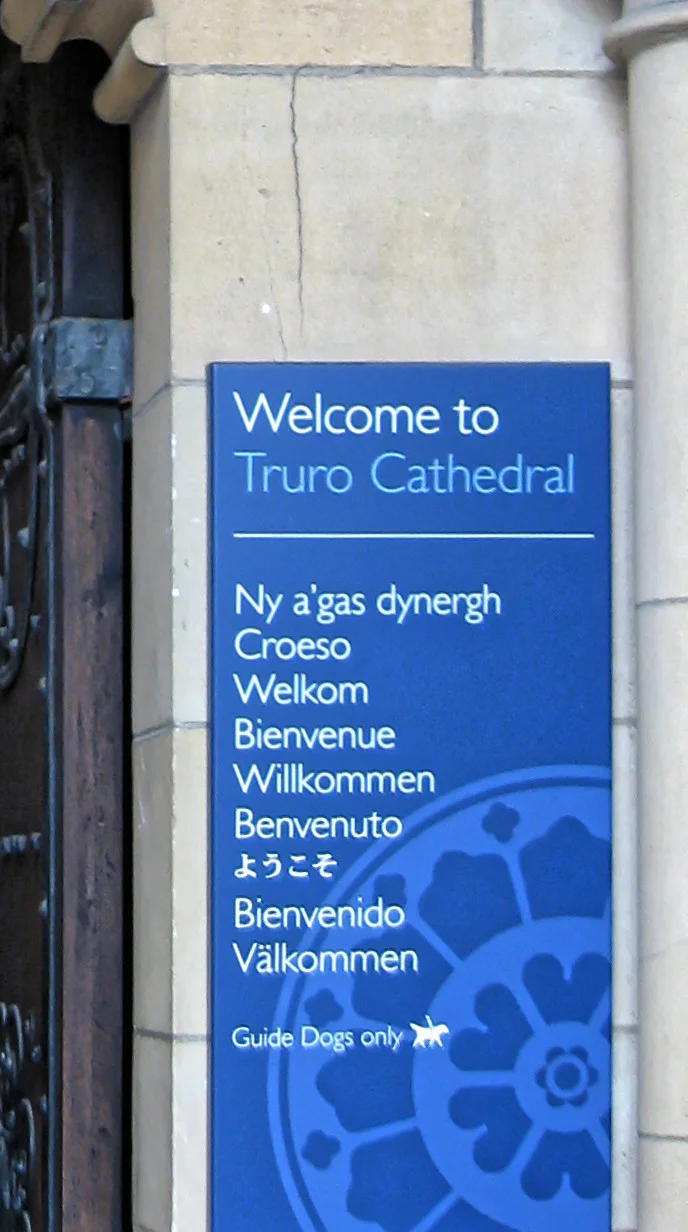
Cornish was recognised by the UK government in 2002 under the European Charter for Regional or Minority Languages. In 2014 the Cornish people gained recognition as a national minority under the Framework Convention. Cornish-language signs appear at railway stations, on town boundaries, on public buildings. The monthly magazine An Gannas has been published in Cornish since 1976, edited by Graham Sandercock from the start. BBC Radio Cornwall broadcasts An Nowodhow, a Cornish news bulletin. The annual Holyer an Gof literary awards honour publications in or about Cornish. The Hobbit was translated as An Hobys in 2014. Cornwall's place-names tell the older story regardless: Penzance is Pen Sans, holy headland; Porthcurno is Porth Kernow, Cornwall's port; Launceston is pronounced Lansǝn, perhaps from Lann Stefan. The language survives in the very ground beneath the English overlay, and now, finally, in living mouths again.
From the Air
The Cornish language is rooted across the whole of Cornwall, but its westernmost strongholds remain Penwith and Kerrier: from Penzance and Mousehole (Dolly Pentreath country) at roughly 50.07 north, 5.55 west, eastward through Camborne, Truro and beyond. Newquay Airport (EGHQ) is the principal gateway to the duchy at 50.44 north, 4.99 west. Exeter (EGTE) lies seventy-five nautical miles northeast. From altitude Cornwall presents as a long granite peninsula thrust into the Atlantic, the place-names beneath the wings still humming with Brittonic. Best appreciated overflying the coast on a clear day when the village pattern becomes visible.
Nearby Stories
- Mount Edgcumbe Country Park 2.6 km away
- Tintagel 4.2 km away
- Wheal Trewavas 6.1 km away
- Tehidy Country Park 14 km away
- Battle of Plymouth (1652) 15 km away
- Okehampton Castle 19 km away
- Goonhilly Satellite Earth Station 32 km away
- Action of 17 November 1917 101 km away