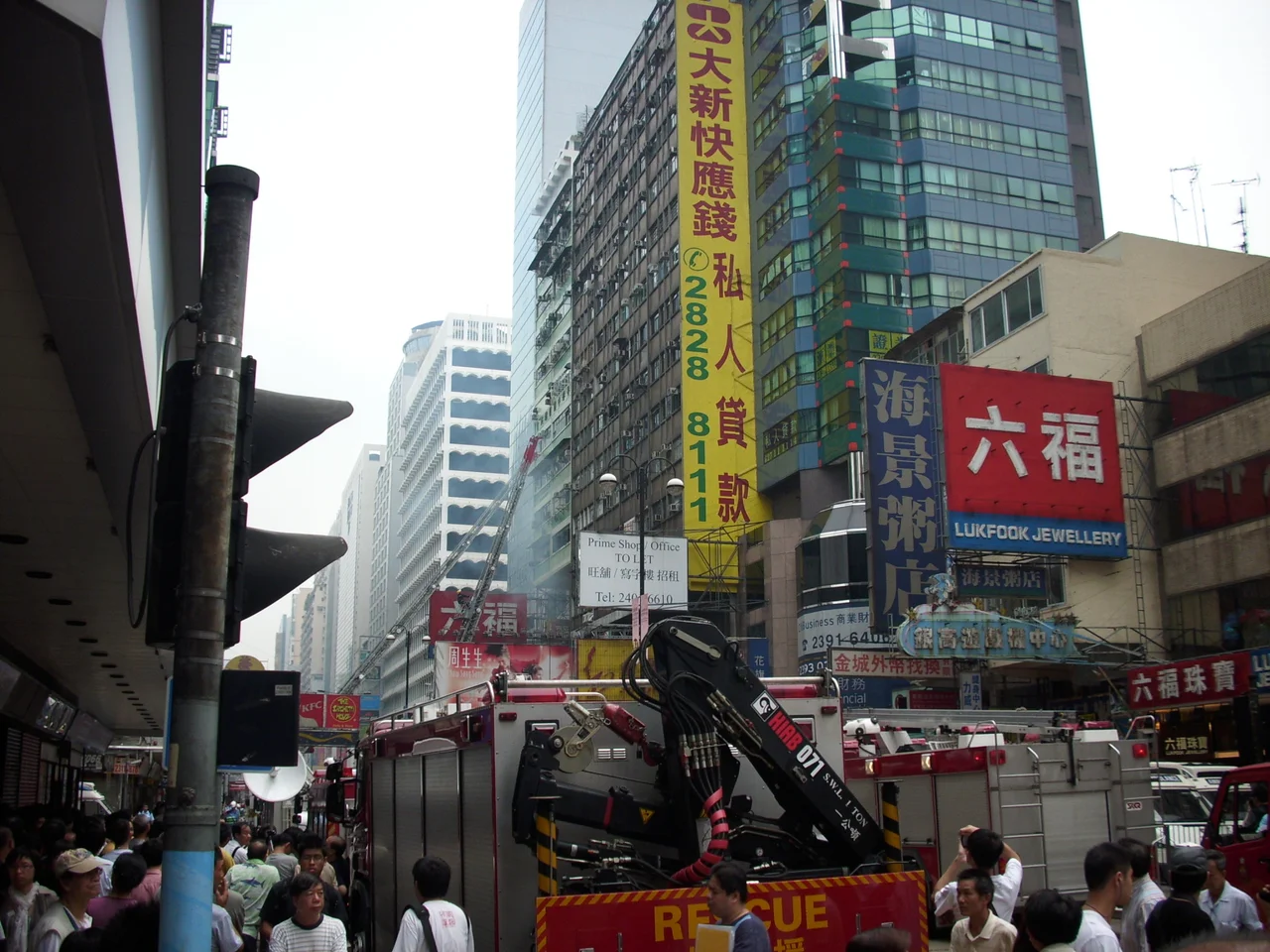

Cornwall Court Fire
It was a Sunday morning, 9:20 a.m., when smoke began rising from the mezzanine floor of Cornwall Court on Nathan Road. The nightclub and karaoke bar on that floor had closed for the night but the fire had already started. Within an hour it had escalated to a No. 4 alarm — a major fire requiring significant resources. By 12:16 p.m. it had been upgraded again, to No. 5, the highest classification in Hong Kong's system. More than 200 firefighters and 40 fire apparatuses from across Kowloon converged on the 15-storey building. Nathan Road, one of the most trafficked streets in the city, was completely closed. Before the fire was extinguished at 3:13 p.m., four people were dead and 55 had been injured. Two of the dead were the firefighters who went in.
Senior Fireman Siu and Fireman Chan
Senior Fireman Siu Wing-fong was 46 years old, with 24 years of service in the Hong Kong Fire Services Department. Fireman Chan Siu-lung was 25 years old, with one year of service — still new to the work. Both were from Mong Kok Fire Station, the station responsible for the district where Cornwall Court stands. They went in together, climbing toward the upper floors where residents were trapped. They died from smoke inhalation on the top floor. Survivors who escaped the building later told investigators and reporters what they had seen: Siu and Chan had given the residents their oxygen breathing apparatus. They handed over the equipment even as they continued carrying the heavy cylinders up through smoke-filled stairwells. The two men kept climbing without their own air supply. They did not come back down.
The Building and Its Residents
Cornwall Court was built in 1962, a mixed-use building typical of Mong Kok's dense vertical character. The lower floors held commercial tenants — the nightclub and karaoke bar on the mezzanine, shops below. The upper floors were residential. People lived there, woke up there on a Sunday morning, and found their escape routes blocked. One of the two civilian victims was a 77-year-old woman on the ninth floor. The other was a woman who worked at the nightclub — her name was recorded as surnamed Man, 39 years old — who had been asleep with colleagues in the nightclub when the fire began. Her body was found there after the fire was extinguished. The 55 people who were injured, and the many others who made it out, were residents and workers whose routines that morning ended in evacuation, hospitals, or temporary shelter at the Mong Kok Community Centre.
After the Fire
The blaze was brought under control by mid-afternoon. Nathan Road's southbound lanes reopened by evening; the pedestrian walkway outside Cornwall Court remained blocked until 12 August while investigators examined the building's cause of ignition and structural state. The building itself stayed closed pending the investigation's outcome. Some residents refused to leave even after the fire was out, unwilling to abandon their homes. Those who had nowhere to go were housed at the community centre nearby. The cause of the fire — whether it originated in the nightclub's electrical systems, fixtures, or something else — was subject to investigation, but what the fire revealed about the building's fire safety systems, about what happens when a nightclub occupies the base of a residential tower, became part of the public reckoning that followed every major fire in Hong Kong's dense urban fabric.
Remembered
Hong Kong holds its firefighters in real regard, and the deaths of Siu Wing-fong and Chan Siu-lung were mourned publicly and specifically — not as abstractions but as people with names, ranks, years of service, and decisions they made in their final minutes. The gesture of handing over their oxygen equipment is the kind of act that gets passed down: a specific thing that happened, a choice made by two men in smoke and heat, documented by the people they saved. Cornwall Court fire is remembered alongside other major Hong Kong fires — the Garley Building fire of 1996, the Wang Fuk Court fire — as part of an ongoing reckoning with what it means to build a city this dense, this vertical, and this old. The building on Nathan Road still stands.
From the Air
Cornwall Court stands at 22.3197°N, 114.169°E on Nathan Road in Mong Kok, Kowloon — a densely packed commercial and residential district north of Tsim Sha Tsui. From the air at 3,000 feet, the Nathan Road corridor is the north-south spine of Kowloon visible as a continuous commercial strip. Mong Kok is identifiable by its intense urban density, with no significant open space to serve as a visual break. Hong Kong International Airport (VHHH) is approximately 30 km to the northwest on Lantau Island. At lower altitudes, the cluster of neon signs and close-packed towers that define Mong Kok is one of the most recognizable visual signatures in the territory.
Nearby Stories
- Lok Ma Chau Loop 2.3 km away
- Portas do Cerco 2.3 km away
- Kweilin Incident 17 km away
- Wanshan Archipelago Campaign 34 km away
- Nanxiong Formation 115 km away
- Battle of Nanpeng Island 148 km away
- Heyuan 169 km away
- Cape Maobitou 632 km away