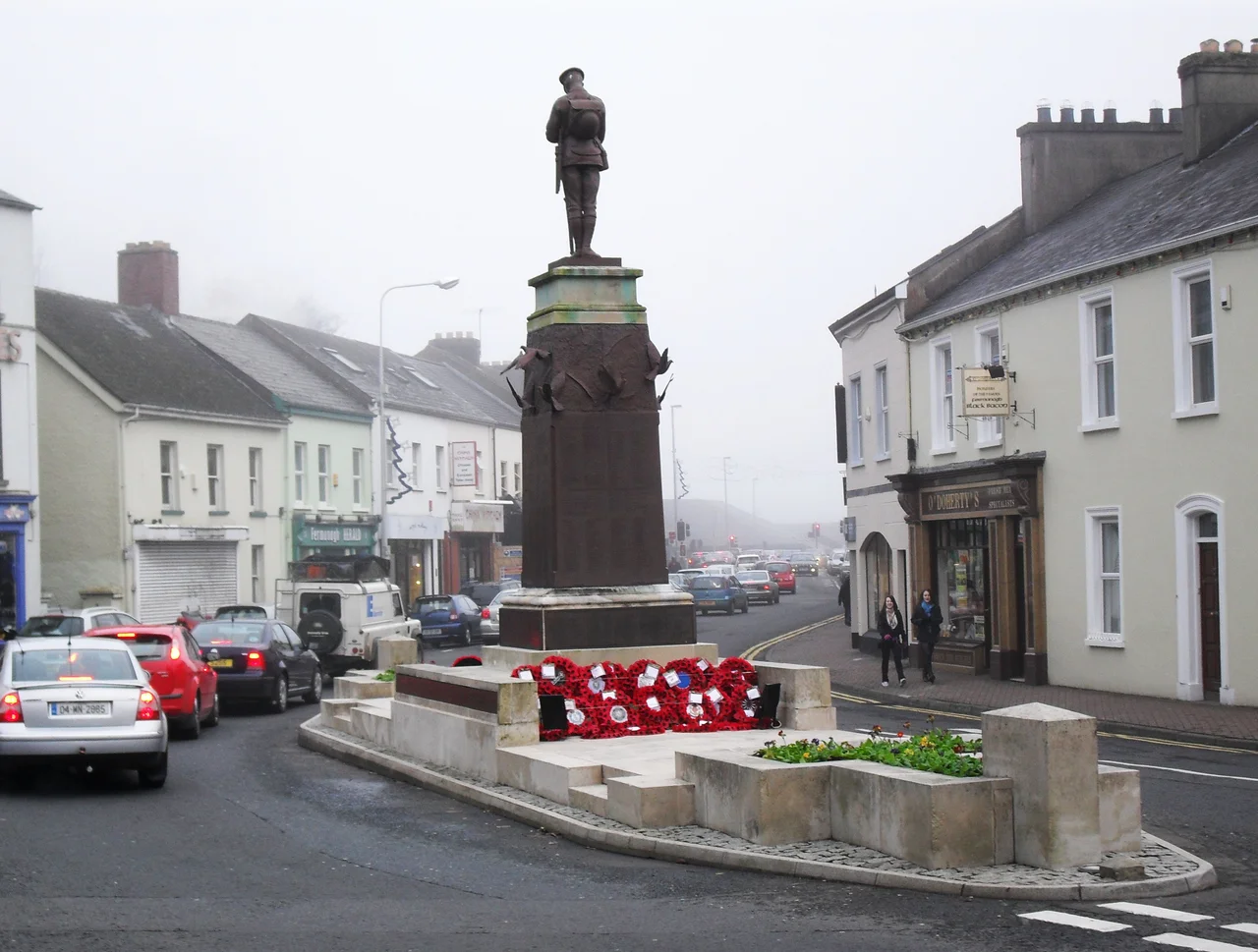

County Fermanagh War Memorial
The soldier on the plinth is not at attention. His head is bowed, his rifle is turned downward in the gesture called arms reversed, and he has stood that way on Belmore Street in Enniskillen since 1922. Carved into the limestone behind him are 612 names, each one a man from County Fermanagh who did not come home from the trenches of the First World War. For sixty-five years the memorial did what war memorials do: it accepted poppies once a year and stood alone the rest of the time. Then, on a cold Sunday morning in November 1987, a bomb went off behind it, and the cenotaph became something more than a monument to the men of 1914 to 1918. It became evidence.
Designing Glorious Dead
When the County Fermanagh War Memorial Committee placed its notice in the Architect and Building News in 1920, the brief was sober and conventional. They wanted a cenotaph for £1,500, entries by November, a winning design chosen by early 1921. The firm Gaffin and Co. delivered. Their British soldier, in peaked cap and greatcoat, was cast in bronze in the mourning-figure tradition sweeping across post-war Britain. The limestone plinth carries the inscription OUR GLORIOUS DEAD, the years 1914 to 1918, and the coat of arms of Enniskillen Castle, the badge worn by the two local regiments raised here, the 6th Inniskilling Dragoons and the Royal Inniskilling Fusiliers. At the base, a bronze relief shows a sword and a rifle crossed, one for the cavalry, one for the infantry. At the unveiling, four senior NCOs from the Fusiliers stood guard at each corner. The names of 612 men were already enough, in a county whose total population was barely more than fifty thousand.
Two Wars on One Plinth
After the Second World War, the cenotaph was altered to hold the names of those who died in the conflict that the men of 1918 had been told would never happen again. Across Ulster the same retrofitting was happening: new panels, new dates, the same grey stone. The Royal Inniskilling Fusiliers and the Dragoons had fought through both wars, in Flanders and France and then again across North Africa, Italy, and Northwest Europe. The cenotaph absorbed the second harvest and kept standing. Every November the town gathered for Remembrance Sunday. Veterans laid wreaths. Buglers played the Last Post. The Boys' Brigade and Girls' Brigade lined up in their uniforms. Children grew up with the figure in stone and barely noticed him.
The Eighth of November 1987
The bomb was planted in the empty Reading Rooms above the gable wall, on the side opposite the parade route. The security forces had searched the road but considered the Reading Rooms a secure area and left them. At about ten thirty in the morning, as the parade of Ulster Defence Regiment soldiers approached for the eleven o'clock service, the wall came down. Photographs taken in the minutes that followed, of rescuers pulling civilians from rubble in front of the cenotaph, of the limestone soldier standing untouched above the dust, ran on every front page in Britain and Ireland the next day. Eleven people died at the scene. A twelfth man, Ronnie Hill, never woke from his coma and died in December 2000. Sixty-three others were injured, some catastrophically. They had been standing where their fathers and grandfathers had been remembered, and they had become something to be remembered themselves.
Renovation and Return
Margaret Thatcher came for the rescheduled service two weeks later. Five thousand people stood on Belmore Street in the cold. In 1990 and 1991 the memorial was renovated, and a new section was added to carry the names of those killed in the bombing alongside the 612 from the Great War. The cenotaph now stands six metres high and roughly four metres square, the soldier still bowed, the rifle still reversed. Since 2012, the Irish Taoiseach has attended Remembrance Sunday in Enniskillen every year, a gesture across the border that would have been unimaginable when the wreath layers of 1987 were still being buried. In 2017, on the thirtieth anniversary, a separate memorial to the twelve was unveiled. After complications with church land it was eventually sited at the Clinton Centre, built in 2002 on the very spot where the Reading Rooms once stood, and there is now talk of visually connecting the two monuments along the street.
Reading the Stone
If you stand on Belmore Street today and read the cenotaph carefully, you can trace three layers of grief on one piece of limestone. The original 1922 inscription names the dead of the trenches. The Second World War additions carry surnames of grandsons who fell in the next war. And the 1991 panel records the names of civilians killed in 1987 by a bomb meant for soldiers, in a country whose troubles by then had outlived two world wars. The soldier above still has his head bowed. He is not specifically mourning anyone any more. He is, by accident of history, mourning everyone.
From the Air
The County Fermanagh War Memorial stands at 54.3443°N, 7.6342°W on Belmore Street in central Enniskillen. From the air, Enniskillen is the bow tie of land between the Upper and Lower Lough Erne, with Enniskillen Castle on the western edge of the island and Belmore Street running east from the cathedral. The cenotaph itself is small and best identified by context rather than silhouette: look for the open ground beside the Clinton Centre, just north of the river bridges. St Angelo Airport (EGAB) lies 4 miles north. Belfast International (EGAA) is roughly 75 nautical miles east; Donegal (EIDL) is 35 nautical miles northwest. Light winds and grey overcast are the usual conditions here, especially on November mornings.
Nearby Stories
- Ballyconnell 3.1 km away
- Castlederg 5 km away
- Belleek, County Fermanagh 8.7 km away
- Castlecaulfield 17 km away
- Lissan House 17 km away
- Castleblayney 19 km away
- McDermott's Castle 19 km away
- Gweebarra Bay 32 km away