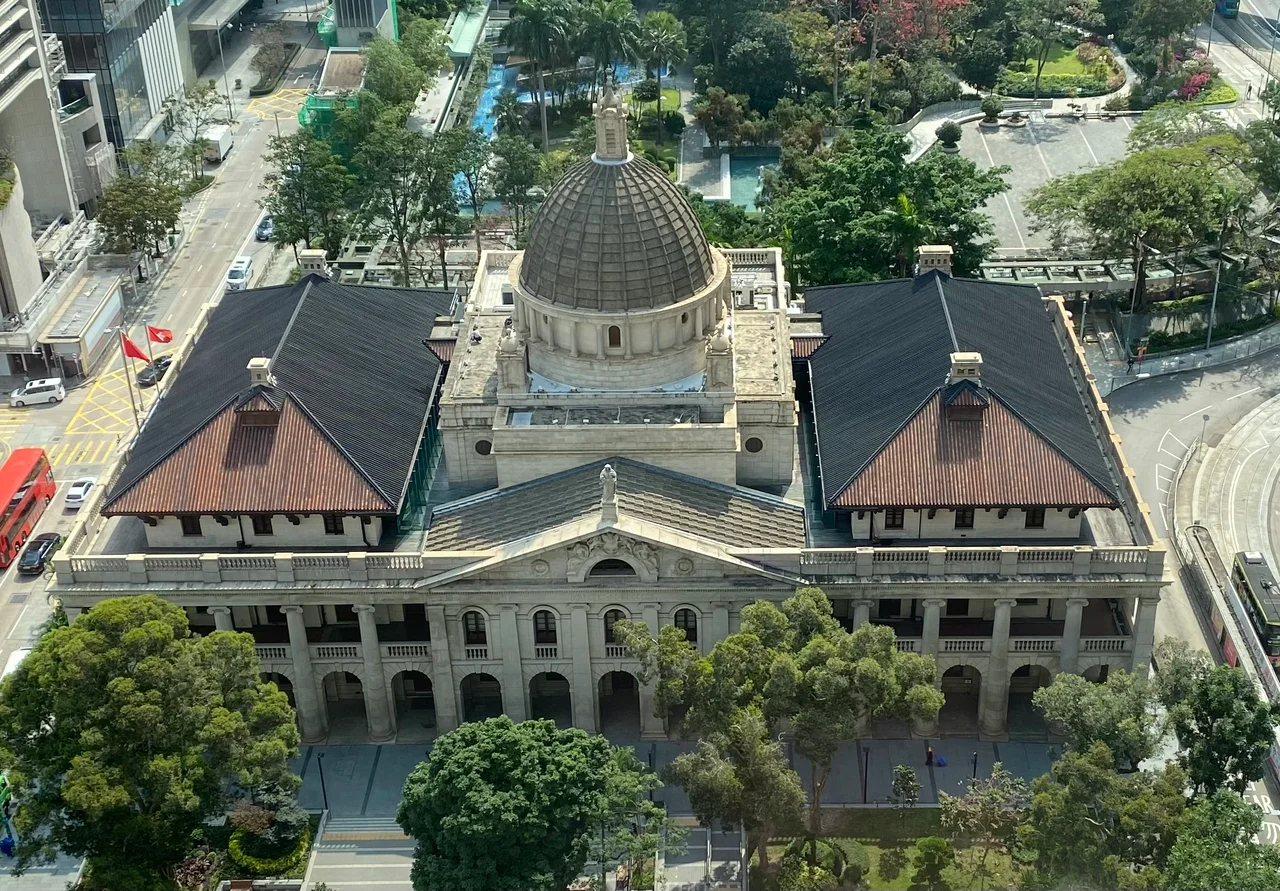

Court of Final Appeal Building
The building is floating. Not metaphorically — it is literally suspended above the former harbor floor on hundreds of Chinese fir tree trunks driven into the reclamation silt when the structure was erected in 1910. Groundwater replenishment systems maintain the level around those timber foundations to this day, keeping the building from settling. This engineering fact captures something essential about the Court of Final Appeal Building: it is a very solid-looking structure resting on a surprisingly provisional foundation, in a city that has always been making itself up as it goes. The neoclassical columns, the Statue of Justice atop the pediment, the inscription in Roman numerals dating the construction to AD 1910 — all of it projects permanence over what is, technically, a timber raft floating on silt.
A Century of Changing Tenants
The building at 8 Jackson Road has housed different institutions across its 115-year history, each transition marking a turn in Hong Kong's political life. From 1912 to 1941, it served as the Supreme Court, with the Attorney General and Crown Solicitor also officed there. Then, in December 1941, the Japanese military occupied Hong Kong and repurposed the building as the headquarters of the Kempeitai — the Imperial Army's military police — a function it served until Japan's surrender in August 1945. The Supreme Court returned after British administration was restored, sharing the building with other courts and legal offices for decades. In 1978, construction of the MTR system damaged the structure significantly and required restoration. The court shifted out temporarily, then reoccupied from 1982 to 1984 before permanently moving to a new building in Admiralty.
The Legislature Takes Up Residence
In 1983, the Executive Council approved converting the building for the Legislative Council. Chief Secretary Sir Philip Haddon-Cave described the move as giving LegCo a clearer identity — separating it visibly from the executive branch. The renovation, completed by the Architectural Services Department, was significant: the old court library became the Council Chamber, a mezzanine level was added for public galleries, and judges' chambers became legislators' offices. The exterior was declared a historic monument in 1984, the same year renovation began. The legislature met there from 1985 until 2011, when it relocated to a purpose-built complex in Tamar. The building's chambers had witnessed the debates over Hong Kong's transition to Chinese sovereignty, the drafting of the Basic Law's implementation, and the political controversies of two decades.
Stone, Symbol, and the Royal Arms
The building's architectural vocabulary is unambiguous colonial classicism. The central pediment facing Statue Square carries a Statue of Justice and, beneath it, the carved British royal coat of arms — the three lions of England in the first and fourth quarters, the lion of Scotland in the second, the harp of Ireland in the third. The motto Dieu et mon droit (God and my right) runs below. On either side stand carved figures of Mercy and Truth. The Tudor Crown sits at the summit. This heraldry remained in place through the Japanese occupation, through the transition to Chinese sovereignty in 1997, through the legislative years, and through the building's most recent reinvention as the Court of Final Appeal. The stone figures have outlasted every political arrangement made in their shadow.
Final Appeal
The Court of Final Appeal — Hong Kong's highest court, and the last stop before cases would theoretically proceed to Beijing's Standing Committee — relocated to the building in 2015. The opening ceremony was held on 25 September 2015, presided over by Chief Justice Geoffrey Ma Tao-li. The building that began as an instrument of colonial justice, was used as a tool of military occupation, became a democratic legislature, and was then declared a monument, had finally returned to its original function. The paradox is that in returning to its origins — a court — the building sits at the center of ongoing debates about what judicial independence means in Hong Kong after 2020. The foundation of Chinese fir below still floats in the harbor silt. What rests above it is less certain.
From the Air
The Court of Final Appeal Building sits at 22.2808°N, 114.1603°E in Central on Hong Kong Island's northern waterfront. From the air, it is identifiable as the colonnaded Neoclassical structure adjacent to Statue Square, just west of the HSBC and Bank of China towers that define the Central skyline. At low altitudes — below 3,000 feet — the white stone and columned facade are distinct from the glass-and-steel towers surrounding it. Hong Kong International Airport (VHHH) is approximately 30 km to the west on Lantau Island. The Star Ferry pier is a few hundred meters to the north, and the building is directly on the waterfront harbor view corridor that makes Central one of the most recognizable urban approaches in Asia.
Nearby Stories
- Lok Ma Chau Loop 2.3 km away
- Portas do Cerco 2.3 km away
- Kweilin Incident 17 km away
- Wanshan Archipelago Campaign 34 km away
- Nanxiong Formation 115 km away
- Battle of Nanpeng Island 148 km away
- Heyuan 169 km away
- Cape Maobitou 632 km away