_(2007).jpg)
Crohamhurst Observatory
On 3 February 1893, more rain fell on this hilltop than on any other place in Australia on any single day before or since: 907 millimetres, nearly a metre of water in twenty-four hours. The young man who measured it was Inigo Owen Jones, and that deluge seems to have set the course of his life. Four decades later he built a small timber observatory here on his property at Crohamhurst, in the green ranges behind the Sunshine Coast, and from this unassuming hilltop he tried to do what no meteorologist could reliably do then and few claim to do now: forecast the weather years in advance.
The Boy Wragge Recruited
Jones came to weather young. The Queensland government meteorologist Clement Wragge, himself a famously colourful figure, was so struck by the schoolboy's ability that he took him on as an assistant in 1888, when Jones was still a teenager. From that apprenticeship grew a lifelong obsession. Jones turned his family's land at Crohamhurst into a private weather station and steadily made himself, in the public mind at least, the most famous long-range forecaster in Australia, consulted by farmers, graziers, and newspapers from the 1920s until his death in 1954. He never claimed he could tell you tomorrow's weather. What he offered was something grander and far more contested: the shape of seasons still years away.
Reading the Planets for Rain
Jones's method was as ambitious as it was unorthodox. He studied the cycles of sunspots and came to believe their irregularities were governed by the gravitational tug of the outer planets, Jupiter, Saturn, Uranus, and Neptune, as they swung through their long orbits. From these celestial rhythms he reasoned he could read the coming pattern of droughts and floods on Earth. Mainstream science was sceptical then and remains so; no solid physical link between planetary alignments and rainfall has ever been established. Yet in a country ruled by drought and flooding rains, where a wrong guess at the season could ruin a farm, the appeal was irresistible. Jones offered rural Australia something the official bureau would not: the promise of foresight.
The Observatory on the Hill
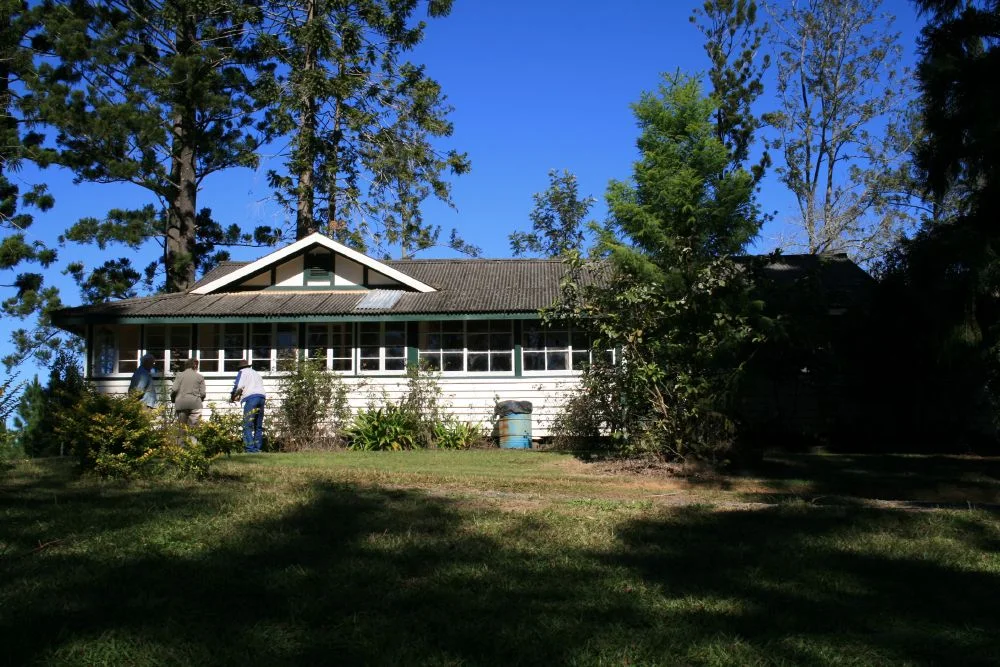
The observatory itself, built in 1935 with financial backing from the Colonial Sugar Refining Company and others, reflects the faith people placed in his work. It is a modest single-storey timber building, set on low stumps atop a dome-shaped hill on open lawn, encircled by mature hoop pines. Around it stand the quiet instruments of his trade: a louvred Stevenson Screen sheltering thermometers, deep earth-temperature pits formed from clay pipes sunk into the ground, the concrete stand of a vanished sundial, the base where a telescope once pointed at the sun. A miniature Stevenson Screen even serves as the letterbox at the gate. It is, in effect, a temple to a particular kind of optimism, the belief that careful enough observation could tame the future.
A Monument to Wanting to Know
When Crohamhurst Observatory joined the Queensland Heritage Register in 2008, the listing made a telling point: the place embodies a nineteenth-century conviction that through science and patient study humans could solve any problem, even outsmart the weather. It is the only known long-range forecasting observatory in Queensland, and its surviving open-air apparatus is a rare physical record of how that hope was pursued. Jones's planetary theories have not aged into accepted science. But the observatory endures as something more durable than any forecast, a memorial to a self-taught man and a farming nation that desperately, understandably, wanted to know what the sky would do next.
From the Air
Crohamhurst Observatory stands at 26.81 degrees South, 152.87 degrees East, on the summit of a dome-shaped hill on the southern side of Crohamhurst Road, north of Peachester and adjoining Crohamhurst State Forest, in the Sunshine Coast hinterland. Sunshine Coast Airport (YBSU) lies roughly 35 km northeast, Caboolture Airport (YCAB) about 25 km southeast, and Brisbane Airport (YBBN) around 65 km south. From a light aircraft the site reads as a green hilltop crowned with a small building and ringed by a distinctive collar of tall hoop pines, set amid forested ridges. The Glass House Mountains rise prominently to the southeast as the standout landmark. This is high-rainfall country, true to its record-setting past, so clear views favour the drier winter months, May through September.
Nearby Stories
- Moreton Island 16 km away
- Abbey Museum of Art and Archaeology 27 km away
- Aarhus Historic Shipwreck 27 km away
- Noosa National Park 40 km away
- Main Range Railway 51 km away
- Bunya Mountains National Park 68 km away
- Hornet Bank Massacre 296 km away
- HMS Porpoise (1799) 527 km away