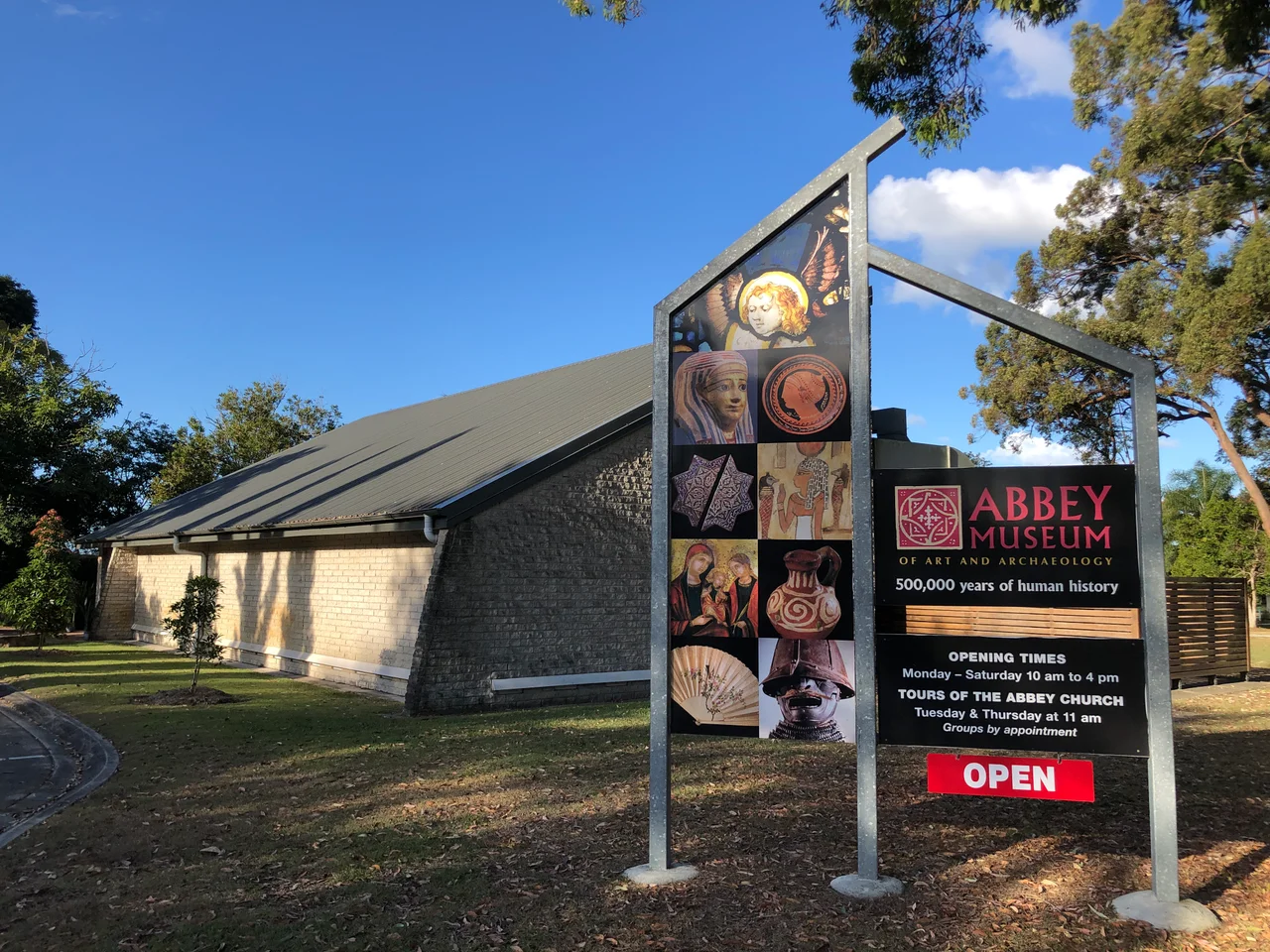

Abbey Museum of Art and Archaeology
Half a million years of human history sit on a hillside outside Caboolture, an hour north of Brisbane, in a low timber building most passing drivers never notice. Inside are Palaeolithic hand-axes worn smooth by hands that died before language was written down, an Egyptian coffin, Roman glass, a knight's chainmail, and panels of medieval stained glass that once glowed in English cathedrals. None of it belongs here, in the geographic sense. That it survives at all is the work of one eccentric Englishman, a wartime evacuation, and a religious community that carried its treasures halfway around the planet rather than leave them behind.
The Scholar the Builders Rejected
The collection began with John Sebastian Marlowe Ward, who was, depending on whom you asked, an antiquarian, an author, an educator, a mystic, and a spiritualist. In 1934, at Barnet north of London, Ward opened the Abbey Folk Park. He had no patience for the glass-case museum where artefacts sit labelled and lifeless. Inspired by Sweden's open-air Skansen, he wanted history you could walk into. He rescued historic buildings slated for demolition and rebuilt them on his land. To house his prehistoric finds, he constructed a replica Bronze Age village from scratch, making himself, almost by accident, a pioneer of what scholars now call experimental archaeology. By 1940 the park held thirty relocated buildings and more than forty thousand objects.
An Ark Through the Blitz
Then the bombs fell. At the height of the London Blitz in 1940, the Abbey Folk Park closed. In 1945 Ward sold the buildings and most of the collection to fund a journey: he and members of the religious community he had founded, the Confraternity of the Kingdom of Christ, emigrated to Cyprus. Ward died there in 1949. But Cyprus offered no peace either, as the island's Greek majority pressed for union with Greece and violence rose against British rule. The community packed up once more. They arrived in Sydney in 1955, settling first at Blackheath in the Blue Mountains before moving north to Queensland. After nearly a decade of wandering, they settled at Caboolture in 1965. The objects they had saved, carried from England to Cyprus to Queensland, finally came to rest. In June 1986 the Abbey Museum of Art and Archaeology opened in its present building.
Five Hundred Thousand Years in One Room
The Abbey is unique among Australian museums for its sheer reach across time, spanning roughly 500,000 years and dozens of civilisations, from chipped stone tools to Renaissance paintings. The neighbouring Abbey Church holds what is widely considered the most significant collection of medieval and Renaissance stained glass in Australia, including fourteenth-century armorial panels and fragments rescued from English cathedrals such as Winchester. The museum runs a genuine research program, consulting with institutions including the British Museum. It states its mission plainly: to be a public museum of international standard, telling the human story impartially, without bias of politics, religion, or gender, an oddly clear-eyed creed from an institution founded by a man who saw spirits.
When Caboolture Becomes the Middle Ages
For most of the year the Abbey is calm. But each July the grounds erupt into the Abbey Medieval Festival, the largest event of its kind in the southern hemisphere and the museum's great annual fundraiser. Knights in full plate thunder at each other in the joust. Archers loose arrows, blacksmiths hammer at glowing iron, and tens of thousands of visitors wander encampments recreating Europe and the Middle East across a thousand years of history. It is the experimental archaeology dream of John Ward made real, not history behind glass but history you can hear, smell, and feel, a medieval world conjured for a weekend in subtropical Queensland.
From the Air
The Abbey Museum sits at 27.07 degrees South, 153.02 degrees East, on a low rise in The Abbey Place at Caboolture, roughly 45 km north of Brisbane and inland from the western shore of Moreton Bay. The nearest field is Caboolture Airport (YCAB), a busy general-aviation strip a few kilometres south. Brisbane Airport (YBBN) lies about 35 km southeast, and Sunshine Coast Airport (YBSU) about 45 km north. From a light aircraft the museum reads as a cluster of buildings amid green paddocks; the broad sweep of Moreton Bay to the east and the distinctive volcanic plugs of the Glass House Mountains to the north are the easiest landmarks. Best viewed in the clear mornings of the dry season, May through September, before afternoon storms build.
Nearby Stories
- Eagle Farm Airport 2.1 km away
- Bribie Island Second World War Fortifications 4 km away
- Cressbrook Homestead 21 km away
- 2010-2011 Queensland Floods 41 km away
- Bunya Mountains National Park 104 km away
- Cape Byron 135 km away
- Cape Byron Light 165 km away
- HMS Porpoise (1799) 551 km away