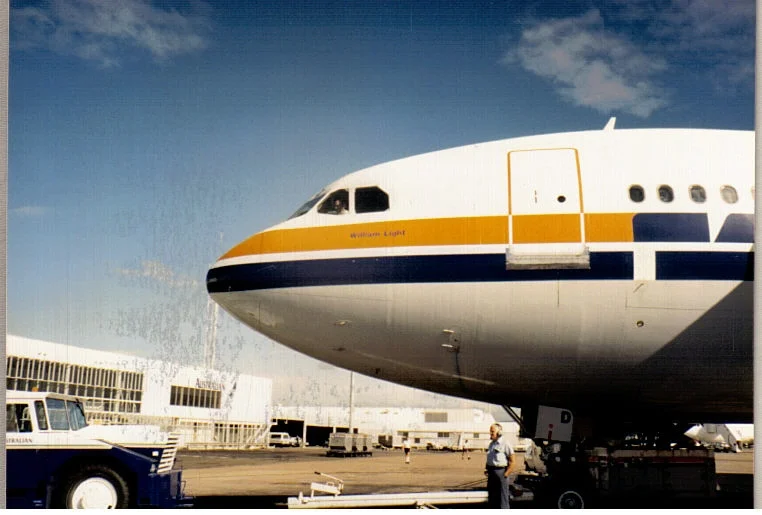

Eagle Farm Airport
On 9 June 1928, twenty-five thousand people stood on a grass paddock at Eagle Farm and watched the sky. They were waiting for a Fokker monoplane called the Southern Cross, and when Charles Kingsford Smith brought it down after the first flight across the Pacific from California, the crowd surged forward to touch a machine that had done the impossible. That paddock, six kilometres northeast of Brisbane, was the city's first real airport. Over the next sixty years it would launch record-breaking flights, hide one of the war's strangest secret workshops, and grow into Brisbane's gateway to the world, before vanishing almost entirely beneath a motorway and the runways of its own successor.
A Field for the Air Age
Aviation came to Eagle Farm almost by accident. A patch of ground near the racecourse was first used as a landing field in 1922, and the aerodrome opened officially in 1925. Qantas flew scheduled services from here by 1926 and established the Brisbane Flying Training School in 1927, when flight itself was still a novelty most Australians had never witnessed. This was the era of the great long-distance attempts, and Eagle Farm sat at the centre of them. Kingsford Smith departed again in October 1934, this time from the newer Archerfield aerodrome, flying the Lady Southern Cross with Gordon Taylor to attempt the first eastward crossing of the Pacific, from Australia to the United States. By 1931, though, civil flying had shifted to the new Archerfield aerodrome, and Eagle Farm fell quiet, its hangars carted away. The pause would not last.
The Hangar 7 Secret
When the Pacific War erupted in December 1941, the Allies discovered they were flying half-blind. They knew almost nothing about the Japanese aircraft outclassing them in the skies over New Guinea. The answer took shape inside Hangar 7 at Eagle Farm, where the Allied Technical Air Intelligence Unit gathered the wreckage of crashed enemy planes and, piece by piece, rebuilt them to fly. From the remains of five smashed aircraft recovered near Buna, engineers assembled a single airworthy Zero. On 20 July 1943, Captain William Farrior lifted that rebuilt fighter off the Eagle Farm runway and flew it for thirty minutes over Brisbane. In mock dogfights that August, the Zero out-turned a Spitfire below twenty thousand feet, a sobering lesson learned from an aircraft that should never have flown again.
Naming the Enemy
The unit at Eagle Farm did something else that outlived the war: it gave the enemy's aircraft names. Allied pilots needed a quick, memorable way to call out aircraft types in the chaos of combat, so a small team led by Captain Frank McCoy and Sergeant Francis Williams invented a code. Fighters got men's names, bombers got women's names, and the men reached for whatever names were close to hand. A bomber was christened Louise after McCoy's wife, another June after his daughter. An interceptor was named George, after the unit's own RAAF illustrator, Flight Sergeant George Rimmington, who drew the recognition silhouettes. This homespun scheme, dreamed up in a Brisbane hangar, became the standard Allied code for Japanese aircraft across the entire Pacific theatre.
Gateway and Ghost
After the war Eagle Farm returned to civilian life, and Ansett and Trans Australia Airlines moved in during 1947, working out of surplus military sheds nicknamed igloos. For four decades it was simply Brisbane's airport: more than two million passengers passed through in 1977 alone. But the city had outgrown it. Long-haul flights to Asia had to stop and refuel elsewhere, putting Brisbane at a disadvantage, and so a larger airport was built just to the north. When the new Brisbane Airport opened in 1988, the final flight left the old field on 20 March, and Eagle Farm closed for good. Much of it disappeared under the Gateway Motorway. Yet a trace survives: the northeastern end of the old main runway lives on as a taxiway at the airport that replaced it, a faint line of asphalt remembering where Australian aviation learned to fly.
From the Air
The former Eagle Farm Airport occupied roughly 27.425 degrees south, 153.084 degrees east, about 6 kilometres northeast of central Brisbane near the Brisbane River. It is gone as an airfield, its land now industrial estate and motorway, but it lies immediately south of the modern Brisbane Airport (ICAO YBBN, IATA BNE), which inherited part of the site and even a stretch of the old runway as a taxiway. That makes this busy, fully controlled airspace; the other historic Brisbane field, Archerfield (ICAO YBAF), sits to the southwest. From above, look for Doomben and Eagle Farm racecourses just to the west as a reference, with the river curling past to the east.
Nearby Stories
- Redcliffe Peninsula 2.7 km away
- Tamborine National Park 12 km away
- Cressbrook Homestead 27 km away
- Main Range National Park 31 km away
- 2010-2011 Queensland Floods 38 km away
- Cape Byron 96 km away
- Cape Byron Light 126 km away
- HMS Porpoise (1799) 588 km away