
Cube Houses
Roughly a quarter of the floor space inside a cube house is unusable. The angles see to that. The walls tilt inward at 54.7 degrees, the ceilings slope toward you wherever you stand, and the furniture has to be either custom-built or accepting of its fate. None of this has prevented people from buying them, renting them, photographing them, or sleeping in them as part of a hostel chain. Piet Blom designed the Kubuswoningen as an architectural argument: that high-density urban housing should still feel like a village, and that the way to get there might be to take a familiar cube and balance it on one of its corners. The argument has been standing in Rotterdam since 1984. Some 38 small cubes and two larger ones, perched on hexagonal concrete pylons above the Blaak metro station, still draw the curious by the busload.
The Helmond prototypes
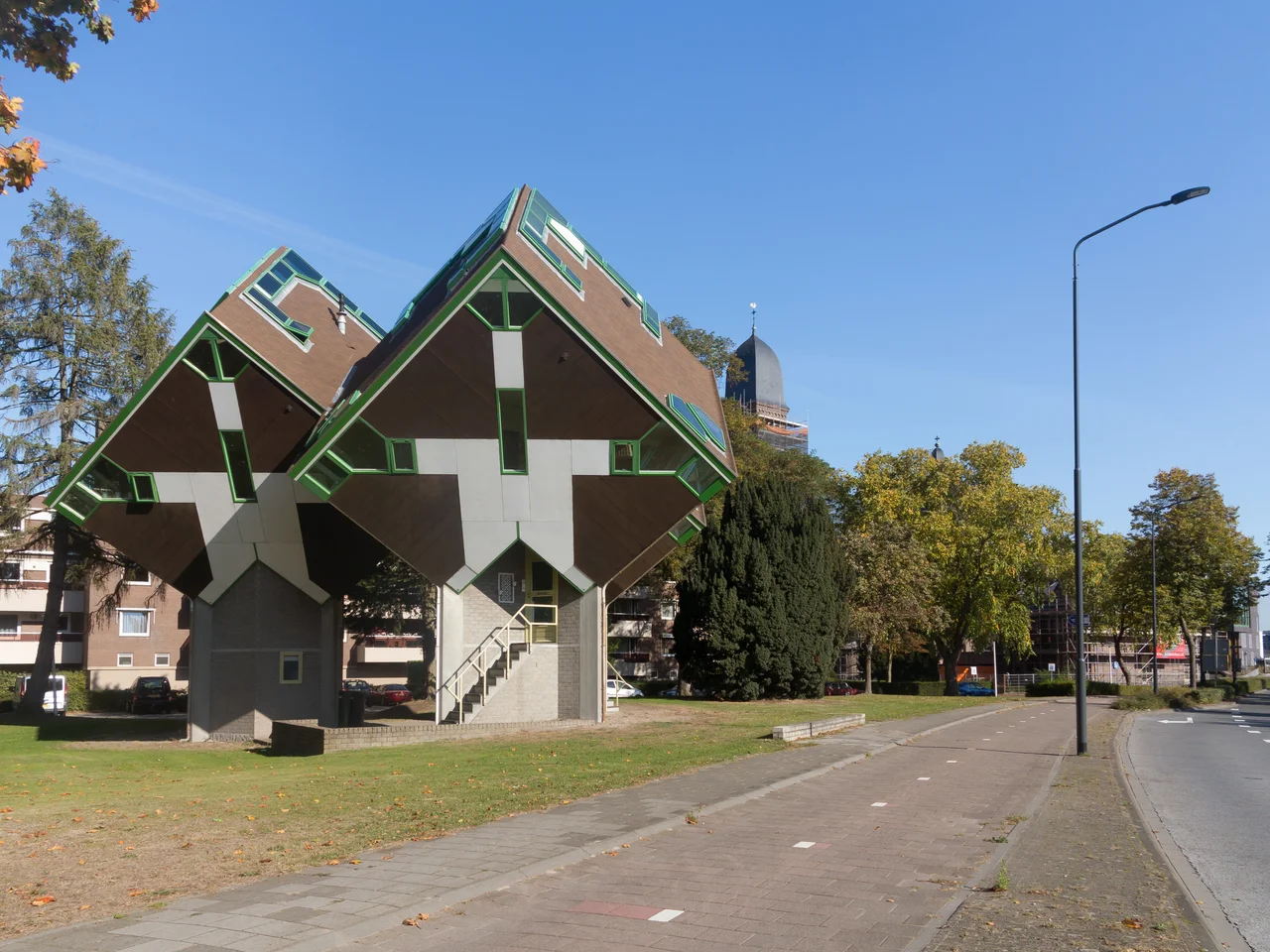
Before Rotterdam, there was Helmond. In 1972 the city assigned Blom an empty site in the center, asking him to fill it with a meeting center. Blom proposed something more ambitious: a hybrid of cultural facilities and housing in which cube houses would surround a new theater, Theater 't Speelhuis. After the underground parking garage was cut from the design, the plan still called for 60 cubes. The city council balked. To break the impasse, Minister Hans Gruijters subsidized three test cubes on the Wilhelminalaan in 1974, and the project received the national status of Experimental Housing. By 1977 a forecourt of 18 cube houses ringed the new theater at the Piet Blomplein. They stood for 34 years. On 29 December 2011, the theater burned down, taking two of the adjacent cubes with it. The damaged houses were restored in 2013 and 2014. The theater itself was demolished in 2012.
Living as an urban roof
Blom called the underlying idea "living as an urban roof." The ground level stays open for shops, walkways, and the chess piece museum that opened beneath the Rotterdam cubes in 2006. The houses themselves sit above, balanced on hexagonal columns, leaving the public realm clear for foot traffic and the city's metro to run through it. The Rotterdam cubes are stitched onto Overblaak Street directly above the Blaak metro station, a single sculpted roof over the messy infrastructure of the city below. The 1977 original plan called for 55 cubes; not all of them were built. What did get built includes 38 small cubes and two larger "super-cubes," all linked together to form an overlapping forest of tilted geometry. The first floor holds a living room and open kitchen, the second two bedrooms and a bath, and the pyramid-shaped top floor wraps you in 18 windows that look out across the city in every direction.
What 54.7 degrees costs you
The walls and windows tilt at 54.7 degrees, which is the angle you get when you balance a cube on its corner and let geometry do the rest. The total apartment is about 100 square meters, but roughly a quarter is lost to the regions where the angled ceilings drop too low to use. The structure is honest about itself. A reinforced-concrete hexagonal trunk holds each cube, and a wooden skeleton inside the cube carries the loads, draped in fiber-cement panels with mineral wool between for insulation. The windows are structural elements as much as openings, either doubled glass or wire-infused. Narrow wooden stairs thread between the three floors. Residents have learned to live with the angles, and at least one of them got tired enough of the gawkers staring through the windows that he turned his cube into a permanent open house. The Show Cube on Overblaak still receives visitors who want to know what it actually looks like inside.
Reinventions
The complex has found uses Blom never planned. The chess piece museum opened beneath the houses in 2006. In 2009 the architecture firm Personal Architecture converted the two super-cubes into a hostel run by the Dutch chain Stayokay, sending backpackers up to sleep in angled rooms above the city. In 2019 the Art Cube opened at Overblaak 30, preserving the original layout but turning the interior into a rotating exhibition space for local artists. Blom's experiment in radical geometry has been absorbed into the working life of the city, repurposed by people who never saw the original drawings. In 1996 a Canadian architect named Ben Kutner, inspired by what he had seen in Rotterdam, built a cluster of three cube houses along Eastern Avenue in Toronto on an awkward leftover patch of land. That experiment didn't multiply. In 2018 the land sold for redevelopment, and by 2021 there was an application to put a 35-story building on the site. Toronto's cubes may or may not survive. Rotterdam's have become permanent.
Tilted into the future
Stand on the public deck between the Markthal and the cube houses and look up. The pyramid roofs catch the afternoon light. From below, the buildings look like a single enormous geode broken open. From a passing train on the elevated tracks beside the Blaak station, they flash past like an architectural mistake somebody decided to keep. Blom died in 1999, and the Helmond theater that anchored his first attempt at this idea is gone. The Rotterdam cubes, controversial when they were built and still controversial in some quarters, have outlasted both. They became one of the city's most photographed buildings, the kind of architectural choice that locals stop noticing while tourists never do. The houses where geometry takes a quarter of your floor space, in exchange for a sky view from a pyramid at the top of a tilted cube.
From the Air
Cube Houses sit at 51.9203 N, 4.4906 E, in central Rotterdam directly above Blaak metro station. Best viewed from 1,500 to 3,000 feet. The clustered yellow cubes are easy to spot from the air, just east of the Markthal's silvery arch. Nearest airport is Rotterdam The Hague Airport (EHRD), 8 km north. Amsterdam Schiphol (EHAM) is 60 km north. The Rotterdam waterfront with the Erasmusbrug lies 1 km southwest.
Nearby Stories
- European Cooperation for Space Standardization 2.2 km away
- Operation Pheasant 5.6 km away
- Dutch Language 8.3 km away
- Moerdijk 9.9 km away
- Amsterdam University Medical Center 10 km away
- Delta Works 11 km away
- HMS Cressy 14 km away
- Moermond Castle 24 km away