
Cunnamulla War Memorial Fountain
In a town where rain can fail for years and water is the most precious thing there is, the people of Cunnamulla chose to remember their war dead with a fountain. That decision was the whole point. A flowing fountain in the parched centre of outback Queensland was a kind of sacrifice in itself, water given freely to mark a far greater loss. Standing on a traffic island where five roads meet, the ornate concrete tiers of the Cunnamulla War Memorial Fountain have presided over the town since the 1920s. Without the inscription, you might mistake it for civic decoration. It is, in fact, a substitute grave.
A Roman Fountain in the Mulga
The design did not come from the bush. It is a copy of a fountain in Rome erected some four centuries earlier, a work believed to be by the sculptor Carozzo, transplanted improbably to the red-dirt edge of the continent. The Cunnamulla version was executed by the firm of R.C. Ziegler and Son. The concrete centrepiece rises through four basins that shrink as they climb, crowded with ornament: scalloped edges, gargoyle heads, moulded festoons and scrollwork tapering toward the peak, where the figure of a small boy stands beneath the final basin. At the base, four large winged griffins, heraldic emblems of watchfulness, hold shields charged with emus and kangaroos. It is an extraordinary thing to come upon in a town of this size, a flourish of European grandeur grafted onto unmistakably Australian symbols.
The Weight Behind the Inscription
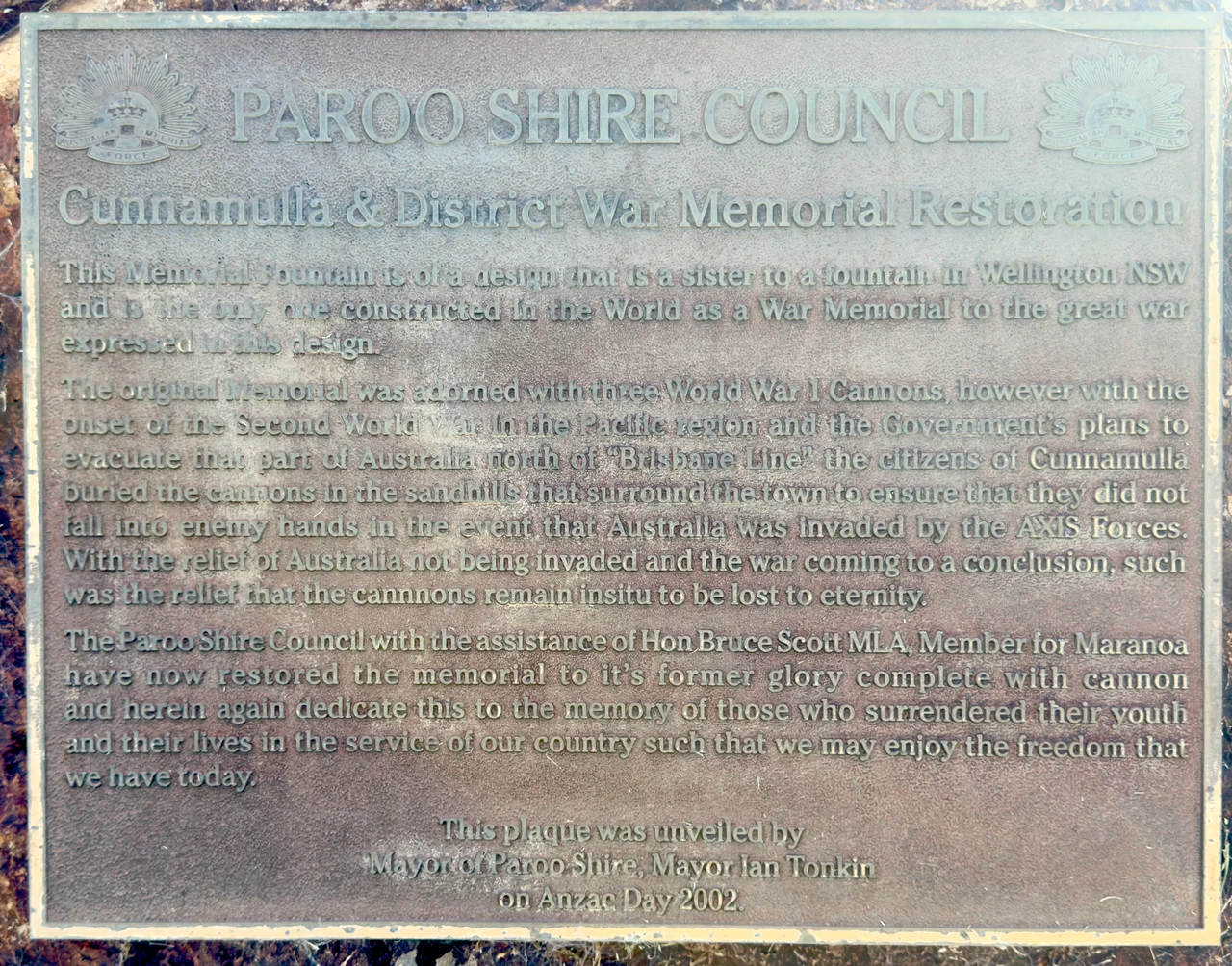
A small leaded marble plaque on the north face carries the words: erected by the citizens of Paroo Shire in memory of those gallant Australians who fell in the Great War 1914 to 1918. The restraint of that line conceals an enormous grief. Australia lost about 60,000 men from a population of fewer than five million, one in five of all who served, a wound so deep that no war before or since has marked the nation more. British policy held that the Empire's dead would be buried where they fell, in cemeteries across Europe and the Middle East, so the families back home had no graves to visit. Memorials like this one became their substitutes, as sacred as headstones. The word cenotaph, so often applied to them, means exactly that: empty tomb.
An Uncommon Choice
Across Queensland, the digger statue, a lone soldier with reversed arms, was the popular form of remembrance, while obelisks dominated the southern states. A grand fountain as a town's principal memorial was rare. Water carried its own meaning: a symbol of renewed life and of cleansing, the same instinct that placed the Pool of Reflection at the heart of the Australian War Memorial in Canberra. The whole project moved quickly. In September 1926 the Paroo Shire Council and the local Diggers' Racing Club agreed to build the fountain in time for the Diggers' Carnival that November, and it was unveiled the following ANZAC Day, in 1927. The names of the fallen were never carved here; they were recorded instead on an honour board, kept first in the Civic Centre and moved in 2019 to the Cunnamulla library.
Still at the Crossroads
More than a century on, the fountain still holds its island at the five-way intersection, ringed by grass and a low post-and-chain fence. There was once a captured gun, a war trophy, set within the enclosure, but it was removed at some point and the date is now forgotten. The Queensland Heritage Register listed the memorial in October 1992, recognising it as a rare and aesthetically distinctive landmark and, more importantly, as the enduring focal point of a community's remembrance. For the people of Cunnamulla it is not a curiosity. It is where the town has gathered to grieve and to honour its own for a hundred years, the quiet centre around which everything else turns.
From the Air
The Cunnamulla War Memorial Fountain stands in the centre of Cunnamulla at roughly 28.07 degrees south, 145.68 degrees east, on a traffic island at a five-way intersection in the town grid beside the Warrego River in South West Queensland. From the air the town reads as a compact cluster of streets on otherwise flat, semi-arid country, with the river's tree-lined channel the most obvious natural feature; the fountain itself is too small to pick out, but the town centre is easily identified. Cunnamulla Airport (YCMU) lies just south of town at about 630 feet elevation and serves the district, with Charleville (YBCV) roughly 190 kilometres north and Quilpie (YQLP) about 207 kilometres away. Conditions are typically clear with excellent visibility, though heat haze and thermals build over the dry plains by day and the Warrego can flood after heavy rain to the north.
Nearby Stories
- Eulo 20 km away
- Koroit opal field 41 km away
- Zero Obelisk 78 km away
- Currawinya National Park 88 km away
- Cheepie, Queensland 129 km away
- Carnarvon Gorge 361 km away
- Hornet Bank Massacre 403 km away
- Warialda 442 km away